
By Unitel; Omar Pereyra, Eju.tv:
Analyst Says PGE 2025 Predicts “More Debt and Pressure on International Reserves and Devaluation”
“Without legal security, without attracting foreign investment, without increasing exports, and without reducing public spending, it is impossible to solve this crisis,” stated economist Jaime Dunn.
Economist Jaime Dunn points out that the draft General State Budget (PGE) for 2025 forecasts “more debt and pressure on international reserves and on the devaluation” of the Bolivian currency. Therefore, “it will not be a year of celebration” as economic actors are “in survival mode.”
The financial analyst warned that, in a scenario marked by a lack of economic resources, a fiscal deficit of over 9% is projected for next year, compared to the 11% fiscal deficit experienced or being experienced in 2024.
“Clearly, resources are lacking, and the Government acknowledges that, for the twelfth consecutive year, there are not enough revenues in the National State, in our country, to cover all the massive public spending contemplated in the General State Budget,” he said.
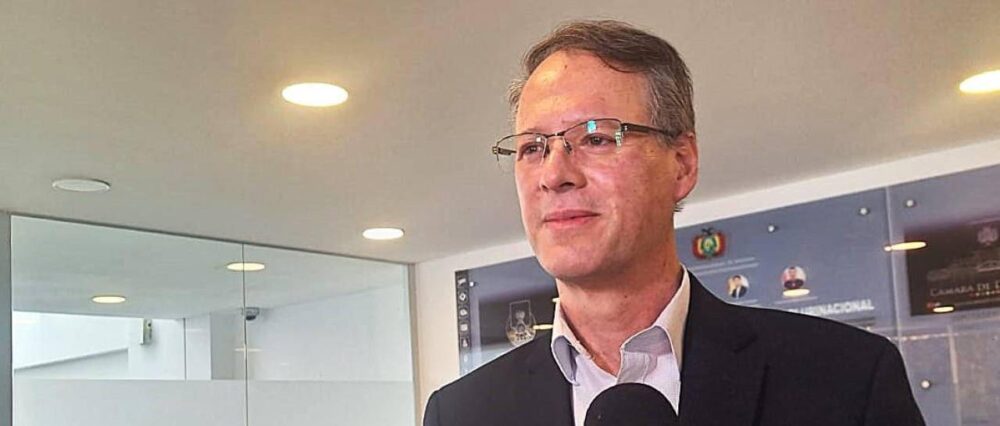
[Photo Ariana Antezana – UNITEL] / Analyst Jaime Dunn.
What is the Government Expected to Do to Generate These Resources?
Dunn believes that the Government, “with 12 years of experience financing fiscal deficits with debt, will continue doing exactly that,” which brings “negative implications” for the country’s economy.
He argued that “by increasing debt, especially since we don’t have access to international credit or markets, there is significant pressure on the Central Bank to continue, alongside the Pension Fund Manager (Gestora), financing the fiscal deficit.”
This pressure is focused “mainly on the Central Bank,” which “has to continue sacrificing international reserves” to do so, “further straining the exchange rate” between the Boliviano and the dollar.
In his view, “this General State Budget already predicts a 2025 with more debt, more pressure on international reserves, more pressure on devaluation—that is, an increase in the price of foreign currency—and, of course, this also implies greater inflation, something the Bolivian State itself acknowledges by projecting a 7.5% inflation rate for 2025.”
“In other words, the Government is aware that its budget is heavily reliant on spending and consumption,” he stated.
Dunn noted that the country is facing a “complex situation” and that “the greatest responsibility lies with the Government” because “it should have presented a credible General State Budget, taking significant measures to address the lack of income, reducing spending—but it did not.”
“And that sends a very negative signal to all economic agents. This also adds pressure to the loss of the currency’s purchasing power because it’s evident that the responsible party for taking these measures is not doing its job correctly,” he added.
Subsidy
Dunn said he was “very surprised” by the figures in the General State Budget (PGE), particularly for hydrocarbon subsidies.
“In reality, if we’re talking about $56 million per week, we’re looking at approximately $2.9 billion for fuel subsidies. That’s above the $2 billion that would have been the result of the 2024 subsidy,” he explained.
“The big question is this: Where will the resources come from? Not just for fuel subsidies but to support the entire massive 12% increase in public spending,” he questioned.
The Government recently approved the free import and commercialization of fuels as a measure to partially address supply problems.
Faced with this scenario, the expert suggested that private entities could take on the responsibility, but “only if there’s a free market, genuine free importation, and, most importantly, access to the resources necessary to make that happen.”
Dunn argued that “these types of measures can indeed work, but they need to be taken at the right time, not when you’re just 20 or 30 days away from a critical harvest.”
“These are measures that should have been taken a year or even two years ago because timing is crucial in economic matters. It’s not just about the measure itself but also about when it’s taken, and a measure taken too late leads to these kinds of consequences,” he said.
Dollars
To bring dollars into the country, Dunn suggested that, as a first step, the Government should stop “spending” the limited foreign currency available in Net International Reserves (RIN).
“Massive spending must be reduced. Sixty percent of the massive budget is pure spending; it’s essential to stop spending, attract foreign direct investment, and immediately liberalize all types of exports,” he said.
“In the short term, you cannot massively bring in dollars, so you must stop spending the few dollars or reserves you still have,” he stated.
“This is already a mission directly attributable to and the responsibility of the State and the Bolivian Government.”
In his view, “the massive spending by the Bolivian Government must be reduced immediately. However, the budget increases current spending—wages, salaries, and administrative costs—by 12%.”
Dunn emphasized that “60% of the massive General State Budget for 2025 is pure spending.”
Proposals
“So, the first thing that must be done is to stop spending, and in parallel, with results more evident in the medium term, attract foreign direct investment, immediately increase and liberalize all kinds of exports, and implement measures like biotechnology,” the economist suggested.
However, Dunn again stressed that such measures “are precisely examples of things that should have been done not just now, but several years ago.”
He argued that “without legal security, without attracting foreign investment, without increasing exports, and without reducing public spending, it is impossible to solve this crisis.”
“The crisis in Bolivia is essentially a crisis of excessive public spending. That must be made clear, and this excess in public spending has had—and continues to have—a significant impact on the balance of payments, leading to an exchange rate crisis,” he stated.
He predicted that “unfortunately, it won’t be a year of celebration because, from self-employed workers to small, medium, and large businesses, absolutely the entire real sector of the Bolivian economy is in survival mode. I don’t think there’s anything to celebrate.”
Por Unitel; Omar Pereyra, Eju.tv:
Analista dice que el PGE 2025 augura “más deuda y presión en las reservas internacionales y devaluación”
“Sin seguridad jurídica, sin traer inversión extranjera, sin incrementar las exportaciones y sin reducir el gasto público, es imposible tener una solución a esta crisis”, afirmó el economista Jaime Dunn
El economista Jaime Dunn señala que el proyecto de Presupuesto General del Estado (PGE) 2025 augura “más deuda y presión en las reservas internacionales y en la devaluación” de la moneda boliviana. Entonces, “no va a ser un año de celebración” porque los actores económicos están “en un modo de supervivencia”.
El analista financiero alertó que, en un escenario marcado por la falta de recursos económicos, para el próximo año “se proyecta un déficit fiscal superior al 9% sobre el 11% del déficit fiscal que hemos tenido o estamos teniendo en 2024”.
“Entonces, claramente están faltando recursos, el Gobierno lo reconoce que por doceavo año consecutivo no hay suficientes ingresos en el Estado Nacional, en nuestro país para cubrir todo el masivo gasto público que se contempla en el Presupuesto General del Estado”, indicó.
[Foto Ariana Antezana – UNITEL] / El analista Jaime Dunn.
¿Qué se prevé que haga el Gobierno para hacer aparecer estos recursos?
Dunn considera que el Gobierno, “ya con 12 años de experiencia de financiar déficits fiscales con deuda, va a seguir haciendo exactamente eso”, lo que trae “implicaciones negativas” en la economía del país.
Argumentó que “al incrementar la deuda, principalmente como no tenemos acceso al crédito internacional, a los mercados internacionales, lo que tenemos en realidad es una fuerte presión para que el Banco Central siga junto a la Gestora financiando el déficit fiscal”.
Esta presión apunta “principalmente el Banco Central” que “para eso tiene que seguir sacrificando las reservas internacionales” y “eso pone más presión sobre el tipo de cambio” del boliviano con el dólar.
En su criterio, “este Presupuesto General del Estado en realidad ya nos augura un 2025 que va a venir con más deuda, con presión en las reservas internacionales, con presión en la devaluación, es decir, con un incremento en el precio de la divisa extranjera, y por supuesto eso implica también mayor inflación, cosa que ya reconoce el Estado boliviano al presupuestar para el año 2025 una inflación del 7,5%”.
“Es decir, el Gobierno está consciente que su presupuesto es de altísimo gasto y consumo”, sostuvo.
Dunn indicó que el país afronta una “situación compleja” y “la responsabilidad más grande viene por el lado del Gobierno” porque “debió haber presentado un PGE creíble, tomando medidas importantes ante la falta de ingresos, reduciendo el gasto y no lo ha hecho”.
“Y eso manda una señal muy negativa a todos los agentes económicos y de ahí viene la presión que estamos viendo también en la pérdida del valor adquisitivo de la moneda, porque se ve que el responsable de tomar las medidas no está haciendo su trabajo de manera correcta”, sostuvo.
Subvención
Dunn dijo estar “muy sorprendido” por las cifras que se establecen en el Presupuesto General del Estado (PGE) por ejemplo para la subvención de los hidrocarburos.
“En realidad, si hablamos de 56 millones semanales, estamos hablando de cerca de 2.900 millones de dólares para subvención de combustibles. Eso sobre los 2.000 millones que habría sido o estaría siendo el resultado de la subvención del año 2024”, afirmó.
“La gran pregunta es esa, ¿de dónde van a salir los recursos? No sólo para la subvención de combustibles, sino para soportar todo el incremento masivo del 12% que tenemos en todo el gasto público”, se cuestionó.
El Gobierno aprobó recientemente la libre importación y comercialización de combustibles como una medida para resolver en parte los problemas de suministro.
Ante este panorama, el experto consideró que los privados pueden asumir la responsabilidad, pero “siempre y cuando tenga libre mercado, libre importación de verdad y, lo más importante, que tenga el acceso obviamente a los recursos para poder hacer eso”.
Dunn consideró que “este tipo de medidas evidentemente pueden funcionar, pero tienen que ser medidas que se tomen a tiempo, no cuando estás apenas 20 o 30 días de hacer una cosecha”.
“Estas son medidas que se deberían haber tomado hace un año o inclusive hace dos años atrás, porque es muy importante en el tema económico. No es sólo la medida que se toma, sino cuándo se toma, y una medida tomada a destiempo pues tiene este tipo de consecuencias”, sostuvo.
Dólares
Para traer dólares al país, Dunn sugirió que en primera instancia el Gobierno deje de “gastar” las pocas divisas que hay en la Reserva Internacional Neta (RIN).
“El gasto masivo tiene que ser reducido. El 60% del masivo presupuesto es puro gasto hay que dejar de gastar, atraer inversión extranjera directa y liberar todo tipo de exportaciones”, sostuvo.
“Al corto plazo no puedes traer masivamente dólares, por lo tanto debes dejar de gastar los pocos dólares que tienes o las pocas reservas que tienes”, dijo.
“Entonces, eso ya es una misión atribuible directamente y de responsabilidad del Estado, del Gobierno Boliviano”.
En su criterio, “el gasto masivo que tiene el Gobierno Boliviano tiene que ser reducido inmediatamente, sin embargo, el presupuesto incrementa el gasto corriente, es decir, sueldos, salarios y gastos administrativos en 12%”.
Dunn puntualizó que “el 60% del masivo Presupuesto General del Estado de 2025 es puro gasto”.
Propuestas
“Entonces, lo primero que se tiene que hacer es dejar de gastar y de manera sincronizada con eso, pero con resultados más a mediano plazo, es pues atraer inversión extranjera directa, incrementar y liberar todo tipo de exportaciones inmediatamente y medidas como la biotecnología”, apuntó el economista.
No obstante, Dunn volvió a puntualizar que ese tipo de medidas “es justamente el ejemplo de algo que se debió haber hecho, pero no recién ahora, sino hace varios años atrás”.
Consideró que “sin seguridad jurídica, sin traer inversión extranjera, sin incrementar las exportaciones y sin reducir el gasto público, es imposible tener una solución a esta crisis”.
“La crisis que tiene Bolivia es en realidad una crisis de exceso de gasto público, eso es lo que tiene que quedar claro, y ese exceso de gasto público ha ido y ha repercutido y repercute de manera muy fuerte en la balanza de pagos, haciendo que tengamos una crisis de tipo de cambio”, afirmó.
Auguró que “lamentablemente no va a ser un año de celebración porque básicamente desde el cuentapropista, la pequeña empresa, la mediana empresa y las grandes empresas, absolutamente todo el sector real de la economía boliviana, están en modo supervivencia, no creo que haya nada que festejar”.

 Bolivian Thoughts | Pensamientos Bolivianos (Bilingual/Bilingüe)