
By Marco Antonio Belmonte, Vision 360:
Ipsos Ciesmori Survey
The Investment Index in Bolivia stands at 20.9 points, suggesting a conservative trend among consumers regarding significant purchases or investments.

There is less public confidence in investing, according to an Ipsos Ciesmori survey. Photo: ABI
In a year, Bolivians’ confidence or investment expectations have declined and deteriorated among the population, according to a recent survey conducted by Ipsos Ciesmori to measure the Primary Consumer Sentiment Index (PCSI) and its employment and investment variables.
The Investment Index in Bolivia stands at 20.9 points, suggesting a conservative trend among consumers regarding significant purchases or investments. This behavior could have implications for various economic sectors. As a reference, countries like Colombia and Mexico show indices above 45 points in this aspect.
In October 2023, that is, a year ago, this index was at 31.2 points, very close to Chile’s 38 points, for example.
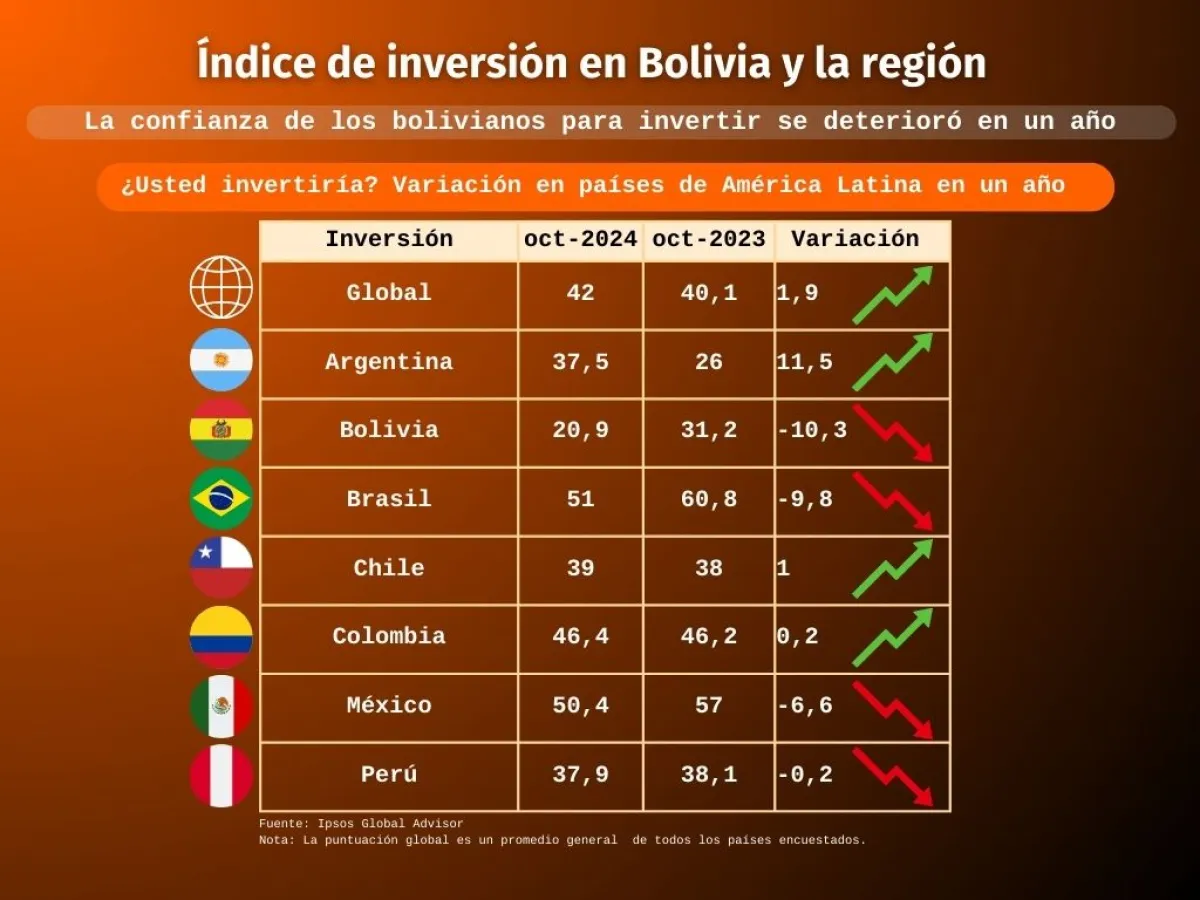
By cities, there are also differences in Bolivia. La Paz shows the highest lack of trust in investment, with the Investment Index at 19.8 points, significantly lower than the 35.5 recorded in October of last year.
In El Alto, the score is similar at 19.7 points, while in Santa Cruz, the index is 22.3, and in Cochabamba, it stands at 20.8 points. However, last year these figures were above 30 points, indicating a decline in investment confidence in 2024.
Other Variables
The Ipsos Primary Consumer Sentiment Index (IPSC), in place since 2010, measures consumers’ attitudes toward the current and future state of local economies, personal financial situations, savings, and confidence in making significant investments.
The Consumer Confidence Index (CCI) is one of four sub-indices that make up the Primary Consumer Sentiment Index (IPSC). This metric enables regular and periodic comparisons across more than 24 countries.
The IPSC measures consumer attitudes about the current and future state of local economies, personal financial situations, savings, and confidence in making major investments.
The IPSC metrics reported monthly for each of the 24 surveyed countries consist of a “Primary Index” based on 10 questions and four sub-indices, each comprising 10 questions.
In Bolivia, the Consumer Confidence Index (CCI) is at 12.3 points, the lowest among the evaluated countries in the region. This figure suggests a cautious perception among Bolivians about the current and future economic situation, potentially influencing consumption decisions in the coming months. By contrast, countries like Brazil and Chile maintain indices above 35 points.
As for the Expectations Index, Bolivia records 39.4 points, the country’s highest sub-index. However, this figure is lower compared to other countries in the region, where nations like Argentina and Peru exceed 45 points. This indicates that Bolivians hold moderate expectations regarding the economic future.
Finally, the Employment Index reaches 18.4 points, reflecting a reserved perception of Bolivia’s labor market. This score indicates room for improvement regarding perceptions of stability and employment opportunities in the country.
According to Ipsos Ciesmori, this situation presents opportunities for improvement for both the government and the private sector, who could consider implementing strategies to strengthen consumer confidence. The contrast with other countries in the region highlights the importance of actions aimed at improving economic perceptions and fostering sustainable growth in Bolivia.
Methodology
- The Consumer Confidence Index (CCI) has been conducted in Bolivia since April 2023.
- The target population consists of individuals over 18 years old of both genders with internet access.
- In Bolivia, 1,200 people were interviewed between August and October 2024.
- The data collected in each survey is weighted so that the sample composition better reflects the demographic profile of the adult population according to official demographic data.
- The data is also weighted to give each city the same weight in the country’s total sample.
- Online surveys can be considered representative of individuals who used the internet in the past six months.
- At the beginning of 2023, internet penetration in Bolivia exceeded 65%; social media users numbered more than 7.5 million, and mobile connections were equivalent to 106.7% of the total population.
Por Marco Antonio Belmonte, Vision 360:
Encuesta de Ipsos Ciesmori
El Índice de Inversión en Bolivia se ubica en 20,9 puntos, sugiriendo una tendencia conservadora de los consumidores hacia compras importantes o inversiones.
Hay menor confianza de la gente para invertir, según encuesta de Ipsos Ciesmori. Foto ABI
En un año, la confianza o la expectativa de inversión de los bolivianos disminuyó y se deterioró entre la población, según una encuesta reciente elaborada por Ipsos Ciesmori para medir el Índice Primario de Sentimiento del Consumidor (IPSC) y sus variables de empleo e inversión.
El Índice de Inversión en Bolivia se ubica en 20,9 puntos, sugiriendo una tendencia conservadora de los consumidores hacia compras importantes o inversiones. Este comportamiento podría tener implicaciones para diversos sectores de la economía. Como referencia, países como Colombia y México muestran índices por encima de 45 puntos en este aspecto.
En octubre de 2023, es decir hace un año, este índice se situaba en 31,2 puntos, muy cerca los 38 puntos por ejemplo de Chile.
Por ciudades, en Bolivia también hay diferencias. La Paz es donde hay mayor desconfianza para invertir, porque el Índice de Inversión se situó en 19,8 puntos, muy inferior a los 35,5 recogidos en octubre del año pasado.
En El Alto el puntaje es similar, con 19,7 puntos, en cambio en Santa Cruz el Índice es de 22,3 y en Cochabamba 20,8 puntos, aunque el año pasado los registros estaban encima de 30 puntos, lo que muestra que este 2024 hay un deterioro en la confianza de invertir.
Las otras variables
El Índice Primario de Sentimiento del Consumidor Ipsos IPSC en vigencia desde el 2010 es una medición de las actitudes de los consumidores sobre el estado actual y futuro de las economías locales, las situaciones de finanzas personales, los ahorros y la confianza para realizar grandes inversiones.
El Índice de Confianza del Consumidor ICC es uno de los cuatro subíndices que conforma el Índice Primario de Sentimiento del Consumidor IPSC Esta medición permite la comparabilidad con más de 24 países, de forma regular y periódica.
El IPSC mide las actitudes de los consumidores sobre el estado actual y futuro de las economías locales, las situaciones de las finanzas personales, los ahorros y la confianza para realizar grandes inversiones.
Las métricas de IPSC informadas cada mes, para cada uno de los 24 países encuestados, consisten en un “Índice Primario” basado en 10 preguntas y en cuatro subíndices, cada uno con 10 preguntas.
El Índice de Confianza del Consumidor (ICC) en Bolivia se sitúa en 12,3 puntos, siendo el más bajo entre los países evaluados en la región. Esta cifra sugiere una percepción cautelosa de los bolivianos sobre la situación económica actual y futura del país, lo que podría influir en las decisiones de consumo en los próximos meses. En comparación, países como Brasil y Chile mantienen índices superiores a 35 puntos.
En cuanto al Índice de Expectativas, Bolivia registra 39,4 puntos, siendo el subíndice más alto del país. Sin embargo, este valor es menor en comparación con otras naciones de la región, donde países como Argentina y Perú superan los 45 puntos. Esto indica que los bolivianos mantienen expectativas moderadas sobre el futuro económico.
Por último, el Índice de Empleo alcanza 18,4 puntos, reflejando una percepción reservada sobre el mercado laboral boliviano. Este valor indica que existe margen de mejora en cuanto a la percepción de estabilidad y oportunidades de empleo en el país.
De acuerdo con Ipsos Ciesmori, esta situación presenta oportunidades de mejora para el gobierno y el sector privado, quienes podrían considerar implementar estrategias para fortalecer la confianza de los consumidores. La diferencia con otros países de la región subraya la importancia de acciones orientadas a mejorar la percepción económica y fomentar un crecimiento sostenible en Bolivia.
Metodología
- El Índice de Confianza del Consumidor – ICC se lleva a cabo en Bolivia desde el mes de abril del 2023.
- El universo está compuesto por individuos mayores de 18 años de ambos géneros, con acceso a internet.
- En Bolivia se entrevistaron a 1.200 personas durante los meses de agosto a octubre del 2024.
- Los datos recopilados en cada medición se ponderan para que la composición de la muestra refleje mejor el perfil demográfico de la población adulta según datos demográficos oficiales.
- Los datos recopilados también se ponderan para dar a cada ciudad el mismo peso en la muestra total del país.
- Las encuestas en línea se pueden tomar como representativas de las personas que usaron internet en los pasados 6 meses.
- A principios del 2023 la penetración de internet en Bolivia superaba el 65%; los usuarios de redes sociales eran más de 7.5 millones y las conexiones celulares equivalían al 106.7% de la población total.

 Bolivian Thoughts | Pensamientos Bolivianos (Bilingual/Bilingüe)