
By ANF, Eju.tv:
Milenio identifies three factors promoted by MAS governments that caused the economic crisis
La Paz.- The country is facing a financial crisis characterized by a shortage of dollars, rising prices of basic products, the loss of purchasing power of the national currency, and the Government’s inability to plan expenditures and generate foreign currency. However, this is said to be a consequence of three factors promoted by the Movement for Socialism (MAS) governments as part of their economic policy, according to Henry Oporto, director of the Milenio Foundation.
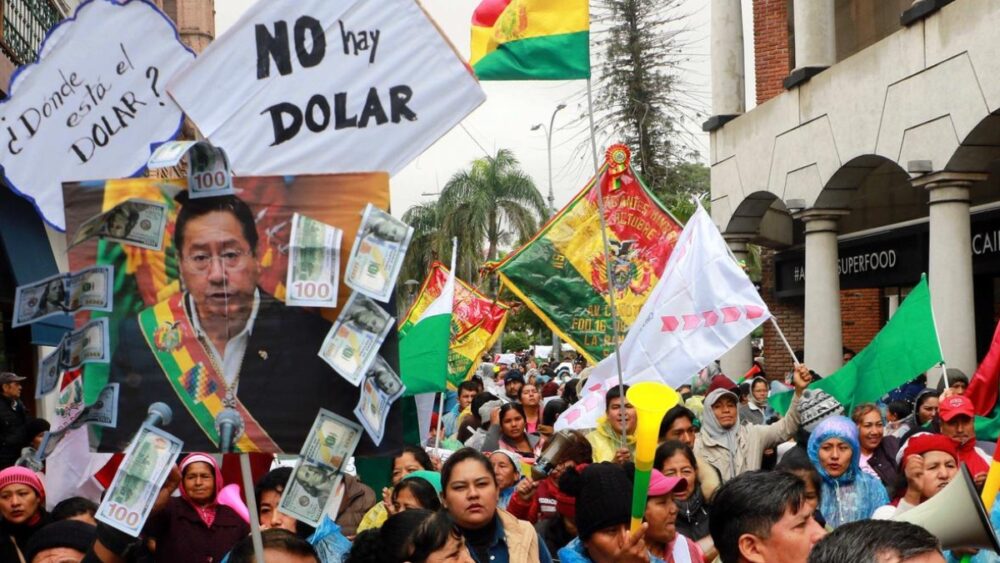
“The nationalization of hydrocarbons, the high fiscal deficit, and the fixed exchange rate are the structural factors that have caused this economic crisis in Bolivia,” Oporto stated in an interview with ANF.
The expert indicated that the nationalization of hydrocarbons was a populist measure that ended up destroying the hydrocarbon industry because it monopolized and discouraged private investment. Now, the government itself has acknowledged that it did not take advantage of the boom times, and for this reason, it no longer has enough production to export gas in significant volumes.
The second element, coinciding with the drop in revenues from gas sales since 2015, is that the country has been registering a sustained fiscal deficit since that year. Recently, the government revealed that the 2023 public spending deficit reached 10.9% in relation to the Gross Domestic Product, a figure exceeding $5.5 billion.
Despite such high spending and meager revenues, the government remains determined to build more public companies and create more spaces for future loyal officials.
So far, the authorities only see contracting more international loans as an option, hoping that at some point their public companies, most of which are deficit-ridden and have not yet recovered their initial investment, will function.
Oporto stated that the fixed exchange rate is the third factor that exacerbates the crisis and has now become a “trap” that the government does not want to trigger, because officially adjusting the exchange rate would imply accepting a formal devaluation, as is happening in practice, and the political cost would be high.
The fixed exchange rate has been maintained since 2011 at Bs 6.96 per dollar, but in the past year, the currency at that price has been scarce in the official market. The population can only access U.S. dollars in the black market, which at its peak reached Bs 14 and is now at Bs 10.
“The government does not have an anti-crisis plan, which should include a set of measures to comprehensively address the crisis. Isolated measures are no longer enough, and patches have no effect,” stated the director of Milenio.
According to the latest data from the Central Bank of Bolivia (BCB), Net International Reserves (NIR) barely reached $1.905 billion.
The country risk index is already high, and international rating agencies have warned that Bolivia is a serious candidate for entering a recession.
Despite all this, the government has not shown structural solutions to overcome the crisis in the short and medium term. The only emergency solution it frequently resorts to is asking the Legislative Assembly to approve more international loans.
Por ANF, Eju.tv:
Milenio identifica tres factores que promovieron los gobiernos del MAS para causar la crisis económica
La Paz.- El país atraviesa por una crisis financiera que se resume en la escasez de dólares, el incremento de precios de productos básicos, la pérdida del poder adquisitivo de la moneda nacional y la falta de capacidad del Gobierno para planificar gastos y generar divisas; sin embargo, esto sería una consecuencia de tres factores que los gobiernos del Movimiento Al Socialismo promovieron como parte de su política económica, según el director de la Fundación Milenio, Henry Oporto.
“La nacionalización de hidrocarburos, el alto déficit fiscal y tipo de cambio fijo son los factores estructurales que han generado este proceso de crisis en la economía boliviana”, sostuvo Oporto en entrevista con la ANF.
El experto indicó que la nacionalización de los hidrocarburos fue una medida demagógica que terminó por destruir la industria hidrocarburífera porque monopolizó y desalentó la inversión privada. Ahora, el propio Gobierno reconoció que no aprovecharon los momentos de bonanza y por eso ya no tienen la suficiente producción para exportar gas en volúmenes importantes.
El segundo elemento, coincidentemente con la caída de ingresos por la venta de gas desde el 2015, el país comenzó a registrar un déficit fiscal sostenido desde ese año. Recientemente, el Gobierno reveló que el déficit del gasto público del 2023 alcanzó a 10.9% con relación al Producto Interno Bruto, cifra que supera los $us 5.500 millones.
Pese a existir un gasto tan elevado y unos ingresos minúsculos, el Gobierno sigue empeñado en construir más empresas públicas y generar más espacios para los futuros funcionarios afines.
Hasta el momento, las autoridades sólo ven como opción contraer más préstamos internacionales bajo la esperanza de que en algún momento sus empresas públicas, que en su mayoría son deficitarias y no terminan de pagar su propia inversión, funcionen.
Oporto sostuvo que el tipo de cambio fijo es el tercer factor que agudiza la crisis y ahora se volvió una “trampa” que el Gobierno no quiere activar, porque mover oficialmente el tipo de cambio implicaría aceptar una devaluación formal, como ocurre en la práctica, y el costo político sería alto.
El tipo de cambio fijo se mantiene desde el 2011 en Bs 6.96 por unidad de dólar, pero en el último año la divisa a ese precio escaseó en el mercado oficial. La población sólo puede acceder al billete estadounidense en el mercado negro que en su pico más alto cotizó a Bs 14, ahora se mantiene en Bs 10.
“El Gobierno no tiene un plan anticrisis, que debe contemplar un conjunto de medidas para atacar integralmente la crisis. Ya no bastan medidas sueltas, los parches ya no tienen ningún efecto”, sostuvo el director de Milenio.
Según el último dato del Banco Central de Bolivia (BCB), las Reservas Internacionales Netas (RIN) apenas llegaron a $us 1.905 millones.
El índice de riesgo país ya es elevado y las calificadoras internacionales alertaron que Bolivia es un serio candidato a entrar en recesión.
Para todo eso, el Gobierno no mostró soluciones estructurales para superar la crisis a corto y mediano plazo. La única solución de emergencia a la que recurre con frecuencia es pedir a la Asamblea Legislativa que apruebe más préstamos internacionales.

 Bolivian Thoughts | Pensamientos Bolivianos (Bilingual/Bilingüe)