
By Gina Baldivieso, EFE, Vision 360:
Tourism and Gastronomy
Among the most affected sectors are tourism and gastronomy, which suffered a severe setback during the post-electoral political and social crisis of 2019 and later due to the restrictions during the COVID-19 pandemic.
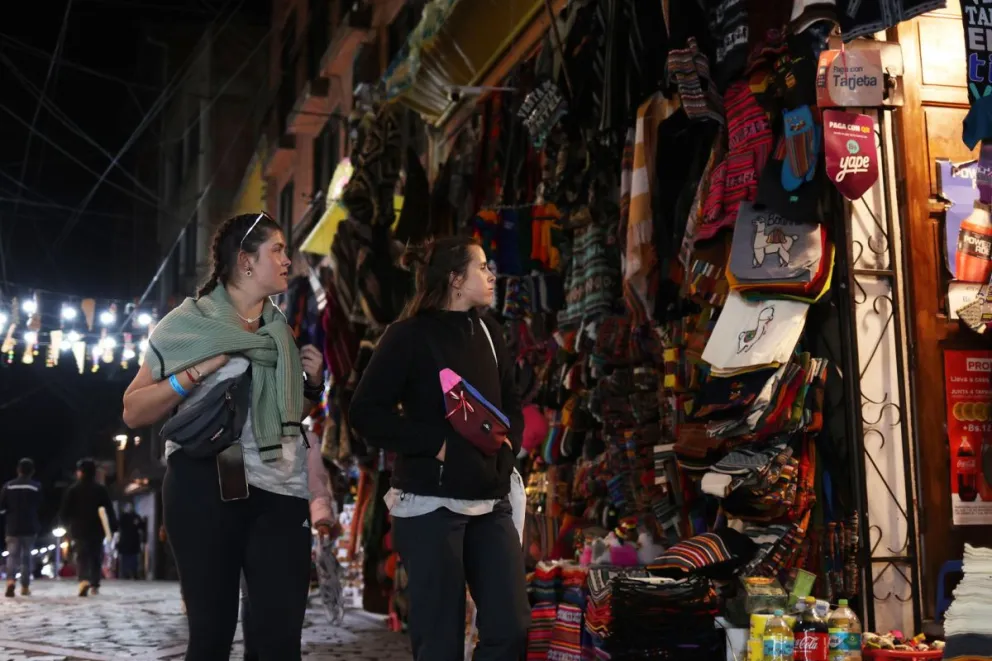
Tourists stroll through the area known as the Witches’ Alley, in the center of La Paz (Bolivia). Photo: EFE / Luis Gandarillas
Social instability, almost a constant in Bolivia, has taken a toll on sectors of the orange economy, such as tourism and gastronomy, which were just beginning to recover after the COVID-19 pandemic and are now once again on the ropes due to the political conflicts registered this year in the South American country.
Aside from economic problems, the main social issue at present stems from the internal struggle within the ruling Movement for Socialism (MAS) between the faction aligned with the country’s president, Luis Arce, and the wing loyal to former president (2006-2019) and party leader Evo Morales over control of the government and the party.
Earlier this year, there was already a blockade by the so-called ‘Evo supporters’ over the judicial elections, as well as against a constitutional ruling that prevents Morales from running again in the 2025 elections.
Now, these groups are blocking roads again in the central part of the country in response to a criminal investigation against the former president in a case of alleged human trafficking and statutory rape, although they also claim to protest the shortage of dollars and fuel and rising food prices, among other issues.
Among the most affected sectors are tourism and gastronomy, which suffered a severe setback during the 2019 post-election political and social crisis and later due to the restrictions during the COVID-19 pandemic.
During the pandemic, restaurant revenue “did not exceed 30%,” yet owners had to continue meeting their responsibilities to employees and banks, Ernesto Olivares, vice president of the Bolivian Chamber of Gastronomic Entrepreneurs (Cadeg), told EFE.
The hotel sector, which had occupancy rates of 60% to 80% before the pandemic, “plummeted” and experienced a “total collapse” due to travel restrictions. It also had to take on debt to continue fulfilling its obligations, explained Luis Ampuero, president of the Bolivian Chamber of Tourism (Cabotur).
After the worst was over, the situation began to improve somewhat for both sectors, but over the past year, problems such as the shortage of dollars and fuel, and rising food prices emerged, exacerbated by road blockades that began on Monday.
Pathological Conflict
Olivares indicated that, at this moment, the blockades “are preventing food like chicken, rice, and sugar,” which are produced on a large scale in Santa Cruz, Bolivia’s economic engine, from reaching other regions. This has resulted in price increases that typically “do not go back down.”
The representative for the gastronomic sector explained that restaurants “maintained their prices as long as they could,” but eventually had to raise them.
“The final consumer starts to feel the pinch when prices increase, begins looking for other options, and therefore, our revenue, which used to be 100%, will drop to 70%,” he warned.
Olivares reminded that the gastronomic sector “is the biggest employer of young people” and that “tightening the noose” only destroys “the poor economy of La Paz” and the national economy.
“Tourism is extremely fragile, volatile. As a tourist, you will never travel to a conflict-ridden place… Reservations simply get canceled,” said Ampuero.
According to Ampuero, while tourism in the rest of South America has recovered, Bolivia has not returned to the levels of 2019, when 1.4 million tourists visited. It is estimated to be 33% below that figure.
“We are increasingly seen as a country in a permanent state of conflict, with destinations where there may be nothing today, but something could happen tomorrow,” he lamented, hindering the sector’s “attempt” to recover.
Nevertheless, Olivares and Ampuero agreed that both sectors have developed “resilience” in a country where social conflict is “almost pathological,” while also urging more decisive action from all levels of government to help boost Bolivia’s orange economy.
Por Gina Baldivieso, EFE, Vision 360:
Turismo y gastronomía
Entre los sectores más afectados están el turismo y la gastronomía, que sufrieron un duro revés durante la crisis política y social poselectoral de 2019 y luego por las restricciones durante la pandemia de la covid-19.
Turistas pasean en el sector conocido como el Callejón de las Brujas, en el centro de la ciudad de La Paz (Bolivia). Foto: EFE / Luis Gandarillas
La inestabilidad social, que es casi una constante en Bolivia, se ha ensañado con sectores de la economía naranja como el turismo y la gastronomía, que apenas se estaban recuperando tras la pandemia de la covid-19 y ahora están nuevamente contra las cuerdas por los conflictos políticos registrados este año en el país suramericano.
Al margen de los problemas en la economía, el mayor problema social actual deriva de la pelea interna en el gubernamental Movimiento al Socialismo (MAS) entre la facción afín al presidente del país, Luis Arce, y el ala leal al exmandatario (2006-2019) y líder del oficialismo Evo Morales por el control del Gobierno y el partido.
A principios de año ya hubo un bloqueo de los llamados ‘evistas’ por las elecciones judiciales, pero también contra un fallo constitucional que impide una nueva candidatura de Morales en las elecciones de 2025.
Ahora estos sectores bloquean nuevamente en el centro del país contra una investigación penal al exmandatario en un caso de presunta trata de personas y estupro, aunque también dicen protestar por la falta de dólares y combustibles y el encarecimiento de algunos alimentos, entre otros.
Entre los sectores más afectados están el turismo y la gastronomía, que sufrieron un duro revés durante la crisis política y social poselectoral de 2019 y luego por las restricciones durante la pandemia de la covid-19.
Durante la pandemia la facturación en los restaurantes “no pasaba del 30 %”, pero los propietarios tuvieron que seguir cumpliendo con sus responsabilidades ante sus empleados y los bancos, dijo a EFE el vicepresidente de la Cámara de Empresarios Gastronómicos de Bolivia (Cadeg), Ernesto Olivares.
El sector hotelero, que estaba con tasas de ocupación de 60 a 80 % antes de la pandemia “se vino a pique” y tuvo un “colapso total” ante las restricciones para los viajeros, y también tuvo que endeudarse para seguir cumpliendo con sus obligaciones, explicó a EFE el presidente de la Cámara Boliviana de Turismo (Cabotur), Luis Ampuero.
Pasado el peor momento, la situación empezó a mejorar un tanto para ambos sectores, pero en el último año surgieron problemas como la falta de dólares y combustibles y el encarecimiento de algunos alimentos, que se ahondaron como consecuencia de los bloqueos de rutas iniciados el lunes.
Conflictividad “patológica”
Olivares indicó que en estos momentos los bloqueos “no están permitiendo que lleguen a otras regiones alimentos como pollo, arroz, azúcar” que se producen a gran escala en Santa Cruz, el motor económico de Bolivia, y que esto se traduce en el incremento de precios que normalmente luego “no vuelven a bajar”.
El representante de los gastronómicos explicó que los restaurantes “han mantenido sus precios hasta donde han podido”, pero ya no se pudo y, consecuentemente, también tuvieron que incrementarlos.
“El consumidor final ya empieza a ver dañada su economía cuando le aumentas el precio, comienza a buscar otras opciones y por lo tanto, las facturaciones que teníamos ya no van a ser de 100 %, van a bajar al 70 %”, alertó.
Olivares recordó que el sector gastronómico “es el que más empleo da al sector joven” y que “ponerle la soga al cuello” solo destruye “la paupérrima economía de La Paz” y la nacional.
“El turismo es sumamente frágil, volátil. Como turista usted nunca va a viajar a un lugar en conflicto (…) Simplemente las reservaciones se cancelan”, señaló por su parte Ampuero.
Según Ampuero, mientras el turismo en el resto de Suramérica se recuperó, en Bolivia no ha vuelto a los niveles de 2019, cuando llegaron 1,4 millones de turistas, y se calcula que debe estar un 33 % por debajo de esa cifra.
“Nos vamos tipificando como un país que está en permanente situación de conflicto, con destinos donde de pronto hoy no hay nada, pero mañana puede haber” y esto frena el “intento” de recuperación del sector, lamentó.
Con todo, Olivares y Ampuero coincidieron en que ambos sectores desarrollaron “resiliencia” en un país donde la conflictividad social es “casi patológica”, aunque también urgieron a una acción más decidida desde todos los niveles estatales para el despegue de la economía naranja boliviana.

 Bolivian Thoughts | Pensamientos Bolivianos (Bilingual/Bilingüe)