
By Juan Carlos Véliz, Eju.tv:
Standard & Poor’s warns that Bolivia’s internal political conflict limits its credit capacity and puts its economy at risk
In the Plurinational Legislative Assembly, more than $1.1 billion in external loans are stalled due to the lack of agreements between political factions, and the SP report specifically points to the relentless infighting within the ruling party, MAS.
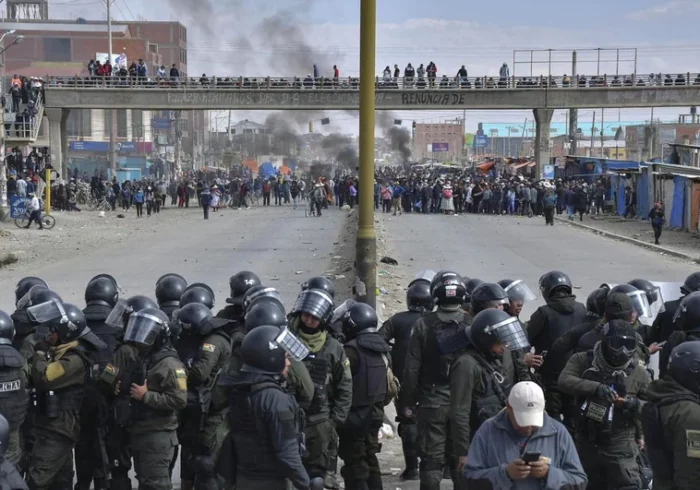
Standard & Poor’s (S&P) Global Ratings warned in its recent assessment that Bolivia’s internal political conflicts are hindering the country’s ability to improve its financial and economic situation. This increases risks to economic and monetary stability, as the country has less room to address its economic challenges and improve its credit capacity.
“A political stalemate limits the country’s ability to reverse the erosion of its external liquidity and fiscal position, posing risks to economic and monetary stability. The deadlock has intensified, reducing the scope to address economic policy challenges,” states the evaluation, which also reaffirms Bolivia’s sovereign credit rating as negative, CCC+/C, due to its “weak capacity to fully meet its long-term debt obligations under a fragile external profile.”
The term “political stalemate” in a Standard & Poor’s (S&P) Global Ratings report refers to a situation where political divisions and conflicts prevent effective decision-making and policy implementation.
S&P is a credit rating agency that assesses the ability of entities, such as governments and companies, to meet their financial obligations. These assessments are known as credit ratings.
These ratings provide an informed and standardized opinion on an issuer’s creditworthiness, helping investors make more confident decisions. Entities with good ratings can access financial markets more easily and at lower costs, allowing them to secure funding for projects and growth.
Although the government rejected the agency’s “pessimistic assessment” for not valuing certain rising figures, the internal political situation is negatively influencing the economic challenges Bolivia faces amid an economic crisis.
“We could raise the ratings in the next 12 months if decisive policies are implemented to improve Bolivia’s external liquidity and move toward a more sustainable fiscal profile. Addressing the deterioration of macroeconomic imbalances would be a first step toward improving investor confidence and gaining better access to external debt markets,” the report notes.
The rating agency argues that “political divisions have intensified ahead of the 2025 presidential elections, delaying approvals for external financing from official entities. The lack of transparency in key external account data also exacerbates uncertainty.”
More than $1.1 billion in external loans are stalled in the Plurinational Legislative Assembly due to the lack of consensus between parties, and the S&P report specifically points to the relentless infighting within the ruling party, MAS.
“Divisions within the Movement for Socialism (MAS), Bolivia’s ruling party, have reduced the margin for passing policies in Congress to address macroeconomic challenges. No faction within MAS controls a majority in Congress, making it difficult to pass significant laws,” it says.
“For example, access to external loans and the approval of key laws aimed at improving conditions for natural resource investments are being delayed in the legislature. Developing these sectors could generate economic growth and public revenues, as well as support the reversal of external imbalances and exchange rate pressures,” it adds.
MAS faces an internal “war” between factions loyal to former president Evo Morales and President Luis Arce, which has even led to physical confrontations between militants during the march led by Morales against Arce two weeks ago.
The agency also warns that “political disputes in the lead-up to the next elections reduce the government’s ability to address challenges.” “The next presidential elections will take place in 2025, which has intensified party divisions and harmed the cohesion and predictability of public policies,” it warns.
One of the reasons for MAS’s internal dispute, aside from control of the political party, is defining the presidential candidate. Evo Morales has declared himself the sole candidate for 2025, but the “Arce” faction is promoting another leadership, and Luis Arce’s re-election cannot be ruled out.
“The first round of the next presidential election will take place on August 17, 2025. The establishment of an electoral timeline has led to an intensification of campaign activism earlier than expected, which has sharpened political divisions within MAS,” summarizes the rating agency, reaffirming that politics is directly linked to the economy.
However, this is not the only political risk factor. The election of the presidents of the Chambers of Deputies and Senators in the Legislative Assembly, following the conclusion of the terms of Israel Huaytari (from the Arce faction) in the Lower House and Andrónico Rodríguez (from the Morales faction) in the Senate, is also a factor. Furthermore, seat redistribution and judicial elections scheduled for December 1 of this year add to the tension.
“Other factors contributing to political tensions include the selection of leaders for both houses of Congress in October, discussions about the redistribution of seats in the Lower House following recent census results, and the judicial elections scheduled for December. The current judiciary is operating under an extended mandate for one year (since the judicial elections were originally scheduled for 2023), and the opposition may have more influence in a divided Congress,” warns the agency.
Por Juan Carlos Véliz, Eju.tv:
Standard & Poor’s alerta que la pelea política interna en Bolivia limita su capacidad crediticia y pone en riesgo su economía
En la Asamblea Legislativa Plurinacional están estancados más de 1.100 millones de dólares de créditos externos debido a la falta de consensos entre bancadas y el informe de SP apunta específicamente a la pugna sin cuartel dentro del partido en función de gobierno, el MAS.
Standard & Poor’s (S&P) Global Ratings alertó en su reciente evaluación que los conflictos políticos internos en Bolivia están dificultando la capacidad del país para mejorar su situación financiera y económica. Esto aumenta los riesgos para la estabilidad económica y monetaria, ya que el país tiene menos margen para enfrentar sus desafíos económicos y mejorar su capacidad crediticia.
“Un estancamiento político limita la capacidad del país para revertir la erosión de su liquidez externa y su posición fiscal, lo que plantea riesgos para la estabilidad económica y monetaria. El estancamiento se ha intensificado, lo que ha reducido el margen para atender los desafíos de política económica”, señala la evaluación divulgada ayer en la que también ratifica la calificación crediticia soberana de Bolivia como negativa, CCC+/C, debido a su “débil capacidad para cumplir plenamente con sus compromisos de deuda en el largo plazo bajo un perfil externo frágil”.
El término “estancamiento político” en un informe de Standard & Poor’s (S&P) Global Ratings se refiere a una situación en la que las divisiones y conflictos políticos impiden la toma de decisiones y la implementación de políticas efectivas.
SP es una agencia de calificación crediticia que evalúa la capacidad de entidades, como gobiernos y empresas, para cumplir con sus obligaciones financieras. Estas evaluaciones son conocidas como calificaciones crediticias.
Estas calificaciones proporcionan una opinión informada y estandarizada sobre la calidad crediticia de un emisor, lo que ayuda a los inversionistas a tomar decisiones con mayor confianza. Las entidades con buenas calificaciones pueden acceder a mercados financieros más fácilmente y a menores costos, lo que les permite obtener financiamiento para proyectos y crecimiento.
Aunque el Gobierno rechazó la “evaluación pesimista” de la agencia porque no valoró algunas cifras en ascenso, la situación política interna está influyendo de manera negativa en los desafíos económicos que tiene Bolivia en medio de una crisis económica que la golpea.
“Podríamos subir las calificaciones en los próximos 12 meses si se generan políticas decisivas que mejoren la liquidez externa de Bolivia y apunten hacia un perfil fiscal más sostenible. Abordar el deterioro de los desequilibrios macroeconómicos sería un primer paso para mejorar la confianza de los inversionistas y obtener un mejor acceso a los mercados de deuda externa”, indica el informe.
La calificadora sostiene que “las divisiones políticas se han intensificado de cara a las elecciones presidenciales de 2025, y eso ha retrasado las aprobaciones de financiamiento externo provenientes de entidades oficiales. La falta de transparencia en datos clave de las cuentas externas también exacerba la incertidumbre”.
En la Asamblea Legislativa Plurinacional están estancados más de 1.100 millones de dólares de créditos externos debido a la falta de consensos entre bancadas y el informe de SP apunta específicamente a la pugna sin cuartel dentro del partido en función de gobierno, el MAS.
“Las divisiones dentro del Movimiento Al Socialismo (MAS), el partido gobernante en Bolivia, han reducido el margen para aprobar políticas en el Congreso para abordar los desafíos macroeconómicos. Ninguna facción del MAS controla la mayoría en el Congreso, lo que dificulta la aprobación de leyes significativas”, indica.
“Por ejemplo, el acceso a préstamos externos y la aprobación de leyes clave destinadas a mejorar las condiciones para las inversiones en recursos naturales se están retrasando en la legislatura. El desarrollo de aquellos sectores podría generar crecimiento económico e ingresos públicos, además de apoyar la reversión de los desequilibrios externos y las presiones cambiarias” complementa.
El MAS afronta una “guerra” interna entre corrientes leales al expresidente Evo Morales y al presidente Luis Arce, y que ha derivado incluso a enfrentamientos físicos entre sus militantes durante la marcha dirigida por Morales en contra de Arce hace dos semanas.
La agencia también advierte que “las disputas políticas en vista de las próximas elecciones reducen la capacidad del gobierno para atender los desafíos”. “Las próximas elecciones presidenciales se realizarán en 2025, lo que ha intensificado las divisiones partidarias, y ha perjudicado la cohesión y la previsibilidad de las políticas públicas”, alerta.
Una de las razones de la disputa interna del MAS, al margen del control de la sigla política, es la definición del candidato presidencial. Evo Morales se proclamó como el único candidato para 2025, pero la facción “arcista” apuntala otro liderazgo y no se descarta la reelección de Luis Arce.
“La primera vuelta de las próximas elecciones presidenciales tendrá lugar el 17 de agosto de 2025. El establecimiento de un calendario electoral condujo a una intensificación del activismo de campaña antes de lo previsto, y eso agudizó las divisiones políticas al interior del MAS”, resume la agencia calificadora que ratifica que la política está concatenada directamente con la economía.
No obstante, no es el único factor de riesgo en el ámbito político. También la elección de presidentes de las cámaras de Diputados y de Senadores en la Asamblea Legislativa a la conclusión de los mandatos de Israel Huaytari (arcista) en la cámara Baja y Andrónico Rodríguez (evista) en el Senado. Asimismo, la redistribución de escaños y las elecciones judiciales previstas para el 1 de diciembre de este año.
“Otros factores que contribuyen a las tensiones políticas incluyen la selección de líderes para ambas cámaras del Congreso en octubre, las discusiones sobre la redistribución de escaños en la cámara Baja tras los recientes resultados del censo y las elecciones judiciales programadas para diciembre. El actual poder judicial se encuentra en una extensión de su mandato por un año (ya que las elecciones judiciales estaban originalmente programadas para 2023), y la oposición puede tener más influencia en un Congreso dividido”, alerta.

 Bolivian Thoughts | Pensamientos Bolivianos (Bilingual/Bilingüe)