
By EFE, Brujula Digital:
Around 258,000 Bolivians Turn to Cryptocurrencies Due to Dollar Shortage
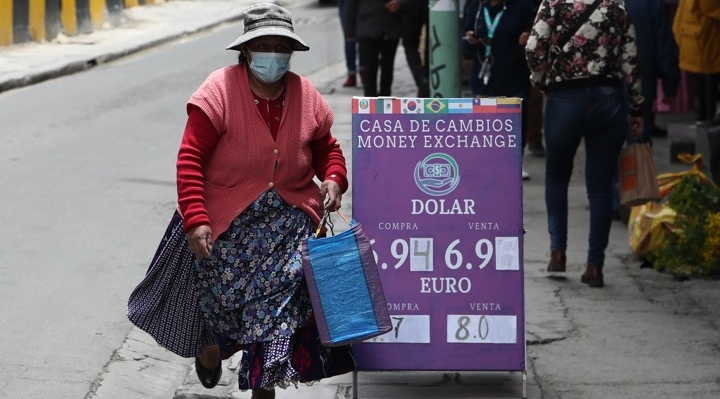
A woman walks in front of a currency exchange house. Photo: EFE
The Central Bank of Bolivia (BCB) reported on Thursday that around 258,000 Bolivians have been using cryptocurrencies over the past three months, following the official authorization for buying, selling, and investing in these virtual assets. This comes as the Andean nation faces an economic crisis that has led to a shortage of US dollar liquidity.
“There are 258,801 people in Bolivia who hold virtual assets as of 2024 (…) We estimate this represents 6% of the population with formal income,” said BCB president Edwin Rojas, citing an evaluation conducted by the Bolivian government in collaboration with the Latin American Financial Action Task Force (Gafilat).
Additionally, Rojas noted that Bolivia currently ranks 14th in Latin America in terms of cryptocurrency value.
Bitcoin, the most widely used digital currency, was valued at 452,526 bolivianos per unit on Thursday, while Ethereum, the second most popular, was priced at 17,756 bolivianos.
The values of these cryptocurrencies fluctuate daily, even hourly, due to various factors such as supply and demand, and they tend to be more volatile than traditional investments like bonds and stocks.
“The estimated value Bolivia holds in crypto assets is around one billion dollars,” added Rojas.
It has now been three months since the Central Bank authorized the buying and selling of virtual assets through the Bolivian financial system. This allows users to conduct daily commercial transactions and save digital currencies for the long term.
“We consider this a fundamental step that enables the modernization of our payment system,” the BCB president emphasized during a press conference.
As of July this year, there were 250,000 citizens with cryptocurrency accounts, according to financial analyst Jaime Dunn, who shared this information with EFE at the time.
Rojas explained that prior to the official authorization of virtual assets, Bolivia generated $7.6 million in cryptocurrency transactions, but after the approval, these transactions increased to between $13 million and $16 million.
Parallel to the authorization of cryptocurrencies, Bolivia has been experiencing a dollar liquidity shortage since early 2023. This has made it more difficult for citizens to carry out foreign transactions, leading to rising prices of essential and other goods.
While the US dollar has remained stable in Bolivia, the economic crisis intensified in August when the parallel market exchange rate skyrocketed to over 14 bolivianos—more than double the official rate of 6.96 bolivianos.
The Central Bank of Bolivia (BCB) has assured that there are no plans to adjust the official exchange rate, which has been fixed since 2011. The bank claims this provides economic stability, though it has yet to explain the reasons behind the ongoing liquidity shortage.
BD/
Por EFE, Brujula Digital:
Unos 258.000 bolivianos recurren a las criptomonedas por la escasez de dólares
Una mujer camina frente a una casa de cambio. Foto: EFE
El Banco Central de Bolivia (BCB) informó este jueves que unos 258.000 bolivianos usan las criptomonedas desde que hace tres meses, cuando se habilitó oficialmente la compra, venta e inversión en estos activos virtuales, ya el país andino vive una crisis económica que derivó en la falta de liquidez de dólares.
“Existen en Bolivia 258.801 personas que poseen activos virtuales a 2024 (…) Calculamos que es un 6 % de la población con un ingreso formal”, afirmó el presidente del BCB, Edwin Rojas, basado en un informe de evaluación que hizo el Gobierno boliviano con el Grupo de Acción Financiera de Latinoamérica (Gafilat).
Además, señaló que actualmente Bolivia ocupa el puesto 14 de Latinoamérica en ser un país que tiene ya “un valor” en criptoactivo.
El Bitcoin la moneda digital más usada está a
452.526 bolivianos por unidad este jueves, mientras que el Ethereum, la segunda más usada, está a 17.756 bolivianos.
Los valores de estas criptomonedas varían día a día, incluso cada hora, por diversos factores como la oferta y demanda, y suelen ser más volátiles que las inversiones tradicionales como bonos y acciones.
“El valor que se estima que posee Bolivia en criptoactivos está en mil millones de dólares”, añadió Rojas.
Hoy se cumplen tres meses desde que el Banco Central habilitó las operaciones de compra y venta de activos virtuales a través del sistema financiero boliviano, con lo que los usuarios pueden realizar operaciones comerciales de uso diario y ahorrar la moneda digital a largo plazo.
“Consideramos que es un paso fundamental que permite la modernización de nuestro sistema de pagos”, destacó el presidente del BCB en una conferencia de prensa.
Hasta julio de este año había 250.000 ciudadanos con cuentas criptos, según informó a EFE el analista financiero Jaime Dunn en aquella ocasión.
Rojas explicó que antes de la habilitación formal del uso de los activos virtuales se generaban 7,6 millones de dólares en criptomonedas, mientras que después de la aprobación de su uso las operaciones subieron entre 13 y 16 millones de dólares.
Paralelo a la habilitación del uso de las criptomonedas, Bolivia sufre, desde principios de 2023, una falta de liquidez de dólares, lo que le ha complicado aún más este año a los ciudadanos realizar varias transacciones en el exterior y ha derivado en el encarecimiento de los precios de productos de primera necesidad y otros.
Si bien en el país andino la divisa estadounidense logró una estabilidad, en agosto, la crisis económica se sintió con más fuerza debido a que el dólar en el mercado paralelo se disparó por encima de los 14 bolivianos, más del doble de la cotización oficial que es de 6,96 bolivianos.
El Banco Central de Bolivia (BCB) aseguró que no se tiene previsto modificar el tipo de cambio del dólar establecido desde 2011, lo que según el ente emisor le da estabilidad económica al país. Sin embargo, no explica hasta la fecha a qué se debe la falta de liquidez.
BD/

 Bolivian Thoughts | Pensamientos Bolivianos (Bilingual/Bilingüe)