
By Marco Belmonte, Vision 360:
Air Monitoring
The Atmospheric Physics Laboratory warns of an environmental catastrophe and foresees a lack of rain due to the fires.
The problem is that the Amazon region of the continent is experiencing one of the most intense droughts in recent years, which could result in the rain not arriving when it is most needed, according to the LFA.
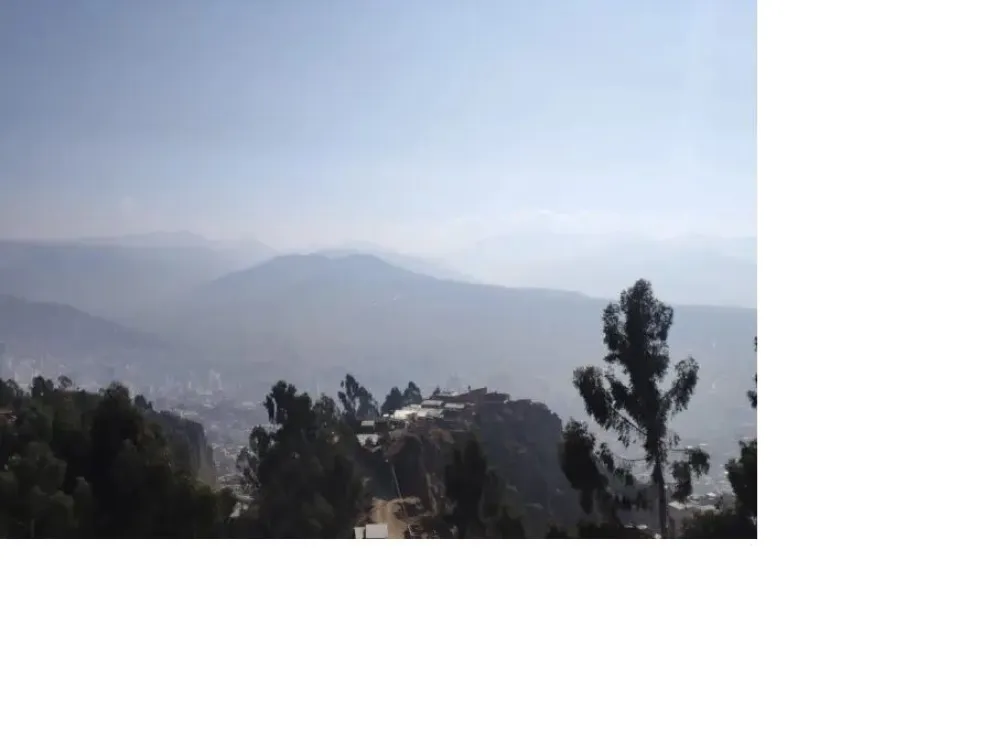
Air Quality Worsens in La Paz Due to Slash-and-Burn Practices. Photo: ABI
The Atmospheric Physics Laboratory (LFA) warns that forest fires, slash-and-burn practices, and the lack of action from those responsible are causing an environmental catastrophe, with consequences that will result in a lack of rainfall.
This situation is destroying flora and fauna, and the ashes are compromising public health, warns the unit, which is part of the Faculty of Pure and Natural Sciences at the Universidad Mayor de San Andrés (UMSA).
According to the Laboratory, the fires and slash-and-burn practices are generating an unprecedented amount of smoke in the country, degrading air quality, with a very high concentration of particulate matter (mainly smoke) and carbon monoxide, a harmful gas for human health.
It points out that from August 30 onward, air quality in the entire La Paz region has reached “poor” and “very poor” levels. Other regions are also showing very high levels of particulate matter, especially in lowland areas.
The fact that elevated areas like the cities of La Paz and El Alto have been experiencing several days of high pollution levels, the report states, is due to meteorological factors, mainly wind direction and lack of precipitation.
The issue is that the Amazon region of the continent is facing one of the most intense droughts in recent years, which may result in rain not arriving when it is most needed.
To make matters worse, the Laboratory notes that scientific evidence shows that the presence of smoke could inhibit precipitation processes, creating a dangerous cycle that could prolong the current poor air quality conditions.
Therefore, government-level measures are urgently needed to reduce the number of fires until the rains can help improve conditions.
It is recommended to monitor the air quality reported by LFA-GAMLP. In response, the Bolivian Society of Pulmonology advises the use of masks in open areas, increased water consumption to stay hydrated, and humidifying indoor environments.
Por Marco Belmonte, Vision 360:
Monitoreo del aire
Laboratorio de Física de la Atmósfera advierte catástrofe ambiental y avisora falta de lluvias por los incendios
El problema es que la zona amazónica del continente está presentando una de las sequías más intensas de los últimos años por lo que podría suceder que las lluvias no lleguen cuando tanto se las necesita, según el LFA.
La calidad del aire empeoró en La Paz por los chaqueos. Foto ABI
El Laboratorio de Física de la Atmósfera (LFA) advierte que los incendios forestales, los chaqueos y la falta de acción de quienes están llamados a intervenir, están produciendo una catástrofe ambiental y las consecuencias se traducirán en falta de lluvias.
Esto a su vez está aniquilando la flora, fauna y las cenizas comprometen la salud de la población, advierte esa unidad dependiente de la facultada de Ciencias Puras y Naturales de la Universidad Mayor de San Andrés (UMSA).
Según el Laboratorio los incendios y chaqueos están generando una cantidad de humo pocas veces observada en el país, deteriorando la calidad del aire y se reporta una concentración muy elevada de material particulado (humo principalmente) y de monóxido de carbono, un gas nocivo para la salud de las personas.
Señala que el aire a partir del 30 de agosto alcanzó una valoración “mala” y “muy mala” en todo el territorio de La Paz. En otras regiones también se muestra niveles muy altos de material particulado, especialmente en tierras bajas.
El hecho de que se tengan varios días con niveles con alta contaminación en lugares elevados como las ciudades de La Paz y El Alto, señala, es consecuencia de factores meteorológicos, principalmente la dirección de los vientos y falta de precipitación.
El problema es que la zona amazónica del continente está presentando una de las sequías más intensas de los últimos años por lo que podría dar el caso de que las lluvias no lleguen cuando tanto se las necesita.
Para colmo, de acuerdo con el Laboratorio, existen evidencias científicas que la presencia de humo podría inhibir los procesos de precipitación por lo que se estaría en un peligroso círculo vicioso que podría prolongar las condiciones de la calidad de aire tan mala como la de los últimos días.
Urgen, por lo tanto, medidas a niveles gubernamentales para tratar de reducir el número de incendios hasta que las lluvias puedan favorecer.
Se recomienda hacer seguimiento a la calidad del aire reportada por el LFA-GAMLP. En consecuencia, la Sociedad Boliviana de Neumología, recomienda el uso de barbijos en lugares abiertos, consumo de agua para favorecer la hidratación y humidificar los ambientes.

 Bolivian Thoughts | Pensamientos Bolivianos (Bilingual/Bilingüe)