
By Gregory Beltrán, La Prensa; Luz Mendoza, Eju.tv:
The Association of Private Banks of Bolivia (Asoban) presented the balance for the first half of the year, confirming that deposits in the national currency reached 90.8 percent.
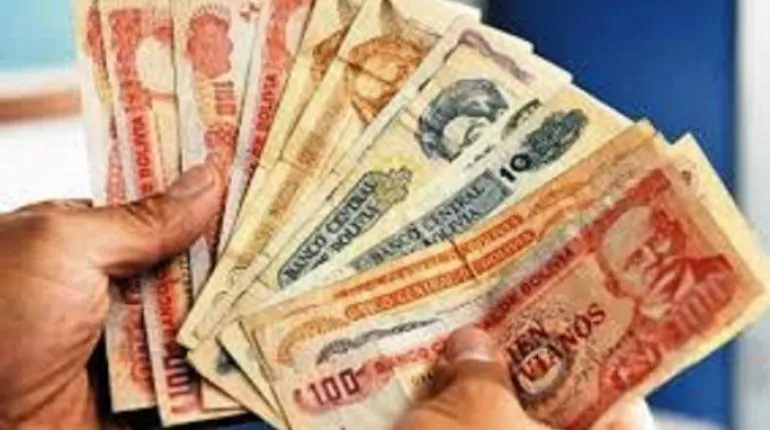
If a person tries to open a savings account in dollars or wants to buy foreign currency, the response is that “at this moment” such transactions cannot be carried out. Not only that, but according to recent reports from the Financial System Supervisory Authority (Asfi) as of July of this year, 99.4 percent of loans and 90.7 percent of deposits in the financial system are in the national currency.
“In other words, the boliviano plays a significant role both in the granting of loans and in the collection of deposits within the Bolivian financial system,” reads a report from the supervisory authority.
The Association of Private Banks of Bolivia (Asoban) presented the balance for the first half of the year and confirms that deposits in the national currency stood at 90.8 percent, “a result that responds, on the one hand, to an increase of 2.696 million dollars in deposits in national currency over the past year, reflecting the confidence of the population; and on the other hand, a reduction of 478 million dollars in foreign currency, in a context of increased public demand for dollars,” it notes.
The Asfi report states that in the first half of the year, deposits reached 221.737 million bolivianos, distributed across more than 15.7 million accounts, “of which 1.01 million were opened in the last 12 months.” Of the total deposits, 49.3 percent, or 109.261 million bolivianos, corresponds to Fixed-Term Deposits, and 30 percent, or 66.429 million bolivianos, to savings accounts, “among the main alternatives preferred by the Bolivian population.”
According to Asfi’s criteria, there is a “dominance of the national currency: while foreign currency deposits have decreased by 3.527 million bolivianos between July 2023 and 2024, this is a result of withdrawals motivated by the speculative context related to U.S. dollars. However, deposits in national currency grew significantly by 18.161 million bolivianos, emphasizing the public’s preference for the Bolivian currency, an indicator of stability.”
MORE DATA.
Asoban’s report indicates that both the number of borrowers and the number of savings accounts in the banking system have grown, along with advances in banking access, “impacting financial inclusion.”
In this regard, the number of borrowers stood at 1.560.916, with an increase of 50.143 over the course of a year.
However, there is a discrepancy between Asoban and Asfi regarding delinquency rates, which refers to delays in loan payments. While the rate remains below the regional average, the perspectives differ. According to Asoban, the non-performing loan portfolio reached 971 million dollars, and the delinquency rate stood at 3.4 percent, “maintaining an upward trend primarily due to rescheduled delinquency.” Regulators, however, assure that delinquency is under control and well-covered, with the rate “remaining at a controlled 3.5 percent, below the regional average of 3.6 percent.”
It is important to note that Bolivia applies stricter criteria in calculating delinquency, considering delays of more than 30 days, while the international standard is 90 days. Additionally, the provisions for covering delinquency stand at a solid 124 percent, ensuring that institutions are prepared to handle any deterioration in the loan portfolio. Furthermore, Asfi points out that the financial system has not only shown stability in delinquency rates, “but other key variables also reflect positive performance,” such as the annual credit portfolio growth of 4.1 percent and liquidity reaching 70.896 million bolivianos, covering 65 percent of short-term deposits. Profits reached 1.033 million bolivianos, with an increase of 116 million bolivianos.
Por Gregory Beltrán, La Prensa; Luz Mendoza, Eju.tv:
La Asociación de Bancos Privados de Bolivia (Asoban) presentó el balance del primer semestre y confirma que los depósitos en moneda nacional se situaron en 90,8 por ciento.
Si una persona intenta abrir una cuenta de ahorro en dólares o quiere comprar divisas, la respuesta es que en “este momento” no se puede realizar esa transacción. No sólo eso, según recientes reportes de la Autoridad de Supervisión del Sistema Financiero (Asfi) a julio de este año el 99,4 por ciento de los créditos y el 90,7 por ciento de los depósitos en el sistema financiero están en moneda nacional.
“Es decir, el boliviano tiene una participación destacable tanto en la otorgación de créditos como en la captación de depósitos dentro el sistema financiero boliviano.”, se lee en un informe de la supervisora.
La Asociación de Bancos Privados de Bolivia (Asoban) presentó el balance del primer semestre y confirma que los depósitos en moneda nacional se situaron en 90,8 por ciento, “resultado que responde, por un lado, al aumento de 2.696 millones de dólares de depósitos en moneda nacional en el último año, dando cuenta de la confianza de la población; y por otra parte, la reducción de 478 millones de dólares en moneda extranjera, en un contexto de mayor demanda de dólares por parte del público”, anota.
El reporte de la Asfi señala que en el primer semestre los depósitos llegaron a 221.737 millones de bolivianos distribuidos en más de 15,7 millones de cuentas, “de las cuales, 1,01 millones fueron aperturadas en los últimos 12 meses”. Del total de depósitos 49,3 por ciento, es decir 109.261 millones de bolivianos corresponde a Depósitos a Plazo Fijo y 30 por ciento, es decir 66.429 millones de bolivianos, a cajas de ahorros, “entre las principales alternativas preferidas por la población boliviana”.
En criterio de la Asfi hay un “predominio de la moneda nacional: aunque los depósitos en moneda extranjera han disminuido en 3.527 millones de bolivianos entre julio de 2023 y 2024, este hecho es consecuencia de retiros motivados por el contexto especulativo relacionado con los dólares estadounidenses. Sin embargo, los depósitos en moneda nacional crecieron significativamente en 18.161 millones de bolivianos, subrayando la preferencia del público por la moneda boliviana, un indicador de estabilidad”.
MÁS DATOS.
El informe de Asoban señala que tanto el número de prestatarios como la cantidad de cuentas de ahorro en el sistema bancario registraron crecimiento, además de avances en materia de bancarización “con efecto en la inclusión financiera”.
En este sentido, el número de prestatarios se situó en 1.560.916, con un aumento de 50.143 en un año.
En algo que no coinciden la Asociación de Bancos y la Asfi es en la mora, es decir el retraso en el pago de créditos bancarios que, si bien se sitúa por debajo del promedio regional, hay una discrepancia respecto a la perspectiva. Según Asoban, la cartera en mora alcanzó a 971 millones de dólares y el índice de morosidad llegó a en 3,4 por ciento “manteniendo la tendencia al alza que proviene principalmente de la mora reprogramada”. Responsables de la entidad reguladora aseguran que la mora está controlada y suficientemente cubierta, debido a que el índice “se mantiene en un controlado 3,5 por ciento, por debajo del promedio regional de 3,6 por ciento.
Es importante señalar que Bolivia aplica un criterio más estricto al calcular la mora, considerando retrasos superiores a 30 días, mientras que el estándar internacional es de 90 días. Además, las previsiones para cubrir la mora alcanzan un sólido 124 por ciento, asegurando que las entidades están preparadas para manejar cualquier deterioro en la cartera de créditos”. Algo más, la Asfi indica que el sistema financiero no sólo ha mostrado estabilidad en la mora, “sino que otras variables clave también reflejan un desempeño positivo”, como por ejemplo el crecimiento anual de la cartera de créditos anual del 4,1 por ciento y la liquidez que llegó a 70.896 millones de bolivianos, cubriendo el 65 por ciento de los depósitos a corto plazo”, las utilidades llegaron a 1.033 millones de bolivianos, con un incremento de 116 millones de bolivianos.
https://eju.tv/2024/09/la-banca-se-bolivianiza-ante-la-escasez-de-dolares/


Leave a Reply