
Marco Antonio Belmonte, Vision 360:
The company considers that the lack of access to the sea may increase the costs of lithium and points out that the country must promote industrialization and, at the same time, redevelop the hydrocarbon sector.
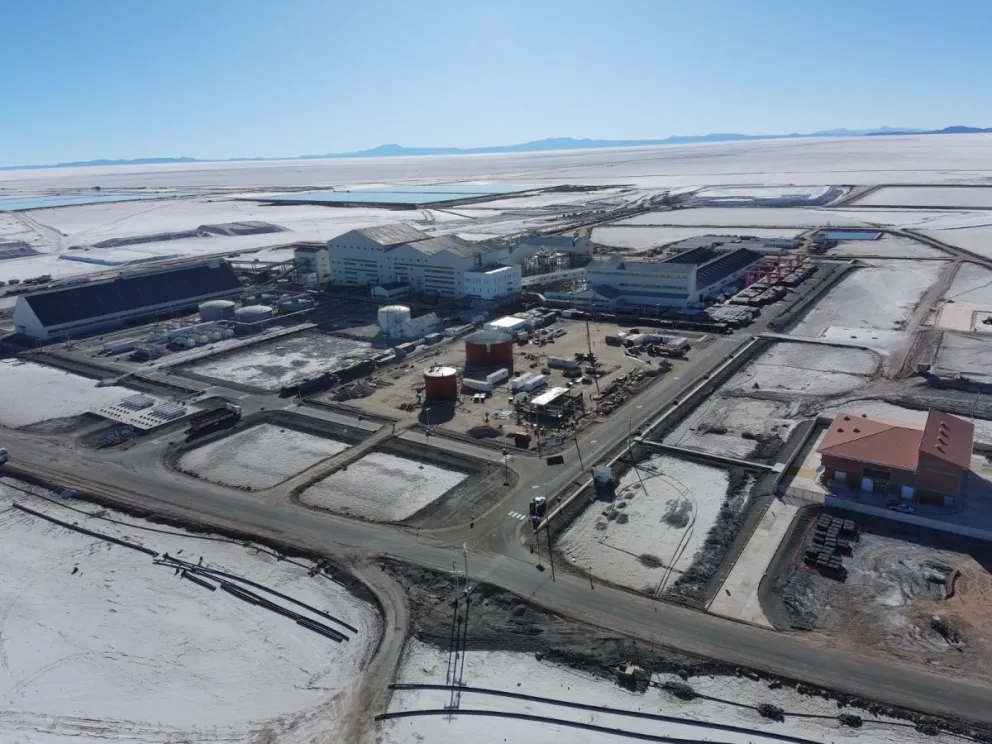
The Lithium Carbonate Industrial Plant inaugurated in December 2023, in Colcha K. Photo: MHE.
While in Bolivia, lithium is seen as a hopeful source of income, Moody’s Ratings believes that this natural resource may represent a significant business opportunity for the country, but it won’t be enough to compensate for the revenues generated by natural gas exports.
The company conducted an assessment of the Bolivian economy, the banking and insurance financial system, and the prospects for risk rating at the “Inside Latam Bolivia 2024” event on Wednesday.
During the event, William Foster, Senior Vice President of Sovereign Risk at Moody’s Ratings, was asked how Bolivia’s lithium reserves would impact the country’s economic profile in the short term and what possibilities exist for this to become part of the country’s economic profile in the future.
Foster emphasized that lithium is very important for Bolivia, and everyone wonders how it can impact the economy and fiscal position. It’s clear that the country has the largest lithium deposits or reserves in the world, which represents a significant revenue opportunity.
According to Foster, the problem is that lithium is difficult to extract, and its quality in Bolivia is lower compared to the product obtained in other countries. For example, Chile has a higher magnesium content.
Additionally, he noted that the country lacks access to the sea, which can increase costs compared to other countries with maritime infrastructure. “Lithium can be important and support Bolivia’s exports in the future, but from our point of view, it will not be enough in terms of the relationship and what is happening in the hydrocarbon sector, that is, supporting or reversing the trend we observe in the external accounts,” he explained.
In Foster’s opinion, along with the promotion of the lithium industry, Bolivia also needs to redevelop the hydrocarbon sector.
State lithium project
Bolivia has reserves of over 23 million tons of lithium in the Uyuni and Pastos Grandes salt flats in Potosí, and in Coipasa in Oruro.
In December of last year, the lithium carbonate industrial plant was inaugurated in the municipality of Colcha K, south of the Uyuni Salt Flat, and this year, it will produce at 30% capacity, i.e., 3,000 tons, gradually scaling up to its maximum capacity of 15,000 tons per year.
Work is also underway on several parallel projects, such as the exploration of more than 28 salt flats and saltwater lagoons in the country for lithium and evaporitic exploitation, agreements for the development and implementation of Direct Lithium Extraction technology, and the implementation of a pilot plant for the development of cathodes using Bolivian lithium carbonate.
Natural gas exports, after reaching a peak of $6.113 billion in 2013 and $6.011 billion in 2014, have declined in recent years due to production declines in the country. Last year, sales to the markets of Brazil and Argentina totaled $2.046.8 billion, a 31.1% decrease.
The revenue of Yacimientos Petrolíferos Fiscales Bolivianos (YPFB), from gas sales to external and internal markets, decreased by $1.030 billion, or 30.2%, between 2022 and 2023.
La compañía considera que la falta de acceso al mar puede incrementar los costos del litio y señala que el país debe impulsar la industrialización y, a la par, desarrollar otra vez los hidrocarburos.
La Planta Industrial de Carbonato de Litio inaugurada en diciembre de 2023, en Colcha K. Foto: MHE.
Mientras en Bolivia se ve como una esperanza de ingresos al litio. Moody´s Ratings, ve que este recurso natural puede representar una gran oportunidad de negocio para el país, pero no será suficiente como para compensar los ingresos que generaban las exportaciones de gas natural.
La compañía realizó este miércoles una evaluación de la economía boliviana, el sistema financiero bancario y de seguros, y de las perspectivas de la calificación de riesgo, en el evento “Inside Latam Bolivia 2024”.
Durante el encuentro se le preguntó a William Foster, vicepresidente Senior de Riesgo Soberano de Moody´s Ratings, ¿cómo impacta en el corto plazo las reservas de litio de Bolivia y qué posibilidades existen de que esto forme parte del perfil económico del país a futuro?
El ejecutivo resaltó que el litio es muy importante para Bolivia y todos se preguntan cómo puede impactar en la economía y la posición fiscal, y está claro que el país tiene los depósitos o reservas más grandes del mundo y representa una oportunidad grande de ingresos.
Según Foster, el problema es que el litio es difícil de extraer y la calidad de este recurso en Bolivia es menor con relación al producto que se logra en otros países, por ejemplo, en Chile tiene una mayor cantidad de magnesio.
Además, recordó que el país no tiene acceso al mar y esto puede incrementar los costos en relación a otros países que cuentan con la infraestructura marítima. “El litio puede ser importante y apoyar a las exportaciones de Bolivia en el futuro, pero desde nuestro punto de vista, no va a ser suficiente en términos de relación y de lo que está pasando en el sector de hidrocarburos, es decir, apoyar o cerrar la tendencia que observamos en las cuentas externas”, precisó.
En criterio de Foster, junto al impulso de la industria del litio, Bolivia necesita también desarrollar otra vez el sector de hidrocarburos.
El proyecto estatal de litio
Bolivia posee reservas de más de 23 millones de toneladas de litio existentes en los salares de Uyuni y Pastos Grandes, en Potosí, y en Coipasa en Oruro.
En diciembre del año pasado se inauguró la planta industrial de carbonato de litio en el municipio de Colcha K, al sur del Salar de Uyuni y este 2024 producirá a un 30% de capacidad, es decir 3.000 toneladas hasta ir escalando progresivamente hasta alcanzar su capacidad máxima de 15.000 toneladas por año.
También se trabaja en varios proyectos en paralelo, como la exploración de los más de 28 salares y lagunas saladas que posé el país para la explotación de litio y evaporíticos, los convenios para el desarrollo e implementación de tecnología de Extracción Directa de Litio y la implementación de una planta piloto para el desarrollo de cátodos, con carbonato de litio boliviano.
Las exportaciones de gas natural, luego de alcanzar un pico de 6.113 millones de dólares en 2013 y de 6.011 millones de dólares, en 2014, descendieron en los últimos años por la caída en la producción en el país. El año pasado las ventas a los mercados de Brasil y Argentina sumaron 2.046,8 millones de dólares, un 31,1% menos.
La facturación de Yacimientos Petrolíferos Fiscales Bolivianos (YPFB), por la venta de gas a los mercados externos e interno, disminuyó en 1.030 millones de dólares, o un 30,2% menos, entre 2022 y 2023.

 Bolivian Thoughts | Pensamientos Bolivianos (Bilingual/Bilingüe)