
Informes Diagnosis Estudios. (Brújula Digital), El Diario:
Survey by Diagnosis
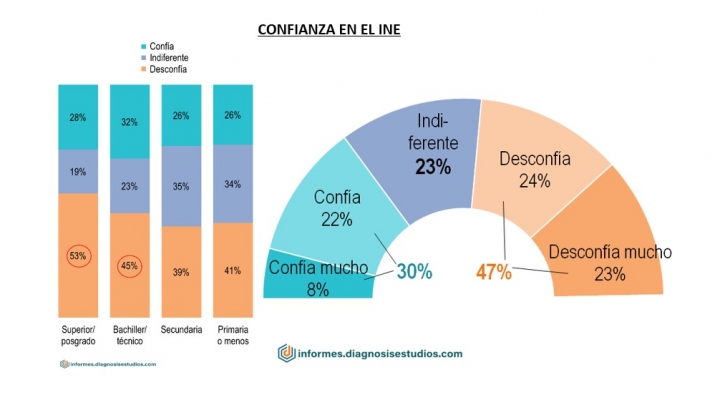
With 17 days left until the National Population and Housing Census, between 50% and 60% of the population surveyed by the company Informes Diagnosis Estudios, conducted between February 24 and 25, distrusts the National Institute of Statistics (INE) and the results of the census to be conducted on the 23rd of this month.
They believe that there will be errors that will distort the reality of the population and housing in the country. Additionally, six out of ten interviewees believe that there will be serious social and regional conflicts to define the redistribution of co-participation resources and the parliamentary representation of departments based on the Census results.
When asked “Do you trust or not trust the INE?” 53% of respondents with higher education and postgraduate degrees expressed distrust, while high school graduates and technicians also expressed the same opinion at 45%, as did those with secondary education at 39% and primary education or less at 41%.
According to social class: “Do you trust or not trust the INE?” 59% of the typical middle class expressed distrust, 48% of the lower-middle class, 45% of the lower class, and 41% of the poor.
According to the area of residence: “Do you trust or not trust the INE?” 53% in the departmental capitals and El Alto also expressed their distrust, followed by 45% of middle-class residents, 38% of towns, and 37% of rural areas.
According to eco-region: “Do you trust or not trust the INE?” 45% of the highlands showed distrust, followed by 51% of valleys and 59% of lowlands.
The study, conducted among men and women aged 18 to 65, also indicates that although distrust in the Census predominates among sectors opposed to the government, skepticism is significant among sectors that support President Luis Arce’s administration.
“Do you trust or not trust the INE?” according to approval of President Luis Arce: 45% approve, 57% express indifference, and 71% disapprove.
Both the government’s and the INE’s credibility are currently weak, seriously threatening the legitimacy of the Census and its results.
In response to the question: “In your opinion, will the Census results be reliable or manipulated by the government?” 27% express confidence, 31% warn of errors but not manipulation, and 12% assert that there will be manipulation. The rest (30%) do not know or do not respond.
In response to the question about trust in the INE and Census results, the following was the response: 24% distrust and 23% strongly distrust.
According to level of education: “In your opinion, will the Census results be reliable or manipulated?” With higher education and postgraduate studies, 28% express confidence, high school graduates and technicians at 25%, 31% for secondary education, and 29% for primary education or less.
According to social class: “In your opinion, will the Census results be reliable or manipulated?” 29% of the typical middle class and 53% of the lower-middle class believe there will be errors but not manipulation. Although 24% of the latter group believe there will be manipulation. 35% of the lower class express confidence in the results. The poor class, at 33%, believes there will be manipulation.
According to eco-region: “In your opinion, will the Census results be reliable or manipulated?” 38% of the highlands trust the results, and 33% of the valleys. In the lowlands, 47% believe there will be errors but not manipulation.
From the Census results, State co-participation resources will be redistributed among departments based on their population, and the number of deputies per department will be redefined according to population. “Do you think there will be conflicts or not to achieve these agreements?” 37% believe there will be conflicts and 23% believe there will be very strong conflicts. 18% say there will be consensus and a similar percentage do not know or do not respond. Only 4% see that there will be peaceful consensus.
Certainly, the population’s expectations of a future scenario of high social and political conflict over resources (redistribution based on Census results) and parliamentary representation (some regions will gain and others will lose) are pessimistic.
The respondents of Diagnosis are preparing for a prolonged situation of political, social, and probably economic instability.
TECHNICAL DETAILS
Fieldwork: February 24 and 25, 2024
Universe Men and women aged 18 to 65
Sample 1,800 surveys in urban and rural areas of the nine departments.
Sampling error of +/- 2.31%
Method: In-person surveys in homes, in digital format
Selection of respondents Multistage. Simple random selection of census zones and segments, and systematic selection of households and respondents
Company: Informes Diagnosis Estudios. (Brújula Digital)
Encuesta de Diagnosis
Cuando faltan 17 días para la realización del Censo Nacional de Población y Vivienda, entre el 50% y el 60% de la población encuestada por la empresa Informes Diagnosis Estudios, realizada entre el 24 y 25 de febrero, desconfía del Instituto Nacional de Estadística (INE) y de los resultados del empadronamiento que recogerá el 23 del presente mes.
Creen que habrá errores que distorsionarán la realidad de la población y de la vivienda en el país. Además, seis de cada 10 entrevistados creen que habrá serios conflictos sociales y regionales para definir la redistribución de recursos de coparticipación y la representación parlamentaria de los departamentos en función de los resultados del Censo.
Ante la consulta ¿confía o no confía en el INE? El 53% de los encuestados con estudios superiores y postgrado expresó su desconfianza, los bachilleres y técnicos también expresaron el mismo parecer en un 45%, al igual que los que tienen estudios de secundaria 39% y primaria o menos 41%.
Según clase social: ¿Confía o no confía en el INE? El 59% de la clase media típica expresó su desconfianza, la media baja en 48%, la baja 45% y la pobre en 41%.
Según el área de residencia: ¿Confía o no confía en el INE? El 53% en las capitales de departamento y de El Alto, también manifestaron su desconfianza, seguido con 45% de clases intermedias, 38% de los pueblos y 37% del área rural.
Según ecorregión: ¿Confía o no confía en el INE? El 45% del altiplano mostró desconfianza, seguido por 51% de los valles y 59% de tierras bajas.
El estudio, realizado entre hombres y mujeres de 18 a 65 años, también da cuenta que, aunque la desconfianza en el Censo predomina en los sectores que se oponen al Gobierno, el escepticismo es relevante entre los sectores que apoyan la gestión del presidente Luis Arce.
¿Confía o no confía en el INE?, según aprobación del presidente Luis Arce: el 45% aprueba, el 57% expresa su indiferencia y el 71% lo desaprueba.
La credibilidad tanto del Gobierno como del INE están en un momento de debilidad, lo que amenaza seriamente la legitimidad de la realización del Censo y de sus resultados.
Ante la siguiente pregunta: ¿Según su opinión los resultados del Censo serán confiables o serán manipulados por el Gobierno? El 27% expresa su confianza, el 31% alerta de errores, pero no manipulación y el 12% asegura que habrá manipulación. El resto (30%) no sabe, no responde.
Ante la consulta de: confianza en el INE y en los resultados del Censo. Esta fue la respuesta: 24% desconfía y 23 desconfía mucho.
Según nivel de instrucción: ¿Según su opinión los resultados del Censo serán confiables o serán manipulados? Con estudios superiores y postgrado en un 28% expresa su confianza, bachilleres y técnicos en 25%, en 31% secundaria, en 29% primaria o menos.
Según clase social: ¿Según su opinión los resultados del Censo serán confiables o serán manipulados? El 29% de la clase media típica y el 53% de la clase media baja expresan que habrá errores, pero no manipulación. Aunque el 24% de este último grupo cree que habrá manipulación. El 35% de la clase baja expresa su confianza en los resultados. La clase pobre en 33% considera que habrá manipulación.
Según ecorregión: ¿Según su opinión los resultados del Censo serán confiables o serán manipulados? En un 38% el altiplano da su confianza a los resultados y el 33% de los valles. En tierras bajas en 47% creen que habrá errores, pero no manipulación.
A partir de los resultados del Censo se redistribuirán los recursos de coparticipación del Estado con los departamentos, según su número de habitantes, y se redefinirá el número de diputados por departamento según población. ¿Según usted habrá o no habrán conflictos para lograr estos acuerdos? El 37% cree que habrá conflictos y el 23% conflictos muy fuertes. El 18% dice que habrá consenso y similar porcentaje no sabe no responde. Solo el 4% ve que habrá consenso pacífico.
Ciertamente, las expectativas de la población sobre un futuro escenario de alta conflictividad social y política por recursos (redistribución con resultados del Censo) y por representación parlamentaria (que algunas regiones ganarán y otras perderán) son pesimistas.
Los entrevistados por Diagnosis se hacen a la idea de que tendrán que adecuarse a una prolongada situación de inestabilidad política, social y probablemente económica también.
FICHA TÉCNICA
Trabajo de campo: 24 y 25 de febrero de 2024
Universo Hombres y mujeres de 18 a 65 años
Muestra 1.800 encuestas en el área urbana y rural de los nueve departamentos.
Error muestral del +/- 2,31%
Método: Encuestas presenciales en hogares, en soporte digital
Selección de entrevistados Multietápica. Selección aleatoria simple de zonas censales y de segmentos, y selección sistemática de hogares y de entrevistados
Empresa: Informes Diagnosis Estudios. (Brújula Digital)
FOTO: DIAGNOSIS


 Bolivian Thoughts | Pensamientos Bolivianos (Bilingual/Bilingüe)