
Carlos Toranzo Roca, Brujula Digital:
We lost the Pacific War because Bolivia had a weak State that did not have a presence in its entire territory, with ravenous institutions; on the other hand, Chile had developed a solid State with more efficient institutions than those that existed in Bolivia.
Many scholars of the Bolivian reality affirm that in Bolivia there has never existed a State that has developed and credible institutions; Almost in unison, they launch the hypothesis that historically Bolivia had more civil society than the State, which is why the strongest institution is that of politics in the streets.
Here, in line with neoinstitutionalism, we understand institutions as habits or customs to follow; these can be framed in laws or only exist as social behaviors and customs. Precisely for this reason we say that politics in the streets is the stellar institution of the country, it has more strength and influence than the Judicial and Legislative powers. The masses in the streets know how to launch their demands and wrest their demands from the State; It is in the streets, more than at the polls, where governments have been overturned.
In Bolivia, the citizenry is weak, the task of building up the citizen is incomplete, so it is natural that the masses, protesting, marching in the streets, blocking, crucifying themselves, or going on hunger strikes “to the last consequences”, achieve their claims. But the protesting masses are aware of their rights and almost never of their obligations. The masses, in their mobilizations, had democratic content when they marched against military dictatorships, but many times they have mobilized with conservative codes, the masses that accompanied the hanging of Villarroel were closer to the conservative proposals of the oligarchies than to advanced ideas of democracy. This is also the case with the masses co-opted by the MAS who move with conservative, archaic and authoritarian codes.
The 1952 Revolution did not lead to the construction of a party system, it did not build the checks and balances necessary for any democracy; Although in 1956 there were elections with universal voting for the first time, these were more of a scrutiny than elections; Although they had already been won in advance by the MNR, paradoxically it still committed open fraud, since there was no democratic institutionality, the electoral authority did not exist as an independent institution.
Even during the first phase of agreed democracy, the electoral institution was weak and totally dependent on the Executive, which is why the Gang of Four had to be left behind and a National Electoral Court of notables had to be formed, they gave autonomy to the electoral authority and began the independent construction of that Institution; However, during the process of change, the institutionality of electoral power was eroded in such a way that with the MAS of Morales and Arce, that power is once again an appendix of the Executive.
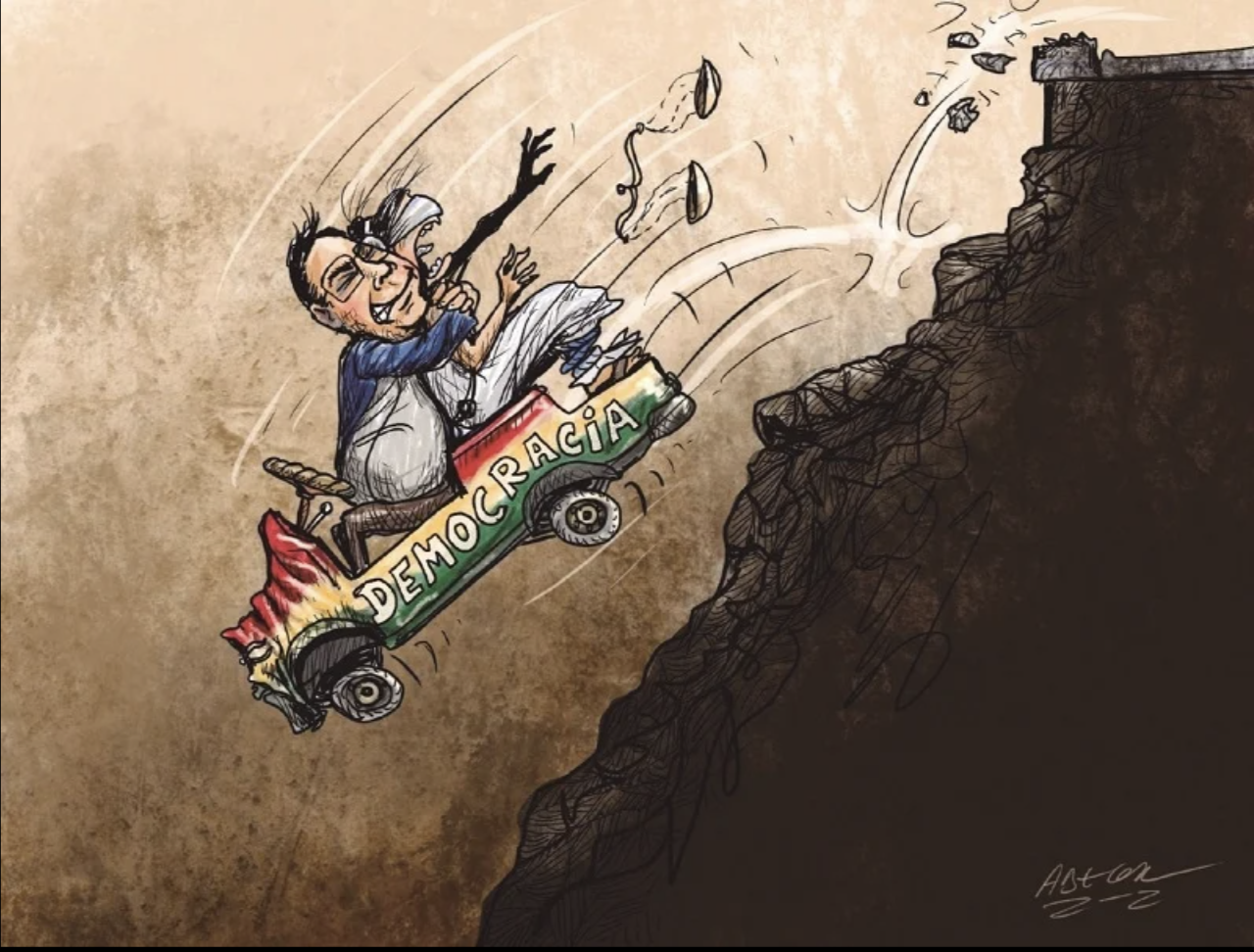
Parliament and the Judiciary obediently accept the decisions of the Executive, which means that they have not become autonomous institutions that fulfill their powers in favor of citizens. Formally, the Judiciary is elected by citizen vote, in reality the Legislative Branch – with a massist majority – did so without paying attention to meritocracy but only following its partisan interest. This means that this power is deinstitutionalized, even more so when we know that its rulings are made “à la carte”, according to the convenience of the Executive.
Years ago the members of the Constitutional Court accepted Morales’ re-nomination, in doing so they demonstrated that the Judiciary was under his control; Now by punishing Morales, preventing his candidacy, what they do is demonstrate that his decisions emanate, once again, from the Executive; That is the shame of a Judiciary that during the MAS governments has been and is servile to the Government.
When the power of the leader is absolute, be it the case of Morales or Arce, his followers – the judiciary – understand that the word of the leader is final, which is why they make the decisions to keep him in power.
Perdimos la Guerra del Pacífico porque Bolivia tenía un Estado débil que no poseía presencia en todo su territorio, con instituciones famélicas; en cambio Chile había desarrollado un Estado sólido con instituciones más eficientes que las que existían en Bolivia.
Buena parte de los estudiosos sobre la realidad boliviana afirman que en Bolivia nunca existió un Estado que posea instituciones desarrolladas y creíbles; casi al unísono lanzan la hipótesis que expresa que históricamente Bolivia tuvo más sociedad civil que Estado, por eso la institución más fuerte es la de la política en las calles.
Aquí, en consonancia con el neoinstitucionalismo, comprendemos a las instituciones como hábitos o costumbres a seguir, éstas pueden estar enmarcadas en leyes o solamente existir como conductas y costumbres sociales. Justamente por eso decimos que la política en las calles es la institución estelar del país, posee más fuerza e influencia que los poderes Judicial y Legislativo. Las masas en las calles saben cómo lanzar sus demandas y arrancarle al Estado sus reivindicaciones; es en las calles, más que en las urnas, donde se han volteado gobiernos.
En Bolivia la ciudadanía es débil, la tarea de edificar al ciudadano es incompleta, por eso es natural que la masa, protestando, marchando en las calles, bloqueando, crucificándose, o haciendo las huelgas de hambre “hasta las últimas consecuencias”, consiga sus reivindicaciones. Pero la masa que protesta es consciente de sus derechos y casi nunca de sus obligaciones. Las masas, en sus movilizaciones, tuvieron contenidos democráticos cuando marchaban contra las dictaduras militares, pero muchas veces se han movilizado con códigos conservadores, las masas que acompañaron al colgamiento de Villarroel estaban más cerca de las propuestas conservadoras de las oligarquías que de ideas avanzadas de democracia. Así sucede también con las masas cooptadas por el MAS que se mueven con códigos conservadores, arcaicos y autoritarios.
La Revolución de 1952 no condujo a la construcción de un sistema de partidos, no edificó los check and balances necesarios para cualquier democracia; aunque en 1956 hubo elecciones con voto universal por primera vez, éstas fueron más un escrutinio que elecciones; aunque ellas ya estaban ganadas con antelación por el MNR, paradójicamente éste hizo de todos modos fraude abierto, pues no había institucionalidad democrática, no existía la autoridad electoral como institución independiente.
Inclusive, durante la primera fase de la democracia pactada, la institución electoral era débil y totalmente dependiente del Ejecutivo, por eso se tuvo que dejar atrás a la Banda de los Cuatro y formar una Corte Nacional Electoral de notables, éstos le dieron autonomía a la autoridad electoral y comenzaron la edificación independiente de esa Institución; empero, durante el proceso de cambio, la institucionalidad del poder electoral se erosionó de tal manera que con los MAS de Morales y Arce, ese poder es otra vez un apéndice del Ejecutivo.
El Parlamento y el Poder Judicial aceptan con obsecuencia las decisiones del Ejecutivo, lo que quiere decir que no han llegado a ser instituciones autónomas que cumplan sus competencias a favor de la ciudadanía. Formalmente el Poder Judicial se elige por medio del voto ciudadano, en realidad lo hizo el Legislativo –de mayoría masista– sin hacer caso a la meritocracia sino solo siguiendo su interés partidario. Ello significa que ese poder está desinstitucionalizado, más aún cuando sabemos que sus fallos son hechos “a la carta”, según sea la conveniencia del del Ejecutivo.
Hace años los miembros del Tribunal Constitucional aceptaron la repostulación de Morales, al hacerlo demostraron que el Poder Judicial estaba bajo su control; ahora al castigar a Morales, impidiendo su candidatura, lo que hacen es demostrar que sus decisiones emanan, otra vez, del Ejecutivo; esa es la vergüenza de un Poder Judicial que durante los gobiernos del MAS ha sido y es servil al Gobierno.
Cuando el poder del caudillo es absoluto, sea el caso de Morales o de Arce, sus obsecuentes –el poder judicial– entienden que la palabra del caudillo es definitiva, por ello toman las decisiones para mantenerlo en el poder.
https://brujuladigital.net/opinion/carencia-de-institucionalidad

 Bolivian Thoughts | Pensamientos Bolivianos (Bilingual/Bilingüe)