
Breitbart:
Bolivia Disqualifies Socialist Wannabe Dictator Evo Morales from Presidential Race
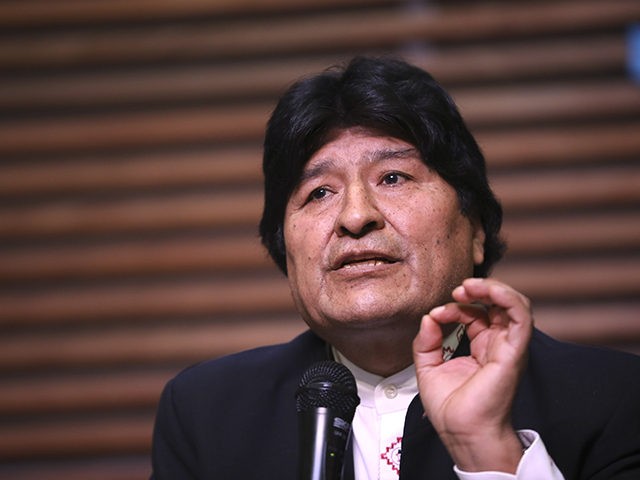
Socialist former President Evo Morales announced on Sunday he would continue to campaign for president of Bolivia despite the nation’s Constitutional Court stating he is term-limited from running.
Morales is campaigning for an unconstitutional fifth term in power; the election is scheduled to take place in 2025.
Morales, who ruled Bolivia from 2006 until his voluntary resignation 2019, claims that he is still eligible to run despite the Bolivian Constitutional Court (TCP) ruling on Friday that the concept of an indefinite presidential reelection “is not a human right.” The ruling overturned a prior finding from 2017, which Morales is believed to have forced the court to issue while president, that allowed Morales to run in the 2019 election unconstitutionally.
“Evo is still qualified, that is my interpretation, neither the State political commission nor the consultative opinion establishes any limitation for discontinuous reelection,” Morales claimed during his Sunday radio show Kawsachun Coca, speaking in the third person.
Morales stated that the court’s resolution was in response to an “injunction for freedom of expression” and not for the “authorization or disqualification” of a candidate.
“Evo is still qualified as a candidate for president, they will try, what else will they do, we must be attentive, but it is an intention to create confusion and susceptibility,” Morales continued.
In its Friday ruling, TCP established that a person may only serve as president and vice-president of Bolivia for a maximum of two terms, whether continuous or discontinuous, and that indefinite reelection is not a human right.
“The restriction to the possibility of indefinite repostulation is a suitable measure to ensure that a person does not perpetuate himself in power,” the court’s ruling reportedly read. The full ruling has not yet been published on the Bolivian Constitutional Court’s website at press time.
The ruling immediately shuts down Morales’ plans to run for president again in 2025 and occurs in the sidelines of a growing schism inside the ruling Movement Towards Socialism (MAS) party between Morales and current socialist President Luis Arce.
Morales condemned the ruling, denouncing it as a “black plan” carried out by Arce’s government to “eliminate” him and his party “politically and even physically.”
Article 168 of Bolivia’s constitution establishes a five-year duration for a presidential term, stating that a president and vice president may only be reelected for one continuous term.
Morales ruled Bolivia between 2006 and 2019 for four terms. Morales was able to bypass the nation’s presidential term limits through the courts.
The courts ruled that his first term, from 2006 to 2009, did not count towards term limits because Bolivia was “refounded” as a “plurinational state” at this time, instituting a new constitution. The legal move was similar to jurisprudence issued in Venezuela in favor of late socialist dictator Hugo Chávez.
During his “second” term, Morales called for a referendum in 2016 to amend the constitution by removing presidential term limits. Bolivian people voted against the measure and the referendum failed. Morales then forced the nation’s courts in 2017 to allow him to run again a fourth time under the premise that presidential term limits represented a “violation” of his human rights.
Morales, after being allowed to run again, held a fraudulent election in October 2019, leading to international condemnation, protests, and his voluntary resignation one month later. Morales fled to Mexico alongside his cabinet of ministers.
Jeanine Áñez, a conservative senator and at the time the second vice-president of the Bolivian Chamber of Senators, was sworn in as president as she was the highest-ranking person left in the line of succession who had not fled to Mexico.
Áñez chose not to be on the ballot in the 2020 election, which resulted in MAS’s return to power and the election of socialist Luis Arce, who is currently Bolivia’s current president.
The Bolivian government would go on to arrest Áñez in 2022 and sentence her to ten years in prison for having assumed the presidency. Áñez, the right-wing governor of Santa Cruz Luis Fernando Camacho, and six other conservatives stand accused of “plotting to depose” Morales, potentially facing 20-year prison sentences if found guilty.
Bolivia is not the only case in the region of a president bypassing constitutional term limits through court cases. In El Salvador, President Nayib Bukele will present himself for reelection in February despite the Salvadoran constitution explicitly prohibiting reelection — heavily penalizing “those who commit acts, proclamations or adhesions to promote or support the reelection or continuation of the President of the Republic, or use direct means to that end” with the complete loss of citizen rights.
Bukele is able to run for reelection next month thanks to a ruling issued by the Salvadoran courts in 2021, in which the justices — who were appointed by the pro-Bukele majority in Congress prior to the ruling — argued that a person may not run for president if they have “held the office of President of the Republic for more than six months, consecutive or not, during the immediately preceding period, or within the last six months prior to the beginning of the months prior to the beginning of the presidential term.”
Bukele, who stepped down on December 1 in order to comply with the ruling’s provisions, is slated to win in a landslide.
Christian K. Caruzo is a Venezuelan writer and documents life under socialism. You can follow him on Twitter here.
Bolivia descalifica al aspirante a dictador socialista Evo Morales de la carrera presidencial
El expresidente socialista Evo Morales anunció el domingo que continuaría haciendo campaña para la presidencia de Bolivia a pesar de que la Corte Constitucional del país declaró que su mandato está limitado para postularse.
Morales está haciendo campaña para un quinto mandato inconstitucional en el poder; las elecciones están previstas para 2025.
Morales, quien gobernó Bolivia desde 2006 hasta su renuncia voluntaria en 2019, afirma que todavía es elegible para postularse a pesar de que el Tribunal Constitucional de Bolivia (TCP) falló el viernes que el concepto de una reelección presidencial indefinida “no es un derecho humano”. El fallo anuló un fallo anterior de 2017, que se cree que Morales obligó al tribunal a emitir mientras era presidente, que le permitió a Morales presentarse a las elecciones de 2019 de manera inconstitucional.
“Evo sigue calificado, esa es mi interpretación, ni la comisión política del Estado ni el dictamen consultivo establecen limitación alguna para la reelección discontinua”, afirmó Morales durante su programa radial dominical Kawsachun Coca, hablando en tercera persona.
Morales afirmó que la resolución del tribunal fue en respuesta a un “amparo a la libertad de expresión” y no a la “autorización o inhabilitación” de un candidato.
“Evo sigue calificado como candidato a presidente, lo intentarán, qué más harán, hay que estar atentos, pero es una intención de crear confusión y susceptibilidad”, continuó Morales.
En su fallo del viernes, el TCP estableció que una persona sólo podrá ejercer como presidente y vicepresidente de Bolivia por un máximo de dos mandatos, sean continuos o discontinuos, y que la reelección indefinida no es un derecho humano.
“La restricción a la posibilidad de una repostulación indefinida es una medida adecuada para garantizar que una persona no se perpetúe en el poder”, según se informa, dice el fallo del tribunal. Al cierre de esta edición, el fallo completo aún no se ha publicado en el sitio web de la Corte Constitucional de Bolivia.
El fallo inmediatamente cierra los planes de Morales de postularse nuevamente para presidente en 2025 y ocurre al margen de un creciente cisma dentro del partido gobernante Movimiento Al Socialismo (MAS) entre Morales y el actual presidente socialista Luis Arce.
Morales condenó el fallo, denunciándolo como un “plan negro” llevado a cabo por el gobierno de Arce para “eliminarlo” a él y a su partido “política e incluso físicamente”.
El artículo 168 de la Constitución de Bolivia establece una duración de cinco años para el período presidencial, estableciendo que un presidente y un vicepresidente sólo podrán ser reelegidos por un período continuo.
Morales gobernó Bolivia entre 2006 y 2019 durante cuatro mandatos. Morales pudo eludir los límites del mandato presidencial del país a través de los tribunales.
Los tribunales dictaminaron que su primer mandato, de 2006 a 2009, no contaba para los límites de mandato porque Bolivia fue “refundada” como un “Estado plurinacional” en ese momento, instituyendo una nueva constitución. La medida legal fue similar a la jurisprudencia emitida en Venezuela a favor del fallecido dictador socialista Hugo Chávez.
Durante su “segundo” mandato, Morales convocó a un referéndum en 2016 para enmendar la constitución eliminando los límites del mandato presidencial. El pueblo boliviano votó en contra de la medida y el referéndum fracasó. Luego, Morales obligó a los tribunales del país en 2017 a permitirle postularse nuevamente por cuarta vez bajo la premisa de que los límites del mandato presidencial representaban una “violación” de sus derechos humanos.
Morales, después de que se le permitiera postularse nuevamente, celebró elecciones fraudulentas en octubre de 2019, lo que provocó la condena internacional, protestas y su renuncia voluntaria un mes después. Morales huyó a México junto con su gabinete de ministros.
Jeanine Áñez, senadora conservadora y en ese momento segunda vicepresidenta de la Cámara de Senadores de Bolivia, prestó juramento como presidenta por ser la persona de mayor rango en la línea sucesoria que no había huido a México.
Áñez optó por no estar en la boleta electoral de 2020, lo que resultó en el regreso del MAS al poder y la elección del socialista Luis Arce, quien actualmente es el actual presidente de Bolivia.
El gobierno boliviano pasaría a arrestar a Áñez en 2022 y la condenaría a diez años de prisión por haber asumido la presidencia. Áñez, el gobernador derechista de Santa Cruz, Luis Fernando Camacho, y otros seis conservadores están acusados de “conspirar para derrocar” a Morales, y podrían enfrentar sentencias de 20 años de prisión si son declarados culpables.
Bolivia no es el único caso en la región en el que un presidente elude los límites constitucionales de mandato a través de casos judiciales. En El Salvador, el presidente Nayib Bukele se presentará a la reelección en febrero a pesar de que la Constitución salvadoreña prohíbe explícitamente la reelección, penalizando severamente a “quienes cometan actos, proclamas o adhesiones para promover o apoyar la reelección o continuación del Presidente de la República, o utilicen medios directos para ese fin” con la pérdida total de los derechos ciudadanos.
Bukele puede postularse para la reelección el próximo mes gracias a un fallo emitido por los tribunales salvadoreños en 2021, en el que los magistrados —que fueron nombrados por la mayoría pro-Bukele en el Congreso antes del fallo— argumentaron que una persona no puede postularse para presidente si han “desempeñado el cargo de Presidente de la República por más de seis meses, consecutivos o no, durante el período inmediatamente anterior, o dentro de los últimos seis meses anteriores al inicio de los meses anteriores al inicio del período presidencial.”
Bukele, que dimitió el 1 de diciembre para cumplir con las disposiciones del fallo, está previsto que gane de forma aplastante.
Christian K. Caruzo es un escritor venezolano y documenta la vida bajo el socialismo. Puedes seguirlo en Twitter aquí.


 Bolivian Thoughts | Pensamientos Bolivianos (Bilingual/Bilingüe)