
Editorial, El Deber:
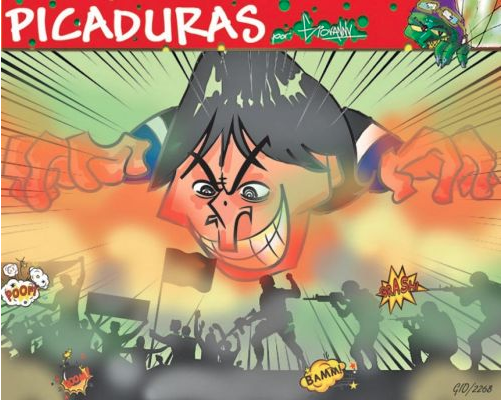
Today marks 20 years since the so-called Gas War, which began as such, but which began a new period for Bolivia. ‘Black October’ ended with 67 people dead, the overthrow of a president, more than 400 people injured and a new political agenda for Bolivia. Is the country better now than then?
Bolivia was swimming in a sea of gas in 2003. The projection was to export and for that wealth to fill the country’s coffers. The big obstacle was that the pipeline had to pass through Chile and that was the fuse that lit the gunpowder. Bolivia still had its maritime claim pending.
But the export of hydrocarbons was not the only reason for this social explosion; several factors had accumulated: the decomposition of politics, with parties that sealed agreements based on disagreements in the public sector; with unaddressed social demands, with an accumulated anger after the ‘tax’ that they had wanted to impose in February 2003 and that caused a confrontation between the military and the police.
Added to the above was a very delicate economic situation, with illiquidity in the public sector and very low citizen approval of President Gonzalo Sánchez de Lozada. All of this was met with the strengthening of an indigenous project of demands, based on the La Paz highlands, where the first clashes and the first victims occurred. The conflict escalated and ended with the resignation of Gonzalo Sánchez de Lozada before Congress.
Two decades after that, Bolivia is no longer swimming in a sea of gas; On the contrary, production falls until it hits rock bottom, as President Luis Arce himself said, and the country is no longer experiencing times of economic prosperity. The policy of agreements between many parties first led to the imposition of a single party, without the possibility of agreements, and ended in the fragmentation of the hegemonic party, triggering paralysis in Congress and the national economy.
The positive social inclusion of sectors that were not previously taken into account has weakened. The indigenous people have political participation, but now there is a kind of discrimination between those from the highlands and those from the lowlands; The rights to the territory of the latter are being violated through the taking over of spaces by oppressors and organized drug trafficking mafias that end up displacing them.
Added to this is the confrontation between Bolivians, which has been steadily fueled by the unions and the politicians of the Movement Towards Socialism, under the logic of “divide and conquer.” The possibilities of synergy and commonwealth seem distant when speeches that call for hatred prevail, such as the one mentioned by a Minister of State against the Government of Santa Cruz, or like those heard in the east of the country when all rural migrants are labeled as overwhelming.
During those 20 years, Bolivia lost the case before the International Court of Justice in which it demanded a sovereign exit to the sea. And relations with Chile continue to be broken, but are also colored by the fight against organized crime that operates on the border.
The events of ‘Black October’ left pain in Bolivia, but the actors with power did not have the capacity to generate resilience. The wounds have not yet healed and others have opened that must be healed.
Two decades later there is a request to renew the national political agenda. Bolivia is a country with infinite possibilities for development and community building. All that is needed is the will to dialogue, to build by adding differences, to have a country that learns from its mistakes and can look to the horizon with hope.
Hoy se cumplen 20 años de la denominada Guerra del Gas, que comenzó como tal, pero que dio inicio a un nuevo periodo para Bolivia. ‘Octubre negro’ acabó con 67 personas muertas, el derrocamiento de un presidente, más de 400 personas heridas y una nueva agenda política para Bolivia. ¿El país es mejor ahora que entonces?
Bolivia nadaba en un mar de gas en 2003. La proyección era exportar y que esa riqueza llene las arcas del país. El gran obstáculo era que el ducto debía pasar por Chile y esa fue la mecha que encendió la pólvora. Bolivia aún tenía pendiente la reivindicación marítima.
Pero la exportación de los hidrocarburos no era la única razón de esa explosión social, sino que se habían acumulado varios factores: la descomposición de la política, con partidos que sellaban acuerdos en base a pegas en el sector público; con reivindicaciones sociales no atendidas, con una bronca acumulada tras el ‘impuestazo’ que se había querido imponer en febrero de 2003 y que provocó un enfrentamiento entre militares y policías.
A lo anterior se sumaba una situación económica muy delicada, con iliquidez en el sector público y con una bajísima aprobación ciudadana del presidente Gonzalo Sánchez de Lozada. Todo eso se encontró con el fortalecimiento de un proyecto indigenista de reivindicaciones, asentado en el altiplano paceño, donde se produjeron los primeros choques y las primeras víctimas. El conflicto fue en ascenso y acabó con la renuncia de Gonzalo Sánchez de Lozada ante el Congreso.
Dos décadas después de aquello, Bolivia ya no nada en un mar de gas; al contrario, la producción cae hasta tocar fondo, como lo dijo el mismo presidente Luis Arce, y el país ya no vive los tiempos de bonanza económica. La política de acuerdos entre muchos partidos derivó primero en la imposición de un solo partido, sin posibilidad de acuerdos, y acabó en la fragmentación del partido hegemónico desencadenando una parálisis en el Congreso y en la economía nacional.
La positiva inclusión social de sectores que antes no fueron tomados en cuenta se ha debilitado. Los indígenas tienen participación política, pero ahora hay una suerte de discriminación entre los de tierras altas y los de tierras bajas; los derechos al territorio de los últimos están siendo vulnerados mediante la toma de espacios por parte de avasalladores y de mafias organizadas del narcotráfico que acaban desplazándolos.
A ello se suma la confrontación entre bolivianos, que ha sido sostenidamente alimentada desde los sindicatos y los políticos del Movimiento Al Socialismo, bajo la lógica del “divide y vencerás”. Las posibilidades de sinergia y de mancomunidad se ven distantes cuando prevalecen discursos que llaman al odio, como el mencionado por un ministro de Estado contra la Gobernación cruceña, o como los que se escuchan en el oriente del país cuando se tacha a todos los migrantes rurales como avasalladores.
Durante esos 20 años, Bolivia perdió el juicio ante el Tribunal de Justicia Internacional en el que reclamaba una salida al mar con soberanía. Y las relaciones con Chile continúan rotas, pero además están teñidas por la lucha contra el crimen organizado que opera en la frontera.
Los hechos de ‘Octubre Negro’ dejaron dolor en Bolivia, pero los actores con poder no tuvieron la capacidad de generar resiliencia. Las heridas aún no sanan y se abrieron otras que hay que curar.
Dos décadas después hay un pedido de renovar la agenda política nacional. Bolivia es un país con infinitas posibilidades de desarrollo y de construcción de mancomunidad. Solo hace falta la voluntad de dialogar, de construir sumando diferencias, para tener una patria que aprende de sus errores y puede mirar el horizonte con esperanza.
h

 Bolivian Thoughts | Pensamientos Bolivianos (Bilingual/Bilingüe)