
Manfredo Kempff, El Deber:
Now that we are approaching August 6, the date of the birth of the Republic, we start to think about whether the Plurinational State has achieved its objective of getting rid of it and we see that it is making very little progress in its purpose, because it is facing the patriotic sentiment of a nation, which, in almost 200 years of independent life, is Bolivian and fails to understand what the Movement for Socialism (MAS) wants to do, with that of burying the old Republic to impose a new native and culturally Andean State.
There is no doubt that the Republic, damaged and wronged, still stands. And it is clear that the attacks against it, no matter how much anger there is, have not gone beyond being symbolic. They have tried to impose the wiphala and their success has reached as far as the lowlands begins. In the plains, although it is stubborn that the garish wiphala is indicated in the Constitution as a symbol of the State next to the tricolor, it has not been accepted. Because? Simply because for many it means nothing, absolutely nothing. There have been no shortage of pilgrim suggestions to change even the lyrics of the national anthem, without much echo. And when Evo Morales spoke of modifying a stanza of the Santa Cruz anthem referring to “Great Spain”, since then we, Santa Cruz, have sung that stanza with greater conviction.
Building, almost mounted on top of the old republican palace, the Casa Grande del Pueblo, is already an irreversible fact. The Burned Palace is not very functional, certainly. But there was no reason to break with the harmony of a republican city like La Paz, raising a mass of cement on top of a historic house, which could well have been built, as an annex, outside Plaza Murillo. Making the Palacio Quemado a museum of a presumably dead past is another of the many symbolisms in which the masismo has insisted.
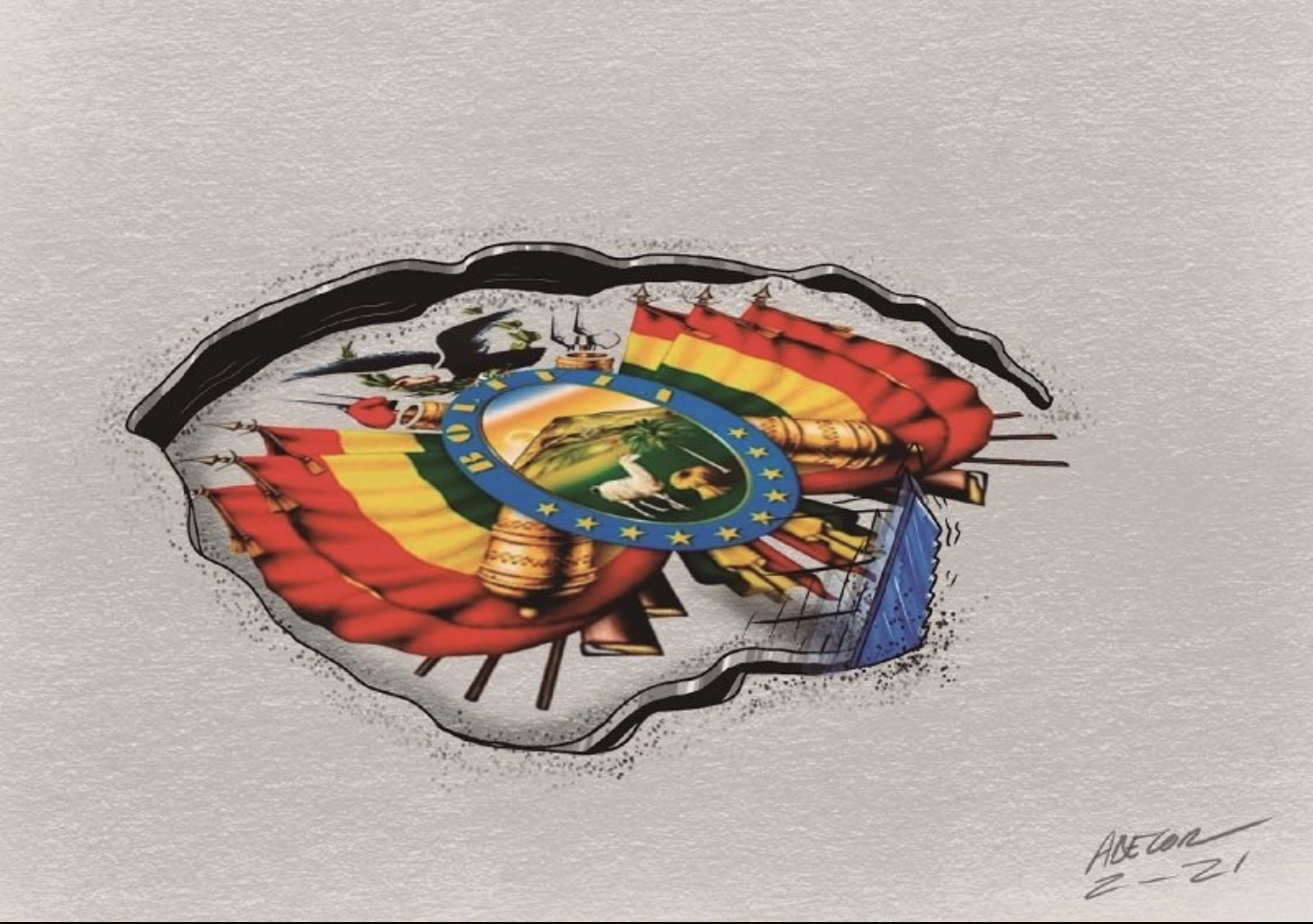
But, for example, we ask ourselves, what has happened to our coat of arms? In this case, not even reviewing the Constitution from top to bottom do we find the Chakana Cross as a national symbol. However, the republican shield is in the process of disappearing, because everything when the government of Arce Catacora is carried out, from its works to the offices of the ministers and the numerous official stationery, has that cross as its emblem, which, for many citizens, is an unknown.
Looking on the computer and in some press releases, we found that this Chakana Cross had Quechua origin and that it symbolizes the Inca culture, supposedly with a cosmic meaning, articulating the cosmos with humanity. Who knows who understands it. Its various colors represent the sun, the moon, the water, Mother Earth, and all the curious modernity that the masismo tries to impose on us and that they themselves don’t give a damn about.
The fact is that, very soon, just as the wiphala was removed from squares and streets in the east, the Chakana Cross suffered the same fate, at the moment when some departmental authorities dared to wear it at public events. The MAS has every right to print its cross on its party stationery, as political parties have always done and large and small companies do. These are advertising logos that you are authorized to use. But it cannot be tolerated that an unknown cross, which they now say is a symbol of the Inca culture, and that links humanity with the cosmos, appears instead of the national coat of arms. It is one more step, absolutely despicable, although innocuous, towards the destruction of republican history. What will the Armed Forces think?
What we citizens ask ourselves is why the masistas are so enthusiastic about the Bicentennial of the Republic, if they hate it so much. Because, just so you know, on August 6, 2025, two centuries of republican Bolivia are celebrated. We are not going to celebrate 16 or 17 years of the Plurinational State. They remember that every June 22. What are we up to then? Why does the MAS get excited about the celebration of the Bicentennial? Perhaps because the MAS knows that Bolivia is still republican and that, politically, it is not convenient for them to ignore a historical stage of the nation, whether it has been good or bad.
Bautista Saavedra presided, in Sucre, the Centennial of the Republic, in an environment of hostility, politically difficult. He did not have the brilliance that would have been desired, but he waved the tricolor and marked his seal with the imposing national emblem. Now it will be up to someone who tries to replace the Republic with something else, like Arce, to remember the 200 years since the creation of the Republic.
Isn’t that a contradiction? Will denatured wiphalas and chakana crosses appear in the House of Liberty? Will the Libertadores and the guerrillas of the “little republics” be honored as they should be? Or will it be only indigenous heroes who will appear as the most meritorious forgers of Independence?
Ahora que nos aproximamos al 6 de agosto, fecha del nacimiento de la República, nos ponemos a pensar si el Estado Plurinacional ha logrado su objetivo de deshacerse de ella y vemos que avanza muy poco en su propósito, porque se enfrenta al sentimiento patriótico de una nación, que, en casi 200 años de vida independiente, es boliviana y no llega a entender qué quiere hacer el Movimiento al Socialismo (MAS), con eso de sepultar a la vieja República para imponer un nuevo Estado originario y culturalmente andino.
Es indudable que la República, averiada y agraviada, sigue en pie. Y queda a la vista que las arremetidas en contra suya, por más rabia que exista, no han pasado de ser simbólicas. Se ha tratado de imponer la wiphala y su éxito ha llegado hasta donde empieza la llanura. En los llanos, aunque se porfíe en que la colorinche wiphala está señalada en la Constitución como símbolo del Estado al lado de la tricolor, no se la ha aceptado. ¿Por qué? Simplemente porque para muchos no significa nada, absolutamente nada. No han faltado sugerencias peregrinas para cambiar hasta la letra del himno nacional, sin mayor eco. Y cuando Evo Morales habló de modificar una estrofa del himno cruceño referido a la “España grandiosa”, desde entonces esa estrofa los cruceños la cantamos con mayor convicción.
Construir, casi montada encima del viejo palacio republicano, la Casa Grande del Pueblo, ya es un hecho irreversible. El Palacio Quemado es poco funcional, ciertamente. Pero no había por qué romper con la armonía de una ciudad republicana como La Paz, levantando una mole de cemento sobre una casa histórica, que bien pudo hacerse, como un anexo, fuera de la plaza Murillo. Hacer del Palacio Quemado un museo de un pasado presuntamente muerto, es otro de los tantos simbolismos en que se ha empeñado el masismo.
Pero, por ejemplo, nos preguntamos, ¿qué ha sucedido con nuestro escudo de armas? En este caso, ni revisando la Constitución de arriba a abajo encontramos la Cruz Chakana como un símbolo nacional. Sin embargo, el escudo republicano está en vías de desaparecer, porque todo cuando realiza el Gobierno de Arce Catacora, desde sus obras hasta los despachos de los ministros y la cuantiosa papelería oficial, tiene como emblema esa cruz, que, para muchos ciudadanos, es una incógnita.
Buscando en la computadora y en algunas notas de prensa, nos encontramos con que esta Cruz Chakana había tenido origen quechua y que simboliza la cultura incaica, dizque con sentido cósmico, articulando el cosmos con la humanidad. Vaya a saber quién lo entiende. Sus diversos colores representan el sol, la luna, el agua, la madre tierra, y toda la curiosa modernidad que el masismo trata de imponernos y que a ellos mismos les importa un sorete.
El hecho es que, muy pronto, así como a la wiphala se la quita de plazas y calles del oriente, la tal Cruz Chakana corra la misma suerte, en el momento en que algunas autoridades departamentales se atrevan a lucirla en actos públicos. El MAS tiene todo el derecho de imprimir su cruz en su papelería partidaria, como siempre lo han hecho los partidos políticos y lo hacen las empresas grandes y pequeñas. Se trata de logos publicitarios que está autorizado utilizar. Mas no se puede tolerar que una cruz desconocida, que ahora dicen que es símbolo de la cultura incaica, y que enlaza la humanidad con el cosmos, aparezca en lugar del escudo nacional. Es un paso más, absolutamente despreciable, aunque inocuo, hacia la destrucción de la historia republicana. ¿Qué opinarán las Fuerzas Armadas?
Lo que los ciudadanos nos preguntamos es por qué los masistas están tan entusiasmados con el Bicentenario de la República, si la detestan tanto. Porque, para que sepan, el 6 de agosto de 2025 se celebran dos siglos de la Bolivia republicana. No vamos a celebrar los 16 o 17 años del Estado Plurinacional. Eso lo rememoran ellos cada 22 de junio. ¿En qué estamos entonces? ¿Por qué el MAS se enardece entusiasmado con la celebración del Bicentenario? Tal vez porque el MAS sabe que Bolivia sigue siendo republicana y que, políticamente, no le conviene ignorar una etapa histórica de la nación, haya sido esta buena o mala.
Bautista Saavedra presidió, en Sucre, el Centenario de la República, en un ambiente de hostilidad, políticamente difícil. No tuvo la brillantez que se hubiera deseado, pero flameó la tricolor y marcó su sello el imponente escudo nacional. Ahora le corresponderá recordar los 200 años de la creación de la República a alguien que intenta reemplazar la República por otra cosa, como es Arce.
¿No es una contradicción? ¿Aparecerán desnaturalizadas wiphalas y cruces chakanas en la Casa de la Libertad? ¿Se honrará a los Libertadores y a los guerrilleros de las “republiquetas” como se debe? ¿O serán solo héroes indígenas quienes aparecerán como los más meritorios forjadores de la Independencia?
h

 Bolivian Thoughts | Pensamientos Bolivianos (Bilingual/Bilingüe)