
Tatiana Sanabria reports for Pagina Siete:
Bolivia has insects for export
ALTERNATIVE. Experts explain that the country possesses the natural wealth to export, but we lack, for example, management plans, which require time and money.
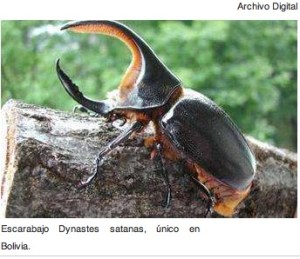 Bolivia is conspicuous by its biodiversity. Situated between the 15 countries with greater diversity on the planet, it meets all the potential for exporting a variety of insects in a sustainable way. However, before removing them to the foreign market legally, we need to meet certain conditions that may require effort, time and money.
“Bolivia has great potential and possibility for any kind of sustainable export of natural resources, but there are different aspects to be taken into account for thinking about this alternative to become a reality,” says Eduardo Forno, biologist and director of Conservation International.
For example, the country has about 3,500 species of butterflies and moths. This number puts us in fourth place of countries with the largest number of these insects.
As for beetles, there are an estimated 1,400 species of long antennae, 220 of tero tero, and 105 of Tiger beetles, to name a few.
These two species of invertebrates are the most attractive for foreign market and, therefore, they are considered more at the time of the capture, explains Dedy González, head of the General Directorate of Biodiversity (DGB).
“The potential (for export) is great, because there are endemic species, large and beautiful colors that are prized by Asian, European and North American collectors,” says naturalist Fernando Guerra, researcher of the Bolivian Technical University and the Bolivian collection of fauna.
Although, and par excellence, the most biodiversity-rich ecoregion is the Yungas, high plateau and Amazonian territories also have “exquisite” species for foreign buyers.
In general the more demanded are the exotic butterflies, the Prepona garleppiana, Prepona xenagoras, Pseudopieris nehenia, Morpho godarti and Agrias amydon boliviensis, which we can offer between $85 and $3,500 each.
As for unique specimens such as Dynastes Satan or ‘rompefocos’, an exclusive beetle of the town of Coroico, in La Paz, some collectors can pay up to $375.
Other species, however, are offered on web sites from 50 cents. The more extravagant is the insect, the higher its price.
Each species reaches a differentiated market. Beetles that go to Asia are usually kept as pets or used in handicraft. Butterflies, on the other hand, are intended for display in the largest and most famous museums for tourist purposes. If they die, are kept as samples.
Requirements
But what prevents the legal export of insects? In the legal field, the Decree 22641 of the general and indefinitely prohibition, bans harassment, gathering and packaging of wild animals under sanctions that contemplate the forfeiture and penalties established in the Penal Code.
In addition, “the Ministry of environment and water in 1996 adopted by ministerial resolution, the official guidelines for management plans under which the sustainable harvesting of any kind would be”, says Gonzalez.
The marketing of species without a management plan which specify the ownership of the land where is the resource, achievement levels without affecting the conservation of the species, infrastructure conditions, the percentages of crop, the potential buyer and how will the equitable distribution of benefits is prohibited.
Forno considered to carry out a management plan for insects “it is very complicated and demand a very high cost.” However, it considers that, it, could opt for two pathways to a sustainable export.
The first is to enable farms to control the reproduction, growth and feeding of the species and the second is to apply the technique of ‘rancheo’, which consists of keeping players in nature, extracting only the eggs to raise them, and after his birth return a portion to the wild.
In this regard, Guerra explained that in 2004 the Nayriri Butterfly House, in El Chairo, was built to export insect with a management plan approved by the DGB, which would benefit the Yungas communities and would be a response to the rising foreign market demand. However, it had to close for lack of budget.
Outside this project in Bolivia there another authorized public or private initiative to export invertebrates.
Gonzalez added that while there is a market for collectors, there are activities that are fast and cost-effective. “Is not the same go to the mine and take gold in a day, than to raise a butterfly in their biological cycle and then out on sale”, he says.
Another aspect to consider, explains Forno, is the way to reach markets. If you want to send butterflies halfway through their stage of growth, it will have to be considered the conditions of the journey: time of flight, weather, the container to prevent its death, and also ensure customs authorization in the shortest possible time.
If they could meet all legal requirements and other conditions are overcome, nature could generate new revenue that could benefit, mainly, communities.
http://www.paginasiete.bo/2012-12-09/Gente/NoticiaPrincipal/24-25Gen00309-12-12-P720121209.aspx
It was argued for many decades that sustainable development of our population who live in these areas could be attained. However, red tape, bad politics and at times incompetence have produced zero results. Thus, deforestation takes over to plant rice, corn and even coca, in eco-regions where they cannot be sustainable.
I recall two activities: the vicuña fiber, there are hundreds of kilo of the high-value fiber that cannot be sold due to red tape. The other is the paraba eggs, a bird saves only one out of the two or three it has, and throws the rest. Well, each egg is priced at $50K in European zoos, but again, due to cumbersome red tape and the slow and inept bureaucracy, of those who provide the laws, regulation and control… our indigenous communities are forced to accept illegal crops in their lands…

 Bolivian Thoughts | Pensamientos Bolivianos (Bilingual/Bilingüe)