
Pagina Siete reports a survey made to 800 individuals in main Bolivian cities (Santa Cruz, La Paz, El Alto, Cochabamba); survey was done by Captura Consulting, it reflects Bolivian society views with regard to the TIPNIS conflict.
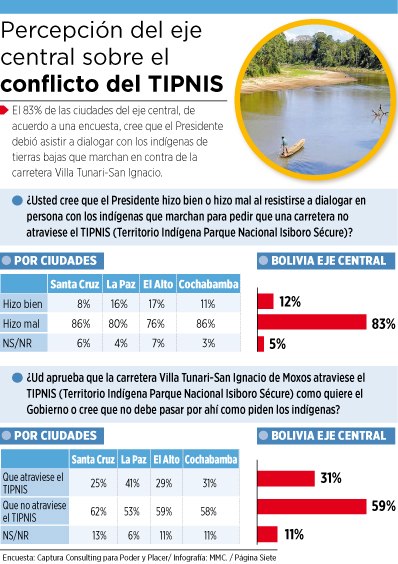 The first question asks: “Do you believe the president did right or wrong by resisting to dialogue in person with the indigenous people who march to ask that a road does nor cross the TIPNIS?”
83% responded he did wrong, only 12% believe he did right (mainly in La Paz department where La Paz and El Alto cities are located).
The second question asked “Do you approve that the road Villa Tunari-San Ignacion de Moxos crosses the TIPNIS as the government wants or do you believe it should not pass by there as the indigenous request?”
59% people said the road should not cross the TIPNIS. 31% agree the road should cross the TIPNIS. 11% does not know, does not respond.
This survey had a reliability of 95% and took place between August 26-28. Santa Cruz rejects the road to cross TIPNIS by 62% and La Paz city supports the road to cross by 41%.
http://www.paginasiete.bo/2011-09-06/Nacional/Destacados/4Esp00106.aspx
The government is now trying to enforce a public consultation, where coca growers and settlers will be asked about the construction of the road, in an attempt to outnumber and minimize the rights of the indigenous people of the TIPNIS.
During the Republic, there was differences between the status and rights of campesino/farmer, settler and indigenous (originary) people. Under the new Constitution that this government put in place, they all fall under one category… so, many of the non-indigenous people, who happen to be mostly highlanders, are now “questioning” why so few indigenous from the lowlands happen to have such large extension of territory. That is why settlers from Yucumo are blocking the road where the marching group intends to pass; that is why some cocalero groups are so interested in more land to deforest and plant coca.
I hope this government realizes that TIPNIS people as recognized by the Constitution are left to decide how best or worse they intend to handle their development. For better or worse, they were recognized as a nation and should get the respect they deserve.
Most Bolivians do want roads, but in this case not to cut in half someone else’s territory. The road will exist but by passing along the border of the TIPNIS. Does that, mean it will cost more? of course but as environmental economists say “let us internalize the externalities,” assume the real cost of development and save the environment for people 100 years from now. Let them decide then , not now.

 Bolivian Thoughts | Pensamientos Bolivianos (Bilingual/Bilingüe)