By Erbo:
Fitch Questions Sustainability of Bolivia’s Reserve Accumulation
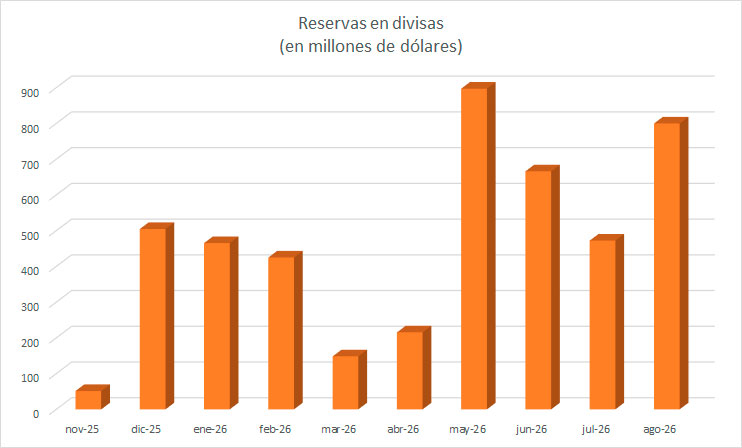
Foreign-currency holdings within Bolivia’s International Reserves during the Paz administration. (August data as of the 14th.)
Fitch Ratings has raised concerns about Bolivia’s ability to sustain the accumulation of International Reserves, despite the recent easing of the exchange-rate regime and the agreement reached with the International Monetary Fund (IMF).
Fitch noted that foreign-currency reserves, excluding gold, fell to $472 million at the end of July from $897 million at the end of May, despite the issuance of a $1 billion sovereign bond during the same month.
Reserves in foreign currency later recovered to around $800 million as of August 14. However, Fitch said it remains unclear whether this increase marks the beginning of a sustained accumulation trend.
The agency pointed out that reports of fuel shortages persist, which could be masking an underlying source of foreign-currency demand. It also noted that the Central Bank of Bolivia (BCB) authorized interventions to curb excessive volatility in the U.S. dollar exchange rate.
Fitch warned that persistently low liquid reserves would limit the BCB’s ability to manage exchange-rate volatility under the new regime and would reduce the resources available to service external debt.
In the short term, the agency said reserves could rise due to IMF disbursements and the potential to unlock additional financing from other multilateral institutions. However, Fitch emphasized that neither the amounts nor the timing of those disbursements are yet known with certainty.
The agency also observed that the financing program requires approval by the Legislative Assembly, amid political tensions following the recent censure of the Minister of Economy.
Fitch argued that sustained reserve accumulation will depend on broader economic policy adjustments that complement the new exchange-rate regime.
Fiscal adjustment is, in the agency’s view, the most important factor, although prospects remain uncertain. As context, Fitch noted that the government of Rodrigo Paz set a 2026 budget aimed at reducing the fiscal deficit to 9% of GDP, down from the 10.3% reported in 2025.
Fitch concluded that, beyond the resources that may arrive through the IMF, rebuilding International Reserves—supported by progress in macroeconomic adjustments—will be a key factor in any future improvement of Bolivia’s sovereign credit rating.
Por Erbol:
Fitch expresa sus dudas sobre la sostenibilidad de la acumulación de Reservas de Bolivia
Las divisas de las Reservas Internacionales durante el Gobierno de Paz. (Agosto es con datos al 14).
La agencia Fitch Ratings expresó sus observaciones sobre la capacidad de Bolivia para sostener un proceso de acumulación de Reservas Internacionales, pese a la reciente flexibilización del régimen cambiario y al acuerdo alcanzado con el Fondo Monetario Internacional (FMI).
Fitch destacó que las Reservas en moneda extranjera, excluido el oro, cayeron a 472 millones de dólares a finales de julio, desde los 897 millones registrados a finales de mayo, pese a la emisión de un bono soberano por 1.000 millones de dólares ese mismo mes.
Las reservas en divisas se recuperaron posteriormente hasta unos 800 millones de dólares al 14 de agosto. Sin embargo, Fitch considera que todavía no está claro si este aumento constituye el comienzo de una acumulación sostenida.
La agencia contextualizó que persisten reportes sobre escasez de combustibles, lo que podría estar ocultando una fuente de demanda de divisas. Asimismo, señaló que el Banco Central de Bolivia (BCB) autorizó intervenciones para contener una volatilidad excesiva del dólar.
Fitch alertó que unas reservas líquidas persistentemente bajas limitarían la capacidad del BCB para gestionar la volatilidad cambiaria bajo el nuevo régimen y reducirían los recursos disponibles para atender el servicio de la deuda externa.
En el corto plazo, preció que las Reservas podrían aumentar por los desembolsos del FMI y el efecto de gatillar mayor financiamiento de otros organismos multilaterales. No obstante, Fitch señaló que todavía no se conocen con precisión el monto ni el calendario de esos desembolsos.
Asimismo, observó que el programa de financiamiento requiere la aprobación de la Asamblea, en un contexto de tensión política en el que el ministro de Economía fue recientemente censurado.
Fitch sostuvo que una acumulación sostenida de reservas dependerá de ajustes más amplios de política económica que complementen el nuevo régimen cambiario.
El ajuste fiscal constituye, a juicio de la agencia, el elemento más importante, aunque sus perspectivas siguen siendo inciertas. Como contexto señaló que el Gobierno de Rodrigo Paz estableció para 2026 un presupuesto que contempla reducir el déficit fiscal al 9% del PIB, desde un 10,3% reportado en 2025.
Fitch concluyó que, más allá de los recursos que lleguen mediante el FMI, la reconstrucción de las Reservas Internacionales, respaldada por avances en los ajustes macroeconómicos, será un factor clave para cualquier eventual mejora de la calificación soberana de Bolivia.


Leave a Reply