Editorial Pensamientos Bolivianos:
La Ley 1720 y el retorno del chantaje político en Bolivia
La controversia alrededor de la Ley 1720 está dejando al descubierto uno de los problemas más profundos de Bolivia: la enorme dificultad para impulsar reformas económicas incluso cuando buscan beneficiar a pequeños productores rurales que necesitan salir de la pobreza.
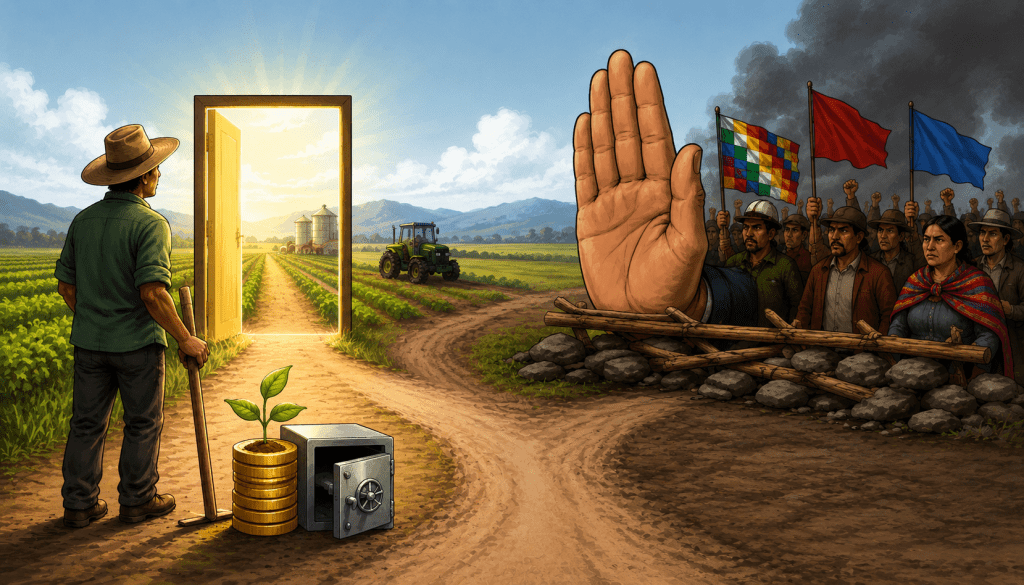
La ley impulsada por el gobierno de Rodrigo Paz pretendía permitir que pequeños agricultores pudieran convertir voluntariamente sus parcelas en medianas propiedades para acceder al sistema financiero formal. La lógica detrás de la norma era sencilla: sin garantías reales, miles de pequeños productores quedan atrapados fuera del crédito bancario, sin posibilidades de mecanizarse, invertir, ampliar producción o competir en mejores condiciones.
Ese es precisamente el drama silencioso del agro boliviano. Muchísimos pequeños agricultores sobreviven con baja productividad no porque no quieran crecer, sino porque el sistema legal y financiero prácticamente los condena a trabajar sin capital. En ese contexto, la Ley 1720 buscaba abrir una puerta para que productores rurales pudieran usar sus tierras como respaldo financiero y mejorar sus condiciones económicas.
Por eso el sector agropecuario cruceño respaldó la propuesta. No solamente por interés empresarial, sino porque el acceso al crédito sigue siendo una de las mayores barreras para modernizar el campo boliviano.
Sin embargo, el debate rápidamente dejó de ser técnico o económico y pasó a convertirse en una batalla política.
La marcha indígena y campesina desde el norte amazónico hacia La Paz fue presentada como una defensa de la tierra y los territorios comunitarios. Existen preocupaciones legítimas sobre posibles abusos o concentración futura de tierras que merecen discutirse seriamente. Pero el conflicto también dejó ver cómo ciertos sectores políticos y sindicales aprovecharon el miedo histórico alrededor de la propiedad agraria para convertir la ley en un símbolo de confrontación nacional.
El discurso sobre “latifundios”, “privatización” y “entrega de tierras” comenzó a desplazar completamente la discusión sobre productividad, pobreza rural y acceso al crédito.
Y allí apareció nuevamente el peso del masismo y de las estructuras corporativas construidas durante casi veinte años. Organizaciones sindicales, dirigentes campesinos y grupos políticamente alineados con el MAS entendieron rápidamente que la Ley 1720 podía transformarse en una herramienta para debilitar al gobierno de Rodrigo Paz y demostrar que cualquier intento de reforma puede ser frenado mediante presión callejera.
Ese es el verdadero peligro que hoy enfrenta Bolivia.
Si toda reforma económica termina convertida automáticamente en una crisis política, el país seguirá paralizado entre miedo ideológico, presión corporativa y cálculos electorales.
El propio gobierno contribuyó a agravar el problema. Rodrigo Paz impulsó una ley estructural sin construir previamente suficiente respaldo político y social fuera del sector productivo. La explicación pública de la norma fue débil y tardía. Eso permitió que otros actores llenaran rápidamente el vacío con campañas emocionales y mensajes alarmistas.
Ahora el Congreso debate revisar, modificar o incluso abrogar la ley. Todavía no existe una decisión definitiva, pero la sola posibilidad ya envía señales preocupantes.
Si el gobierno retrocede completamente, quedará instalado el mensaje de que cualquier grupo organizado puede bloquear reformas mediante movilización política. Y peor aún: miles de pequeños productores rurales volverán a quedar atrapados en el mismo sistema que les niega acceso real al crédito y limita sus posibilidades de crecimiento.
También llama la atención la reacción ambigua de otros líderes opositores. Jorge Tuto Quiroga y Samuel Doria Medina evitaron asumir una defensa clara de la ley o abrir un debate más serio sobre cómo modernizar el agro sin afectar derechos comunitarios. Otra vez predominó la cautela electoral sobre la discusión de fondo.
La Ley 1720 probablemente necesitaba ajustes, mayor debate técnico y mejores garantías para evitar abusos. Pero Bolivia corre el riesgo de repetir un patrón demasiado conocido: bloquear una reforma antes siquiera de intentar perfeccionarla.
Y mientras políticos, sindicatos y organizaciones convierten el tema en otra batalla de poder, quienes siguen esperando soluciones reales son los pequeños agricultores que necesitan crédito, inversión y productividad para competir y dejar atrás la pobreza rural.
Editorial, Bolivian Thoughts:
Law 1720 and the Return of Political Blackmail in Bolivia
The controversy surrounding Law 1720 is exposing one of Bolivia’s deepest problems: the enormous difficulty of advancing economic reforms even when they are intended to benefit small rural producers trying to escape poverty.
The law promoted by Rodrigo Paz’s government sought to allow small farmers to voluntarily convert their plots into medium-sized properties in order to gain access to the formal financial system. The logic behind the measure was simple: without real collateral, thousands of small producers remain locked out of bank credit, unable to mechanize, invest, expand production, or compete under better conditions.
That is precisely the silent tragedy of Bolivian agriculture. Many small farmers survive with low productivity not because they lack ambition, but because the legal and financial system practically condemns them to operate without capital. In that context, Law 1720 aimed to open a path for rural producers to use their land as financial backing and improve their economic conditions.
That is why Santa Cruz’s agricultural sector supported the proposal. Not only out of business interests, but because access to credit remains one of the greatest barriers to modernizing Bolivia’s countryside.
However, the debate quickly stopped being technical or economic and turned into a political battle.
The indigenous and peasant march from the northern Amazon region toward La Paz was presented as a defense of land rights and communal territories. Legitimate concerns do exist regarding potential abuses or future land concentration, and those concerns deserve serious discussion. But the conflict also revealed how certain political and union sectors exploited Bolivia’s historical fears surrounding land ownership to transform the law into a symbol of national confrontation.
The rhetoric about “latifundios,” “privatization,” and “land giveaways” quickly displaced any serious discussion about productivity, rural poverty, and access to credit.
And once again, the influence of MAS and the corporate political structures built during nearly twenty years of its rule became visible. Union organizations, peasant leaders, and groups politically aligned with MAS quickly understood that Law 1720 could become a tool to weaken Rodrigo Paz’s government and demonstrate that any reform effort can be stopped through street pressure.
That is the real danger Bolivia faces today.
If every economic reform automatically turns into a political crisis, the country will remain trapped between ideological fear, corporate pressure, and short-term electoral calculations.
The government itself contributed to worsening the situation. Rodrigo Paz pushed forward a structural reform without first building enough political and social support beyond the productive sector. The public explanation of the law was weak and delayed. That allowed other actors to quickly fill the vacuum with emotional campaigns and alarmist messaging.
Now Congress is debating whether to revise, modify, or even repeal the law. No final decision has been made yet, but the mere possibility already sends troubling signals.
If the government fully retreats, it will reinforce the idea that any organized group can block reforms through political mobilization. Even worse, thousands of small rural producers could once again remain trapped in the same system that denies them real access to credit and limits their opportunities for growth.
The ambiguous reaction of other opposition leaders has also been revealing. Jorge “Tuto” Quiroga and Samuel Doria Medina avoided taking a clear position in defense of the law or opening a more serious debate about how to modernize agriculture without undermining communal rights. Once again, electoral caution prevailed over substantive discussion.
Law 1720 may indeed require adjustments, broader technical debate, and stronger safeguards against abuse. But Bolivia risks repeating a pattern it knows too well: blocking a reform before even attempting to improve it.
And while politicians, unions, and activist organizations turn the issue into yet another power struggle, the people still waiting for real solutions are the small farmers who need credit, investment, and productivity in order to compete and escape rural poverty.


Leave a comment