
By Erbol:
URGENT NEED FOR A POLITICAL AGREEMENT
Experts warn that difficult months are coming in economic and energy terms
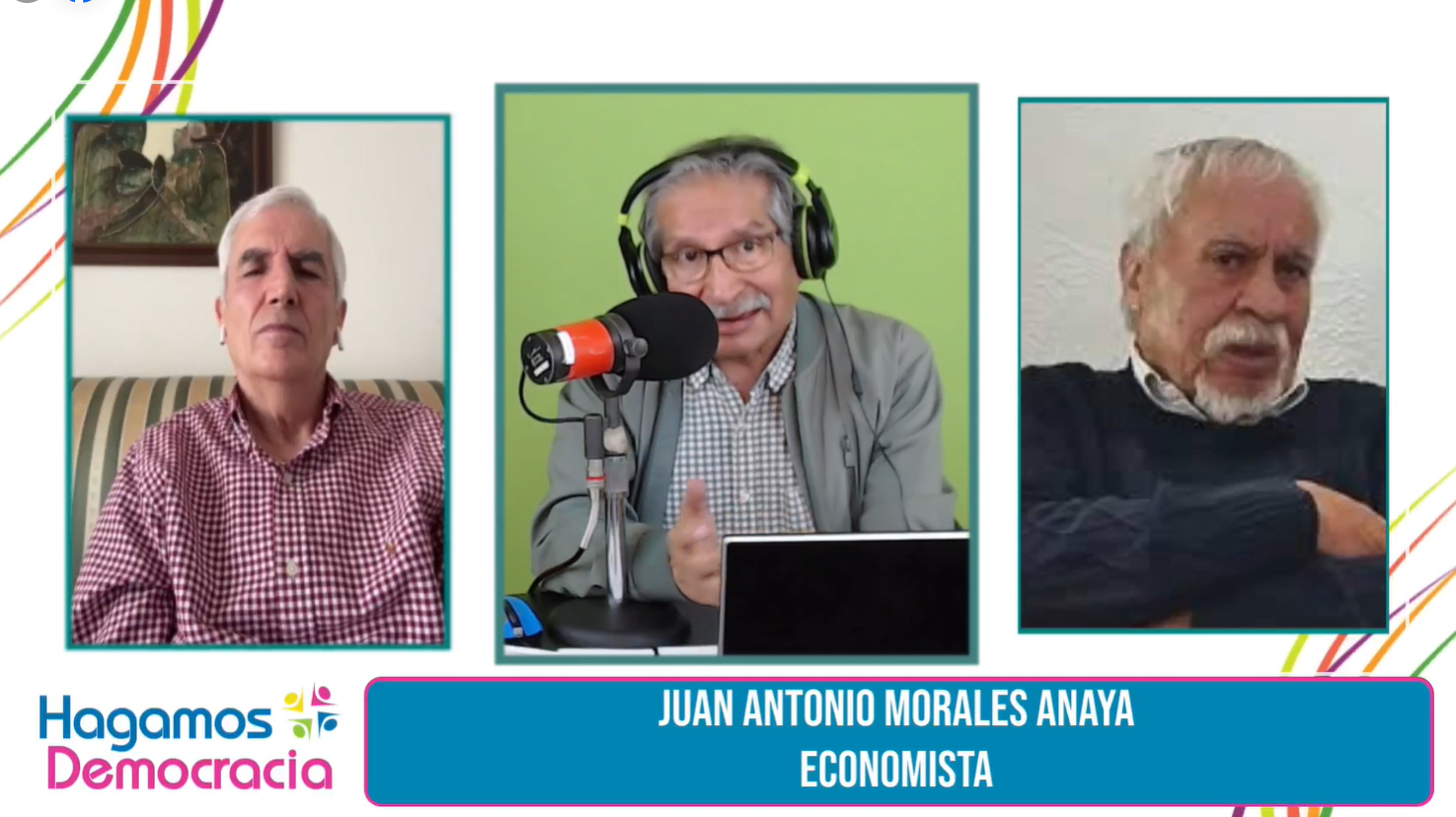
Panel of Hagamos Democracia this Sunday. Photo/screenshot
Two specialists in economics and energy warned this Sunday that Bolivia could face complex months in economic and energy matters due to the shortage of foreign currency and the lack of investment in the hydrocarbons sector, a situation that could even lead to electricity supply problems if urgent measures are not adopted.
The former president of the Central Bank of Bolivia, Juan Antonio Morales, and former senator and oil expert Fernando Rodríguez Calvo participated in the program Hagamos Democracia on the Erbol network, where they agreed on the need to reach political agreements to promote reforms that would attract foreign investment and stabilize the economy.
Morales warned that the country faces a complicated scenario that requires coordination among the different political and economic actors.
“Difficult months are coming that require great cooperation from all political and economic agents,” he said.
The economist noted that several government programs coincide on key proposals to face the crisis. He mentioned, for example, that the proposals of Samuel Doria Medina and Jorge Tuto Quiroga show similarities, and that President Rodrigo Paz would have largely adopted Doria Medina’s economic program.
In that context, he considered that there are conditions to achieve agreements in the Plurinational Legislative Assembly, since among the main proposals there is agreement on the need to apply an exchange rate unification, a measure he described as “absolutely essential.”
He also raised the need to overcome the current “dollar corralito,” allowing the population to recover their deposits in foreign currency or access foreign exchange through credit cards.
To achieve this, he argued, it would be necessary to move toward an agreement with the International Monetary Fund, carefully evaluating its conditions.
“The Monetary Fund is also a key to unlocking resources from the Inter-American Development Bank and other international financial institutions,” he explained.
Morales added that one of the structural changes that should be discussed is the modification of the Political Constitution of the State, which—he said—would be possible if political forces reach consensus in Parliament.
Energy risk
For his part, Rodríguez Calvo said that the debate should not focus on the strength or weakness of the government, but rather on the need to adopt decisions with a country-wide vision.
“What is needed is for our rulers to be statesmen,” he said.
The analyst emphasized that laws must be conceived for the future of the country and not to benefit a particular government or political party.
“When a law is approved, legislation is not made for a ruler but for the country. That is why those who have reached Parliament must set aside pettiness, sectarianism and even personal egos,” he said.
Rodríguez urged both the ruling party and the opposition to assume responsibility for the moment the country is experiencing.
“The moment is critical and, if we do not unite among all of us, we will not move the country forward,” he warned.
The specialist also announced that on Tuesday he will present a proposal to draft a new Hydrocarbons Law aimed at generating more attractive conditions for international investment.
Among the urgent measures, he mentioned the need to resume strategic energy projects such as the Carrizal hydroelectric development, whose final design—he said—has already been completed.
Rodríguez explained that this type of project would allow reducing gas consumption in electricity generation and extending available reserves.
“We need dams to free up gas and stretch its use for as long as possible. We do not want to live the reality of countries where they no longer talk about blackouts but about ‘light-ups,’” he said.
Finally, he insisted on the need to reach a major national agreement that would allow reform of current regulations and the approval of sectoral laws that facilitate the arrival of investments in the energy sector.
“Any law that is drafted must be transparent and attract the major oil companies,” he concluded.
Por Erbol:
URGEN UN ACUERDO POLÍTICO
Expertos advierten que se vienen meses difíciles en lo económico y energético
Panel de Hagamos Democracia de este domingo. Foto/captura
Dos especialistas en economía y energía advirtieron este domingo que Bolivia podría enfrentar meses complejos en materia económica y energética, debido a la escasez de divisas y la falta de inversiones en el sector hidrocarburífero, situación que podría derivar incluso en problemas de abastecimiento eléctrico si no se adoptan medidas urgentes.
El expresidente del Banco Central de Bolivia, Juan Antonio Morales, y el exsenador y experto petrolero Fernando Rodríguez Calvo participaron en el programa Hagamos Democracia de la red Erbol, donde coincidieron en la necesidad de alcanzar acuerdos políticos para impulsar reformas que permitan atraer inversión extranjera y estabilizar la economía.
Morales advirtió que el país enfrenta un escenario complicado que exige coordinación entre los distintos actores políticos y económicos.
“Se nos vienen meses difíciles que exigen una gran cooperación de todos los agentes políticos y económicos”, afirmó.
El economista señaló que varios programas de gobierno coinciden en propuestas clave para enfrentar la crisis. Mencionó, por ejemplo, que los planteamientos de Samuel Doria Medina y Jorge Tuto Quiroga presentan similitudes, y que el presidente Rodrigo Paz habría adoptado en gran parte el programa económico de Doria Medina.
En ese contexto, consideró que existen condiciones para lograr acuerdos en la Asamblea Legislativa Plurinacional, ya que entre las principales propuestas coinciden en la necesidad de aplicar una unificación cambiaria, medida que calificó como “absolutamente imprescindible”.
También planteó la necesidad de superar el actual “corralito de dólares”, permitiendo a la población recuperar sus depósitos en moneda extranjera o acceder a divisas mediante tarjetas de crédito.
Para ello, sostuvo que sería necesario avanzar hacia un acuerdo con el Fondo Monetario Internacional, evaluando cuidadosamente sus condiciones.
“El Fondo Monetario también es una llave para que se liberen recursos del Banco Interamericano de Desarrollo y de otras instituciones financieras internacionales”, explicó.
Morales agregó que uno de los cambios estructurales que debería discutirse es la modificación de la Constitución Política del Estado, lo que —dijo— sería posible si las fuerzas políticas logran consensos en el Parlamento.
Riesgo energético
Por su parte, Rodríguez Calvo afirmó que el debate no debe centrarse en la fortaleza o debilidad del gobierno, sino en la necesidad de adoptar decisiones con una visión de país.
“Lo que hace falta es que nuestros gobernantes sean estadistas”, sostuvo.
El analista remarcó que las leyes deben pensarse para el futuro del país y no para beneficiar a un gobierno o partido político en particular.
“Cuando se aprueba una ley, no se legisla para un gobernante, sino para el país. Por eso quienes han llegado al Parlamento deben dejar de lado las mezquindades, el sectarismo e incluso los egos personales”, afirmó.
Rodríguez exhortó a oficialismo y oposición a asumir con responsabilidad el momento que atraviesa el país. “El momento es crítico y, si no nos unimos entre todos, no vamos a sacar al país adelante”, advirtió.
El especialista anunció además que presentará el martes una propuesta para elaborar una nueva Ley de Hidrocarburos, orientada a generar condiciones más atractivas para la inversión internacional.
Entre las medidas urgentes, mencionó la necesidad de retomar proyectos energéticos estratégicos, como el desarrollo hidroeléctrico de Carrizal, cuyo diseño final —según indicó— ya está concluido.
Rodríguez explicó que este tipo de proyectos permitiría reducir el consumo de gas en generación eléctrica y extender las reservas disponibles.
“Necesitamos represas para liberar gas y estirar su uso el mayor tiempo posible. No queremos vivir la realidad de países donde ya no hablan de apagones, sino de ‘alumbrones’”, señaló.
Finalmente, insistió en la necesidad de alcanzar un gran acuerdo nacional que permita reformar la normativa vigente y aprobar leyes sectoriales que faciliten la llegada de inversiones al sector energético.
“Cualquier ley que se haga tiene que ser transparente y atraer a las grandes empresas petroleras”, concluyó.

 Bolivian Thoughts | Pensamientos Bolivianos (Bilingual/Bilingüe)