
By Omar Escobar, Erbol:
TESTIMONIES
Calls, secret meetings, influence-peddling and favors: the plot behind the “consortium” case
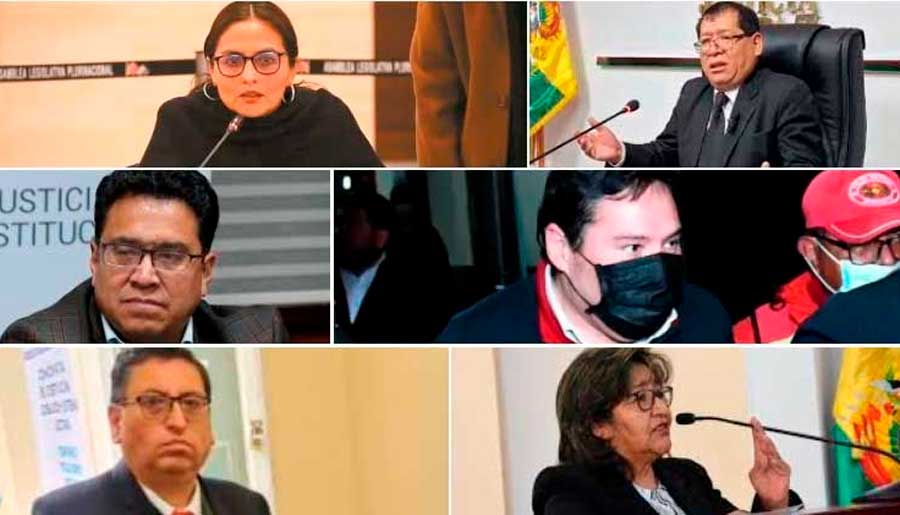
A minister, magistrates, court panel members, judges and prosecutors are mentioned in the “consortium” case, a scheme that, before exploding into public view, followed a path of calls, pressure, private meetings and unwritten agreements, according to statements accessed by Erbol.
The case became public on June 12, 2025, when a provincial judge was arrested accused of trying to stage a “coup” against a magistrate of the Supreme Court of Justice (TSJ). However, the testimonies describe a network of high-level influence, as well as a struggle for power within the judicial administration.
The story began months earlier, in January, when Yvan Córdova assumed the presidency of the Departmental Court of Justice (TDJ) of La Paz. A nomination that, far from being a mere institutional formality, deepened the dispute between the then Minister of Justice, César Siles, and TSJ magistrate Fanny Coaquira, according to testimonies in the investigation.
“The appointment of the new president was communicated to me by Dr. Alan Z. (…) who detailed that there was a confrontation between Minister César Siles and Dr. Fanny Coaquira over the designation of the president,” declared the now former TDJ panel member and detainee, Claudia Castro, before the Public Prosecutor’s Office.
Córdova was a man of confidence for the former minister. In 2023 he was sworn in as Deputy Prosecutor for Supervision and Intervention by then Attorney General César Siles. When the latter reached the Ministry of Justice, Córdova was chosen as a panel member and on January 14, 2025 he assumed the presidency of the TDJ.
According to Castro, a person identified as Erika V. told her that Córdova’s designation responded to “an agreement between magistrate Juan Carlos Berríos and former minister César Siles,” in order to avoid “instability.”
The appointment split the waters. On one side, the bloc aligned with Siles and Córdova; on the other, magistrate Coaquira, who was promoting Margot Pérez to preside over the TDJ, according to the testimonies.
According to Castro, the panel members who supported Córdova were worried about the audits promoted by the magistrate against authorities appointed in 2024, since they were not to their liking. In that context, the removal of the magistrate would have been planned.
“I think that, as was seen, these were political issues. I was not part of their group,” Coaquira told the media in the seat of government.
That dispute translated, over the following days, into parallel agendas that each side promoted outside the institutional line.
In a tense episode recalled by Castro, magistrate Coaquira convened an emergency meeting on the ninth floor of the courthouses and assigned Margot Pérez to coordinate prison decongestion. This upset the TDJ presidency.
With the objective of removing Coaquira already in place, Castro indicated that several meetings were promoted among the members of the plan and approaches were made to representatives of the La Paz Public Prosecutor’s Office.
The group seeking to oust Coaquira met on the seventh floor of Shopping Norte after Carnival. According to Castro, those present included Yvan Córdova and Iván Campero, who was Coaquira’s alternate magistrate and allegedly aspired to assume the full position.
During the meeting described by Castro, then alternate magistrate Campero raised the possibility of reopening a criminal case against Fanny Coaquira and, for that purpose, called the departmental prosecutor, who committed to review the case and receive him the next day in his office. That version was later denied by Campero himself.
At the same meeting they also spoke about alleged forged teaching certificates, the testimony indicates.
Meanwhile, magistrate Coaquira had already taken all her La Paz staff to Sucre, allegedly with the aim of “forcing” proceedings, even external ones, to the point of inquiring into Campero’s teaching background in order to disqualify him as alternate, according to Castro.
Within this struggle, in May, through contacts linked to Siles, a certification was obtained stating that Coaquira had not taught at the Bolivarian University, despite the fact that such a document had allegedly been presented for her application as magistrate.
“This person told Dr. César Siles that Dr. Fanny Coaquira never taught (…) but that the rector had issued the certificate due to a degree of friendship,” Castro declared, specifying that the information was corroborated with other institutions as well.
With that scenario, Córdova’s group decided to push a criminal case for use of a forged instrument and an action of compliance to remove Coaquira from office as magistrate, under the argument that she had used an irregular document to apply.
In his statement, Campero expressed his disagreement, although he admitted having participated in several meetings. By contrast, Castro maintained that he even proposed Orlando Rojas as alternate.
The chosen path to remove Coaquira was an action of compliance. Tasks were divided: some would draft the petition and others would look for the judge to rule on the case.
In the midst of that search appeared the Coroico judge, Fernando Lea Plaza, who allegedly told Castro of his interest in transferring to La Paz or Santa Cruz due to labor conflicts.
In his expanded statement of July 29, 2025, Lea Plaza said he met Claudia Castro when he had to resolve a constitutional amparo she filed in 2024 after applying to the Attorney General’s Office. He claimed he was “harassed” to rule in her favor, under the argument that “that is the Minister’s order” and that, being a directive, he could lose his job.
“You are a simple judge, I have worked here for years, do not put your job at risk,” Castro warned him, according to the former judge’s testimony.
He also recounted insistent calls, even at night, and pressure to take on the action of compliance with which they intended to remove Coaquira.
As part of the preparation of the offensive against Coaquira, there would even have been a meeting among the protagonists of the plan.
“Three days before the hearing on the action of defense, at César Siles’s house, Iván Campero, Yvan Córdova, Lea Plaza and César Siles met,” Castro recounted.
The stage was set for the judge to rule on the action of compliance, since the petition itself had allegedly been steered to reach Lea Plaza’s office.
The hearing was on June 12. According to witnesses, Lea Plaza appeared nervous and received multiple calls. The magnitude of the claim was very large, since he was a judge without experience to resolve resources like this, as he himself said.
During a recess ordered in the middle of the hearing, Lea Plaza received several calls: prosecutors are mentioned; the representative of the Judicial Council; as well as judges and panel members; and, of course, the main interested parties, who pressured him, some to rule in favor and others against. Everyone followed the hearing virtually.
The judge even allegedly asked for help to draft his ruling. “Lea Plaza called me and asked for help; I told him I would take note of what he was telling me. From a number I receive the draft of the supplement and forward it to Lea Plaza, and he calls me again saying he doesn’t understand, that I should summarize it more simply,” recalls the former panel member from the Obrajes women’s prison.
Although Castro denied having participated in the case, attorney Zuleika Lanza said her statement is almost a confession.
Finally, at the hearing, then judge Fernando Lea Plaza decided to suspend the temporary credential of magistrate Fanny Coaquira and ordered the alternate to be summoned to assume the post, that is, Iván Campero.
Although it seemed the plan had been consummated, as soon as the hearing ended the Coroico judge was arrested in his office and taken to the seat of government. The Electoral Tribunal (TSE) and the TSJ described the ruling as a “judicial coup.”
Lea Plaza clarified in his expanded statement of August 15, 2025 that both Castro and Siles had promised him, through his wife, to move their “influences” and “solve” the matter before his precautionary hearing.
Meanwhile, Córdova allegedly told him that he was at the Casa Grande del Pueblo to speak with the “friend,” assuring him not to worry because the “little lady of 17” (in reference to Court 17) was his friend and would arrange a substitute measure. However, Lea Plaza was sent to preventive detention in San Pedro prison.
Faced with those unfulfilled promises, Lea Plaza’s wife threatened to release the audio implicating then minister César Siles; he replied: “don’t release it, let’s talk,” according to the testimony. Even so, the audio became known on June 15 and the case gained relevance by involving high judicial authorities in what came to be investigated as the crime of consortium.
“Don’t worry (…) it’s been discussed at a very high level, doctor (…) you will also be protected (…) I’m also going to talk with Torres and Mariaca,” says part of the audio attributed to Siles, which according to Coaquira is genuine after the expert examination carried out.
After the precautionary hearing, Lea Plaza was taken to a hospital for a few days and then sent to prison, while the other implicated parties remained under the scrutiny of the Public Prosecutor’s Office.
In prison, Lea Plaza allegedly received a visit with an offer for him to change his statement, with the aim of exonerating former minister Siles.
“After about three or four days… Dr. Mariana G. enters (my cell) and told me: ‘to let you know that I have arranged for you to be comfortable. I spoke with the delegate, they are going to take care of you,’ and then she tells me: ‘within the process as such, would you be willing to collaborate to help Minister Siles and change your initial statement?’ My answer was that I had already given my statement,” Lea Plaza recounted.
On the morning of July 29, Lea Plaza said he received a visit from a Vice Minister. She explained that she had been sent by the Minister of Government to ask him three questions: first, about the recording of the audio; then, whether he knew why the Prosecutor’s Office was acting that way; and finally, what possibility there was to help the minister (César Siles).
“Doctor, do you know why the Prosecutor’s Office is bothering so much, why they turned around like this, I told her that I did not know,” the Vice Minister told him, according to Lea Plaza’s statement.
At that time, the former Minister of Justice had already been subjected to precautionary measures, but these were not enforced because he was hospitalized. Before his hearing to lift preventive detention, Mariana G. visited Lea Plaza and told him that Siles was going to “get out with release,” and again proposed collaborating with the minister to help him change his statement, according to the former judge.
“Mariana G. told me to change my statement and say that this case was set up by Coaquira, in coordination with the entire commission of prosecutors and the Attorney General,” Lea Plaza recounted. On another occasion he said he was threatened with being sent to “general population” in prison and to heed the “consequences.”
On August 25, Fernando Lea Plaza was declared an effective collaborator in the case known as “consortium” and, in September, he left San Pedro prison. A few weeks later he appeared dead in his bedroom, in a case that authorities declared a suicide.
His attorney says that the pressure exerted by the group that at the time aligned with Yván Córdova may have influenced his tragic outcome.
Within the process, former minister César Siles, alternate magistrate Iván Campero, former president of the Departmental Court of Justice Yvan Córdova and former panel member Claudia Castro are being investigated, the latter being the only one held in preventive detention in Obrajes prison, as the main accused. It is an investigation into a network of authorities who, according to indications, induced judge Lea Plaza to issue a ruling to illegally remove a sitting TSJ magistrate.
None of this was recorded in official minutes, but rather in accounts, statements and a key audio that today form part of the investigation.
At the same time, however, uncertainty persists over whether magistrate Fanny Coaquira used a forged document to obtain a higher score and gain access to the post, allegedly misleading voters or not.
Por Omar Escobar Mamani, Erbol:
TESTIMONIOS
Llamadas, reuniones secretas, influencias y pegas: la trama detrás del caso “consorcio”
Un ministro, magistrados, vocales, jueces y fiscales aparecen mencionados en el caso “consorcio”, una trama que, antes de estallar ante la opinión pública, recorrió un camino de llamadas, presiones, reuniones privadas y acuerdos no escritos, según las declaraciones a la que tuvo acceso Erbol.
El caso salió a la luz pública el 12 de junio de 2025, cuando se detuvo a un juez de provincia acusado de intentar dar un “golpe” a una magistrada del Tribunal Supremo de Justicia (TSJ), sin embargo, los testimonios dan cuenta de una red de influencias de alto nivel, además de una pugna por espacios de poder en la administración judicial.
La historia comenzó meses antes, en enero, cuando Yvan Córdova asumió la presidencia del Tribunal Departamental de Justicia (TDJ) de La Paz. Un nombramiento que, lejos de ser un trámite institucional, profundizó la pugna entre el entonces ministro de Justicia, César Siles, y la magistrada del TSJ, Fanny Coaquira, según testimonios que forman parte de la investigación.
“La designación del nuevo presidente me la hizo conocer el Dr. Alan Z. (…) donde me detalló que hubo una confrontación entre el ministro Cesar Siles y la Dra. Fanny Coaquira sobre la designación del presidente”, declaró la ahora exvocal del TDJ y detenida, Claudia Castro, ante el Ministerio Público.
Córdova sería un hombre de confianza del exministro. En 2023 fue posesionado como subprocurador de Supervisión e Intervención por el entonces procurador general César Siles. Cuando este último llegó al Ministerio de Justicia, Córdova fue elegido como vocal y el 14 de enero de 2025 asumió la presidencia del TDJ.
Según Castro, una persona identificada como Erika V. le habría señalado que la designación de Córdova respondía a “un acuerdo del magistrado Juan Carlos Berríos y del exministro César Siles”, para evitar una “inestabilidad”.
La designación partió aguas. De un lado, el bloque alineado a Siles y Córdova; del otro, a la magistrada Coaquira, quien impulsaba a Margot Pérez para presidir el TDJ, de acuerdo con los testimonios.
De acuerdo con Castro, los vocales que respaldaban a Córdova veían con preocupación las auditorías promovidas por la magistrada contra autoridades designadas en 2024, ya que no eran de su agrado. En ese contexto, se habría planeado la destitución de la magistrada.
“Pienso que como se vio eran temas políticos. Yo no fui del grupo de ellos”, afirmó Coaquira en contacto con los medios en la sede de Gobierno.
Esa pugna se tradujo, con el paso de los días, en agendas paralelas que cada bando promovió al margen de la línea institucional.
En un episodio de tensión, que recordó Castro, la magistrada Coaquira convocó a una reunión de emergencia en el piso nueve de los juzgados y encargó a Margot Pérez la coordinación para el descongestionamiento carcelario. Esto molestó a la presidencia del TDJ.
Ya con el objetivo de destituir a Coaquira, Castro indicó que se promovieron varias reuniones entre los integrantes del plan y acercamientos con los representantes del Ministerio Público de La Paz.
El bando que pretendía destituir a Coaquira se reunió en el piso siete del Shopping Norte después de Carnaval. Según Castro, en el encuentro participaron, entre otras personas, Yvan Córdova e Iván Campero, quien era el magistrado suplente de Coaquira y habría aspirado a asumir la titularidad.
Durante la reunión relatada por Castro, el entonces magistrado suplente Campero planteó la posibilidad de desarchivar un proceso penal contra Fanny Coaquira y, con ese objetivo, llamó al fiscal departamental, quien se comprometió a revisar el caso y recibirlo al día siguiente en su despacho. Esa versión fue negada posteriormente por el propio Campero.
También, en la misma reunión se habló de presuntos certificados de docencia fraguados, indica el testimonio.
En tanto, la magistrada Coaquira, ya se había llevado a todo su personal de La Paz a Sucre, presuntamente con la finalidad de “forzar” procesos, hasta externos, al punto de indagar sobre la docencia de Campero, con el fin de inhabilitarlo como suplente, según denunció Castro.
En el marco de esta pugna, en mayo, a través de contactos vinculados a Siles, se obtuvo una certificación que señalaba que Coaquira no ejerció docencia en la Universidad Bolivariana, pese a que ese documento habría sido presentado para su postulación para magistrada.
“Esta persona le indicó al dr. César Siles que la dra. Fanny Coaquira nunca dio docencia (…) pero que el rector le habría extendido el certificado por un grado de amistad”, declaró Castro, precisando que la información fue corroborada con otras instituciones más.
Con ese escenario, el bando de Córdova resolvió impulsar un proceso penal por uso de instrumento falsificado y una acción de cumplimiento para cesar a Coaquira del cargo de magistrada, bajo del argumento de que habría usado un documento irregular para postular.
En su declaración, Campero expresó su desacuerdo, aunque admitió haber participado en varias reuniones. Contrariamente, Castro sostuvo que él incluso propuso a Orlando Rojas como suplente.
El camino elegido para destituir a Coaquira era una acción de cumplimiento. Las tareas se repartieron: unos redactarían el recurso y otros buscarían al juez que resuelva la causa.
En medio de esa búsqueda apareció el juez de Coroico, Fernando Lea Plaza, quien habría manifestado a Castro su interés en trasladarse a La Paz o Santa Cruz por conflictos laborales.
En su declaración ampliatoria del 29 de julio de 2025, Lea Plaza afirmó que conoció a Claudia Castro cuando le tocó resolver un amparo constitucional que ella presentó en 2024, tras postular a la Fiscalía General. Aseguró que fue “hostigado” para fallar a su favor, bajo el argumento de que “esa es la orden del Ministro” y que, al tratarse de una disposición, él podría perder su trabajo.
“Usted es un simple juez, yo trabajo años acá, no ponga en riesgo su trabajo”, le advirtió Castro, según testificó el exjuez.
También, relató las llamadas insistentes, incluso nocturnas, y presiones para asumir la acción de cumplimiento con la cual se pretendía destituir a Coaquira.
Como parte de la preparación de la arremetida como Coaquira, incluso habría existido una reunión entre los protagonistas del plan.
“Tres días antes de la audiencia de la acción de defensa, en la casa de César Siles, se reunieron Iván Campero, Yvan Códova, Lea Plaza y César Siles”, relató Castro.
El escenario ya estaba dado para que el juez resuelva la acción de cumplimiento, puesto que incluso, se habría direccionado el recurso para que llegue al despacho de Lea Plaza.
La audiencia fue el 12 de junio. Según testigos, Lea Plaza se mostró nervioso y recibió múltiples llamadas. Era muy grande la magnitud de la demanda, pues era un juez sin experiencia para resolver recursos como este, como él mismo decía.
En un cuarto intermedio dictado en plena audiencia, Lea Plaza recibió varias llamadas: se menciona a fiscales; al representante del Consejo de la Magistratura; además de jueces y vocales; por supuesto, los principales interesados, que lo presionaban unos para que falle a favor y otros en contra. Todos seguían la audiencia mediante la virtualidad.
Incluso el juez habría solicitado ayuda para elaborar su resolución. “Lea Plaza me llamó y me pidió ayuda; le dije que tomaría nota de lo que le estaba indicando. De un número me llega el borrador de la complementación y se lo reenvío a Lea Plaza, y me vuelve a llamar diciendo que no entiende, que lo resuma más sencillo”, recuerda la exvocal desde la cárcel de mujeres de Obrajes.
Pese a que Castro negó que haya tenido participación en el caso, la abogada Zuleika Lanza aseguró que su declaración es casi una confesión.
Finalmente, en la audiencia, el entonces juez Fernando Lea Plaza, determinó suspender la credencial temporal de la magistrada Fanny Coaquira, y ordenó convocar al suplente para asumir el cargo, vale decir, a Iván Campero.
Aunque parecía que se había consumado el plan, ni bien terminó la audiencia, el juez de Coroico fue aprehendido en su despacho y conducido a la sede de Gobierno. El TSE y el TSJ calificaron el fallo como un “golpe judicial”.
Lea Plaza aclaró en su declaración ampliatoria del 15 de agosto de 2025 que tanto Castro como Siles le habrían prometido, a través de su esposa, mover sus “influencias” y “solucionar” el tema antes de su audiencia cautelar.
En tanto, Córdova le habría señalado que se encontraba en la Casa Grande del Pueblo para hablar con el “amigo”, asegurándole que no se preocupara porque la “damita del 17” (en referencia al Juzgado 17) era su amiga y gestionaría una medida sustitutiva. Sin embargo, Lea Plaza fue enviado con detención preventiva a la cárcel de San Pedro.
Ante esas promesas no cumplidas, la esposa de Lea Plaza amenazó con sacar a la luz el audio que implicaba al entonces ministro César Siles; él respondió: “no lo saque, hablemos”, según el testimonio. Pese a ello, el audio se conoció el 15 de junio y el caso cobró relevancia al implicar a altas autoridades de justicia en el caso que paso a ser investigado por el delito de consorcio.
“Usted pierda cuidado (…) está conversado a muy alto nivel, doctor (…) va a estar protegido también usted (…) Yo voy a hablar también con Torres y Mariaca”, refiere parte del audio atribuido a Siles, que según Coaquira es verídico tras el peritaje realizado.
Tras la cautelar, Lea Plaza fue llevado a un hospital por algunos días y luego remitido a la cárcel, mientras los otros implicados permanecían bajo la mira del Ministerio Público.
En la cárcel, Lea Plaza habría recibido una visita con una oferta para que cambie su declaración, con el objetivo de eximir al exministro Siles.
“Después de unos tres o cuatro días… ingresa (a su celda) la Dra. Mariana G. y me dijo: ‘hacerle conocer que yo he gestionado para que usted pueda estar cómodo. Hablé con el delegado, a usted lo van a cuidar’, y en eso me dice: ‘dentro del proceso como tal, usted estaría dispuesto a colaborar para ayudar al ministro Siles y cambiar su declaración inicial?’, mi respuesta fue que ya presté mi declaración”, contó Lea Plaza.
Para el 29 de julio, por la mañana, Lea Plaza dijo que recibió la visita de una Viceministra. Le explicó que había sido enviada por el Ministro de Gobierno para hacerle tres consultas: primero, sobre la grabación del audio; luego, si sabía por qué la Fiscalía actuaba de esa manera; y finalmente, qué posibilidad había de ayudar al ministro (César Siles).
“Doctor, usted sabe por qué la Fiscalía está molestando tanto, por qué ellos se dieron la vuelta, yo le dije que desconozco”, le dijo la Viceministra, según la declaración de Lea Plaza.
En ese tiempo, el exministro de Justicia ya había sido cautelado, pero la medida no se efectivizó porque estaba internado en un hospital. Antes de su audiencia de cesación a la detención preventiva, Mariana G. visitó a Lea Plaza y le comentó que Siles iba a “salir con cesación”, y le propuso nuevamente colaborar con el ministro para ayudarle a cambiar su declaración, según recordó el exjuez.
“Mariana G. me dijo que cambie mi declaración y diga que este caso ha sido armado por Coaquira, en coordinación con toda la comisión de fiscales y con el Fiscal General”, relató Lea Plaza. En otra oportunidad dijo que fue amenazado con ser enviado a “población” en la cárcel y que se atenga a las “consecuencias”.
El 25 de agosto, Fernando Lea Plaza fue declarado colaborador eficaz en el caso denominado “consorcio” y, en septiembre, salió del penal de San Pedro. Unas semanas después apareció sin vida en su dormitorio, en un caso que fue declarado como suicidio por las autoridades.
Su abogada señala que la presión ejercida por el grupo que en su momento se alineó con Yván Córdova pudo haber influido en su trágico desenlace.
Dentro del proceso se investigan al exministro César Siles, al magistrado suplente Iván Campero, al expresidente del Tribunal Departamental de Justicia Yvan Córdova y la exvocal Claudia Castro, esta última es la única detenida de manera preventiva en el penal de Obrajes, como los principales sindicados. Se trata de una investigación sobre una red de autoridades que, según indicios, habrían inducido al juez Lea Plaza a emitir un fallo para destituir de manera ilegal a una magistrada titular del TSJ.
Nada de eso quedó registrado en actas oficiales, pero sí en relatos, declaraciones y un audio clave que hoy forman parte de la investigación.
Pero al mismo tiempo, persiste la incertidumbre sobre si la magistrada Fanny Coaquira utilizó un documento fraguado para obtener una mayor puntuación y acceder al cargo, presuntamente engañando a los electores o no.

 Bolivian Thoughts | Pensamientos Bolivianos (Bilingual/Bilingüe)