
By El Diario:
The change of government and economic model after nearly 20 years has improved Bolivia’s economic indicators, according to analyst and former president of the Tarija College of Economists, Fernando Romero.
The new government of Rodrigo Paz Pereira has sent positive, concrete signals of a pragmatic State willing to work with the private sector, sensibly seeking international financial support to stabilize the economy, and convinced that foreign investment is another key factor for overcoming the crisis. Although the improvements are evident, Romero warned that a long and winding road still lies ahead to strengthen the country’s financial health, with an uncertain cost for the population.
According to the expert, the October 19 runoff election was an important turning point that marked the beginning of Bolivia’s economic stabilization, affecting sensitive variables both economically and politically.
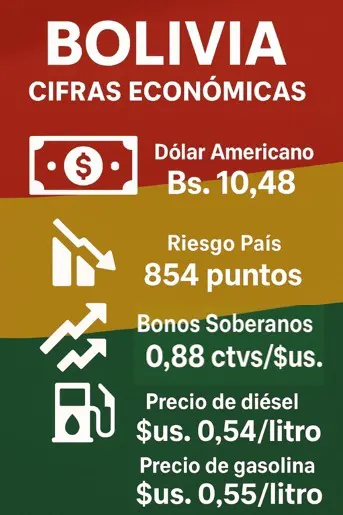
A clear example, he said, is the downward stabilization of the parallel dollar rate, which reached a peak of Bs 15 on the day of the runoff; but it dropped in less than two hours and has since shown a downward trend with relatively short spikes, currently standing near Bs 10.48.
“This phenomenon reflects a recovery in market confidence, while the official exchange rate has now gone 11 years without significant changes,” he stated.
Regarding country risk, on October 20, one day after the runoff, it stood at 1,132 points. Since then, the trend has moved downward, although with some increases at the end of October and the beginning of November.
“As of the 13th of this month the indicator had fallen to 854 points, representing a 25% drop since the runoff — a level not seen since 2023, showing greater attractiveness for international investors,” he added.
“As for sovereign bonds maturing in 2028 and 2030, both were trading until mid-October at 0.81 and 0.85 cents on the dollar, respectively. From the runoff to now, both bonds have risen to approximately 0.88 cents on the dollar, reflecting improved perceptions of debt and economic stability,” he noted.
Regarding fuels, although diesel and gasoline prices have remained fixed at Bs 3.72 and Bs 3.74 per liter for the past 20 years, the new government has made notable efforts to improve fuel supply, significantly reducing lines and ensuring broader access throughout the country.
Romero stressed that Bolivia is going through a complex historic moment, with an economy in recession and high inflation — a dangerous combination that erodes purchasing power and increases poverty. However, since the runoff, there has been a drastic shift in expectations and outlook for Bolivia’s economy at both national and international levels.
External support and the easing of fuel shortages are sensitive indicators that have improved, boosting confidence in the country’s economic direction.
“In short, the current administration is pushing a paradigm shift toward a more financially stable country, even though major challenges lie ahead. The stabilization of the parallel dollar, the reduction in country risk, and improved access to external financing mark positive progress, but the path toward a solid and sustainable recovery is still long and costly for the Bolivian population,” he concluded.
Por El Diario:
El cambio de gobierno y del modelo económico tras casi 20 años mejoraron los indicadores económicos de Bolivia, según el analista y expresidente del Colegio de Economistas de Tarija, Fernando Romero.
El nuevo gobierno de Rodrigo Paz Pereira dio señales positivas y concretas de un Estado pragmático, abierto a trabajar con el sector privado, en una búsqueda sensata de apoyo financiero internacional para estabilizar la economía, y con la convicción de que para salir de la crisis la inversión extranjera es otro factor clave. Aunque hay mejoras evidentes, dijo Romero y advirtió que todavía queda un camino largo y sinuoso para fortalecer la salud financiera del país, con un costo incierto para la población.
Según el experto, el balotaje del 19 de octubre fue un punto de inflexión importante que marcó el inicio de la estabilización económica boliviana, impactando variables sensibles tanto en lo económico como en lo político.
Un claro ejemplo, dijo, es la estabilización hacia la baja del precio del dólar paralelo, que alcanzó un pico de Bs 15 el día del balotaje; pero bajó en menos de dos horas y presentó una tendencia decreciente con alzas relativas y cortas, situándose actualmente cerca de Bs 10,48.
“Este fenómeno refleja una recuperación en la confianza del mercado, mientras que el tipo de cambio oficial cumple ya 11 años sin variaciones significativas”, sostuvo.
Respecto al riesgo país, el 20 de octubre, un día después de la segunda vuelta, se ubicaba en 1.132 puntos. Desde entonces, la tendencia ha sido a la baja, aunque con algunas subidas a finales de octubre y principios de noviembre.
“Al 13 de este mes el indicador descendió a 854 puntos, lo que representa una caída del 25% desde el balotaje, un nivel que no se veía desde el año 2023 y que muestra un mayor atractivo para inversionistas internacionales”, agregó.
“En cuanto a los bonos soberanos con vencimiento en 2028 y 2030, ambos se cotizaban hasta mediados de octubre en 0,81 y 0,85 centavos por dólar, respectivamente. Desde el balotaje hasta la fecha, ambos bonos han subido a aproximadamente 0,88 centavos por dólar, reflejando una mejora en la percepción sobre la deuda y la estabilidad económica”, sostuvo.
Sobre los carburantes, a pesar de que los precios del diésel y la gasolina permanecen fijos en Bs 3,72 y Bs 3,74 por litro desde hace 20 años, el nuevo gobierno ha hecho esfuerzos notables para mejorar la provisión de estos combustibles, reduciendo de manera significativa las filas y garantizando mayor acceso en todo el país.
Romero enfatizó que Bolivia está atravesando un momento histórico complejo, con una economía en recesión y alta inflación una combinación peligrosa que presiona el poder adquisitivo y aumenta la pobreza. Sin embargo, desde el balotaje hasta ahora, se ha observado un cambio rotundo en las expectativas y perspectivas sobre la economía boliviana, tanto a nivel nacional como internacional.
El apoyo externo y la disminución de la escasez de carburantes son indicadores sensibles que han mejorado, elevando la confianza en el rumbo económico del país.
“En definitiva, la gestión actual impulsa un cambio de paradigma hacia un país más estable financieramente, aunque con retos importantes por delante. La estabilización del dólar paralelo, la reducción del riesgo país y el mejor acceso a financiamiento externo marcan avances positivos, pero la ruta para lograr una recuperación sólida y sostenible aún es larga y costosa para la población boliviana”, concluyó.
https://www.eldiario.net/portal/2025/11/18/cambio-de-modelo-economico-comienza-a-favorecer-al-pais/

 Bolivian Thoughts | Pensamientos Bolivianos (Bilingual/Bilingüe)