
By Erika Ibáñez, La Razón:
Guido Balcázar, general manager of Credit Card Administrator (ATC) Red Enlace, confirmed to La Razón that restrictions due to the dollar shortage have had a “significant” impact on card use.
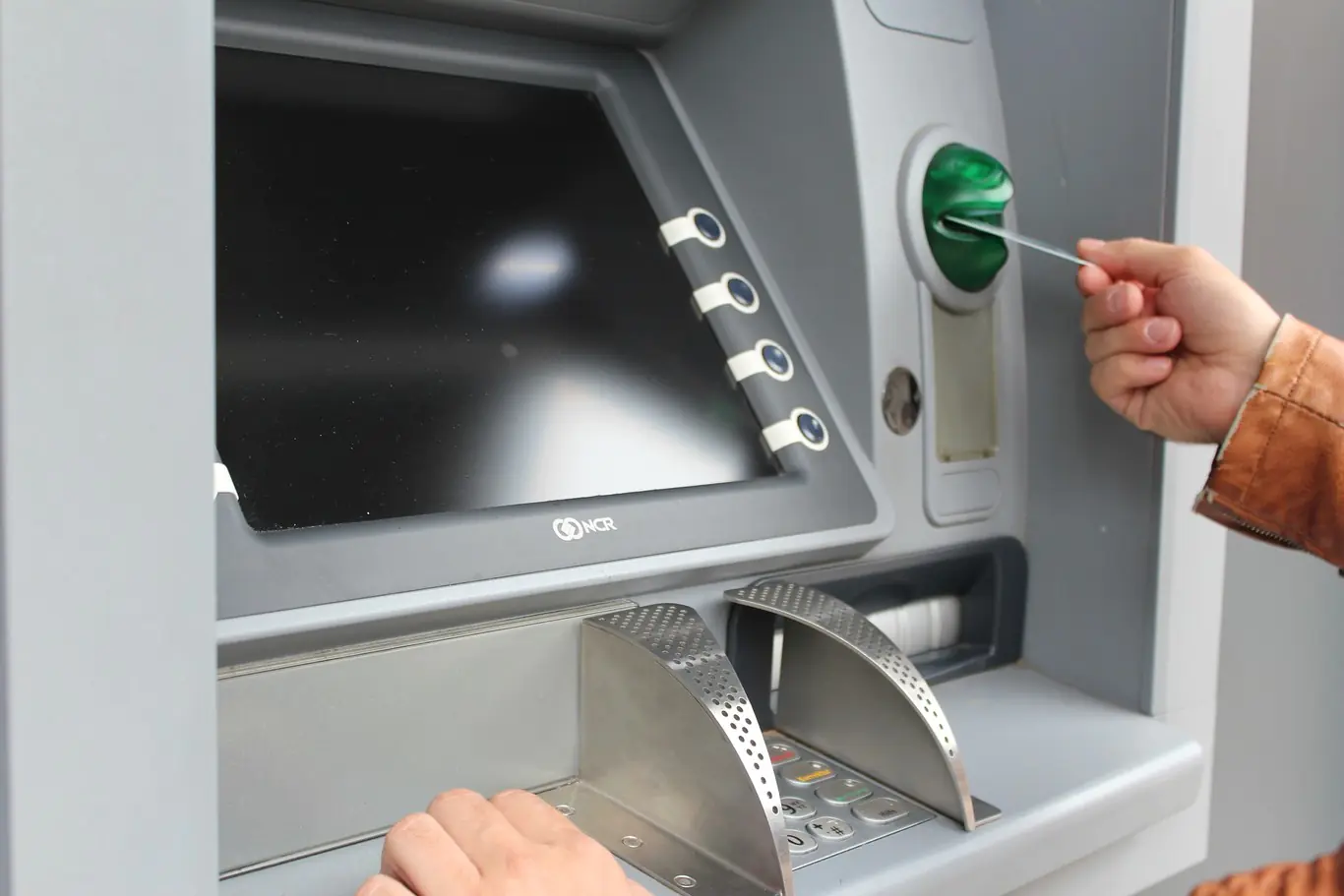
A person uses a debit card at an ATM. Photo: Social Media
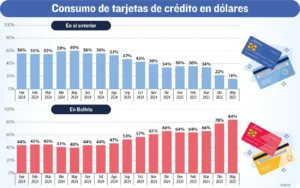
Credit and debit cards are a fundamental tool for modern financial transactions. In Bolivia, however, restrictions have caused dollar-denominated card spending to decrease by at least 40%.
Card use allows for cashless payments, expense management, purchase records, and quick access to funds both in retail and service transactions.
Since 2024, however, dollar-based card operations in Bolivia have been subject to restrictions imposed by the Financial System Supervisory Authority (Asfi) and financial institutions due to the currency shortage.
On August 23, 2024, Asfi set controls and limits on credit card operations related to dollar withdrawals “in response to the massive and unusual increase in spending.”
It clarified that financial intermediaries were the ones to set limits on debit and credit card use abroad. Banks have since established maximum limits for ATM withdrawals, payments at point-of-sale (POS) terminals, and online purchases.
On March 14, 2025, Asfi issued Resolution 216/2025, modifying the Regulation on Interest Rates, Fees, and Charges to determine maximum commissions for international transactions. The rule stipulates that “transactions abroad of up to $100 (online purchases, physical POS payments, and ATM withdrawals) are exempt from commission fees, which apply only to amounts exceeding that limit.”
Cards
In other words, a person can carry out foreign transactions with cards up to $100 without fees, but any amount above that incurs variable charges. [Bolivian Thoughts opinion: yet the bank continues to charge the client as if the card would be performing as usual, i.e. bought the service for a credit card to be able to use up to $10K dollars per month and as such, I pay an amount, end result is I am forced to only use up to a lousy one hundred dollars and pay for the “titanium” card, it is a robbery in plain sight, Asfi does nothing about it and users are charged for what we do not use?!]
Currently, the amounts allowed—different at each bank—are insufficient to cover expenses abroad or even pay for internet-based services like streaming from Bolivia. Adding commissions makes funds practically unusable.
Guido Balcázar, general manager of Credit Card Administrator (ATC) Red Enlace, confirms to La Razón that the impact of restrictions due to the shortage of dollars is “significant” on the use of cards.
ATC Red Enlace manages all payment systems for financial institutions. “We are the ones behind the administration of debit, prepaid credit cards, and ATMs,” he explains.
“The number of restrictions has easily reduced (dollar-denominated card spending) by 40%, the impact has been very significant,” says the Red Enlace executive.
“The fact that you can’t use cards to pay for internet abroad, make purchases, or withdraw large amounts due to limits has caused card spending and transactions to fall by 40%,” he stresses.
Balcázar notes the impact is strongest on credit card transactions.
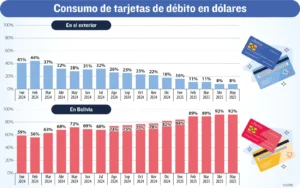
Transactions
According to ATC Red Enlace, last year electronic card transactions in Bolivia totaled 99 million, worth $2.821 billion, lower than 2023 when no restrictions were in place. In 2023, card transactions reached $3.217 billion.
Since 2024, dollar spending with debit cards has declined steadily. In January 2024, 41% of transactions were abroad and 59% in Bolivia; by May 2025, 92% were domestic and just 8% abroad.
Credit cards show a similar trend. In January 2024, 56% of dollar-denominated transactions were abroad, but by May 2025, that fell to 16%, while domestic transactions rose from 44% to 84%.
Still, Balcázar points to one positive note: debit and credit cards are now used more widely inside Bolivia.
Unlike other countries, Bolivia has low credit card penetration, which is tied to the difficulty many people face in obtaining one.
Uses
Regarding how Bolivians use cards, Balcázar explains they are mostly for consumer purchases. “Because of all the restrictions over the past year and a half, credit and debit card use has been focused on these spending groups. Before, when there were no limits, card use abroad was high. It still exists, but restrictions apply.”
As of May 2025, ATC Red Enlace data shows 31% of the population uses debit and credit cards and QR payments in supermarkets; 24% in restaurants and clothing stores; 11% for health, education, and insurance payments; 10% for internet purchases, among other categories.
Despite restrictions, cards remain a key tool for digital payments, online shopping, and international transfers.
Por Erika Ibáñez, La Razón:
Guido Balcázar, gerente general de Administradora de Tarjetas de Crédito (ATC) Red Enlace, confirma a La Razón que el impacto de las restricciones por la escasez de dólares ha sido “significativo” en el uso de las tarjetas.
Una persona utiliza una tarjeta de débito en una cajero automático. Foto: RRSS
Las tarjetas de crédito y débito son en una herramienta fundamental para las transacciones financieras modernas. En Bolivia, sin embargo, existen restricciones que ocasionaron que el consumo en dólares con tarjetas disminuya en al menos 40%.
Con el uso de tarjetas se facilita el pago sin efectivo, la gestión de gastos, el registro de compras y el acceso a fondos de forma rápida en comercios como en servicios.
Sin embargo, en Bolivia las operaciones en dólares con tarjetas están sujetas a restricciones impuestas desde 2024 por la Autoridad de Supervisión del Sistema Financiero (Asfi) y las entidades financieras debido a la escasez de divisas.
El 23 de agosto de 2024, la Asfi fijó controles y límites en las operaciones con tarjetas de crédito con relación al retiro de dólares, “ante el masivo e inusitado incremento en los consumos”.
Y aclaró que las entidades de intermediación financiera son las que fijaron límites en el uso de tarjetas de débito y crédito en el extranjero. Y así fue, pues los bancos establecieron desde entonces límites máximos para retiros en cajeros automáticos, pagos en terminales de punto de venta (POS) y compras en línea.
El 14 de marzo de este año, la Asfi publicó la resolución 216/2025 y modificó el Reglamento de Tasas de Interés, Comisiones y Tarifas para determinar las comisiones máximas a cobrarse para transacciones con el exterior. La resolución dispone que para las “transacciones con el exterior de hasta $us 100 (compras por internet, pagos por POS físicos y retiros en cajeros automáticos) no aplica el cobro de comisión, que se efectuará solo sobre el monto que supere esa cifra”.
Tarjetas
Es decir, una persona puede realizar operaciones en el exterior con tarjetas de hasta $us 100 dólares; a partir de ese monto debe pagar una comisión variable. [Opinión de Bolivian Thoughts: aun así el banco sigue cobrando al cliente como si la tarjeta funcionara como siempre, es decir, compré el servicio de una tarjeta de crédito para poder usar hasta $10 mil dólares al mes y como tal pago un monto, resultado final es que me veo obligado a usar solo hasta unos míseros cien dólares y pagar la tarjeta “titanium”, es un robo a simple vista, ¿¡Asfi no hace nada al respecto y a los usuarios se nos cobra por lo que no usamos?!]
Los montos disponibles en la actualidad —diferentes en cada banco— son insuficientes para una estadía en el extranjero o para el pago por internet de servicios como streaming y otros desde Bolivia. Y si se suma la comisión, el dinero prácticamente no alcanza.
Guido Balcázar, gerente general de Administradora de Tarjetas de Crédito (ATC) Red Enlace, confirma a La Razón que el impacto de las restricciones por la escasez de dólares es “significativo” en el uso de las
ATC Red Enlace es la entidad que administra todos los medios de pago para las entidades financieras, “somos quienes estamos detrás en cuanto a la administración de sus tarjetas de débito y de crédito prepago, también de los cajeros automáticos”, explica.
“La cantidad de restricciones han hecho que disminuya fácilmente un 40% (el consumo en dólares con tarjetas), el impacto ha sido muy significativo”, dice el gerente de la Red Enlace.
“El hecho de no poder usar las tarjetas pagando internet en el exterior, consumos ni hacer retiros por montos altos debido a los límites ha hecho que caiga fácilmente un 40% el consumo y la transaccionalidad”, remarca.
Balcázar explica que el impacto se siente más en las operaciones de las tarjetas de crédito.
Transacciones
Según cifras de la ATC Red Enlace, en Bolivia el año pasado el número de transacciones con tarjetas electrónicas alcanzó a 99 millones por un valor de $us 2.821 millones, una cifra menor a la registrada en 2023, cuando no había ningún tipo de restricciones. En la gestión 2023, el valor de las transacciones con tarjetas llegó a $us 3.217 millones.
Desde 2024, el consumo con tarjetas de débito en dólares fue bajando paulatinamente. En enero del año pasado era de un 41% en el exterior y de 59% en el país; sin embargo, a mayo de 2025, las operaciones con estos medios de pago en Bolivia subieron al 92% y en el exterior bajaron al 8% debido a las restricciones.
En las tarjetas de crédito se ve un panorama similar. En enero del año pasado, las operaciones de consumo en dólares con este medio en el exterior eran de un 56% y a mayo de este año bajaron hasta el 16%; mientras que en el país subieron de 44% a 84%.
Para Balcázar, en ese panorama también hay buenas noticias: las tarjetas de crédito y de débito se usan ahora más en Bolivia.
El gerente de ATC Red Enlace explica a La Razón que, a diferencia de otros países, Bolivia “tiene una penetración baja de tarjetas de crédito y tiene que ver con la restricción que tienen las personas para acceder a una”.
Usos
Respecto del uso que le dan los bolivianos a las tarjetas de crédito y débito, explica que se destinan principalmente para consumo en negocios. “Por todas las restricciones que hay el último año y medio, el uso de tarjetas de crédito y de débito se ha enfocado en estos grupos de consumo. Antes, cuando no teníamos estas limitaciones, el consumo era muy utilizado en el exterior, todavía se lo hace, pero hay restricciones”.
Las cifras de la entidad muestran que, a mayo de 2025, el 31% de la población usa las tarjetas de débito y crédito y el QR para pagos en supermercados; el 24% en restaurantes y tiendas de ropa; el 11% para pagos de salud, educación y seguros; el 10% para pagos por internet, entre los principales rubros.
A pesar de estas limitaciones, las tarjetas siguen siendo herramientas clave para pagos digitales, compras en línea y transferencias internacionales.

 Bolivian Thoughts | Pensamientos Bolivianos (Bilingual/Bilingüe)