
By EFE, Visión 360:
High Quality
About 500 exhibitors, including 200 camelid producers from six Bolivian departments, are taking part in the fair
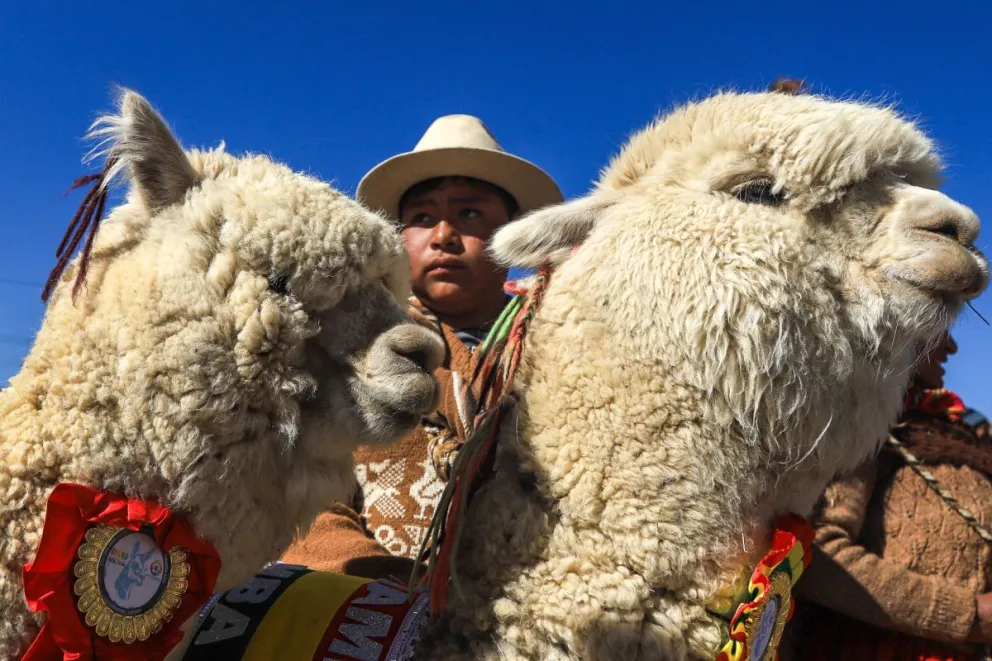
A breeder presents his alpacas during a camelid fair this Saturday in El Alto (Bolivia). Photo: EFE
Dozens of llamas and alpacas of various breeds, sizes, and colors were on display this Saturday at the 15th National Camelid Expo-Fair La Paz 2025. Bolivian producers and artisans are also showcasing “export-quality” products derived from these animals, such as woven garments and charque (dried meat).
The event, held at the Fairgrounds in the city of El Alto, neighboring La Paz, is organized by the National Association of Camelid Producers (Anapca) and the Ministry of Rural Development and Lands.
“There are around 500 participants, including 200 camelid producers from six departments: La Paz, Oruro, Potosí, Cochabamba, Chuquisaca, and Tarija. We’re here to promote everything related to camelid livestock, and we see improvements year after year,” Camilo Rodríguez, president of the Expo-Fair, told EFE.
Rodríguez highlighted that last year’s champion animal weighed 266 kilos and expressed hope that this year’s winner will match or surpass that figure.
He also encouraged the public to visit the event to see the animals and learn about the benefits of their by-products.
“Many people may lose the connection between the countryside and the city, so it’s good for them to see that in the high Andes, in our Bolivian Altiplano, we have these camelids,” he emphasized.
Juan Carlos Mamani, president of Anapca, told EFE that producers brought their best specimens to the fair and underlined the event’s importance for the sector.
“Our goal is to promote and eventually export our products,” Mamani said, adding that they will request the creation of a vice ministry dedicated to the camelid sector to continue advancing.
Eliseo Apaza, national coordinator of the Expo-Fair, told EFE the event is “very important” for promoting and disseminating advances in breeding and producing camelid-based products.

Apaza noted that in the early years of the fair, contestant animals weighed just 87 kilos, while now “they weigh over 200 kilos,” a result of successful genetic improvements.
“Artisans have also progressed significantly. We used to have more rustic garments; now we have export-quality clothing,” the coordinator said.
Exhibition and Production
The first thing visitors see are llamas and alpacas in various pens, some adorned with colorful wool threads and earrings on their ears, placed by breeders. Champion animals wear bands and ribbons to distinguish them from the rest.
Around the fairgrounds, kiosks offer textiles and handicrafts made from camelid fiber, including blankets, sweaters, coats, gloves, and scarves, as well as little llama figurines made from yarn or leather.
In another area, meat product exhibitors present their goods, and there’s also a gastronomic section where visitors can sample various llama meat dishes, such as chicharrones, fried charque, and grilled fillets.
The fair, open through Sunday, rotates each year among the six camelid-producing regions of Bolivia. This year, it is La Paz’s turn.
According to Rodríguez, an estimated 80,000 families in Bolivia raise camelids, with a national herd of about three million animals.
Of that total, nearly two million are llamas, “less than half a million are alpacas, and just over 100,000 are vicuñas,” while “very few” are guanacos, said Rodríguez. He also noted that Bolivia is the world’s top producer of llamas and the second largest producer of alpacas.
Rodríguez emphasized that camelids “preserve the biodiversity of the high Andes” and are “the only animals adapted to survive” in areas with scarce forage and water.
He also praised the “nutritional value” of llama meat, calling it one of the healthiest, with high protein content and low fat.
Gina Baldivieso
Por EFE, Visión 360:
Alta calidad
En la feria participan aproximadamente 500 expositores, incluidos 200 productores de camélidos de seis departamentos del país
Un criador expone sus alpacas durante una feria de camélidos este sábado, en El Alto (Bolivia). Foto: EFE
Decenas de llamas y alpacas de distintas razas, tamaños y colores se lucen este sábado en la XV Expoferia Nacional de Camélidos La Paz 2025, en la que los productores y artesanos de Bolivia también muestran derivados con calidad “de exportación”, como prendas de vestir tejidas y charque o carne seca.
El evento, que se realiza en el Campo Ferial de la ciudad de El Alto, vecina de La Paz, es organizado por la Asociación Nacional de Productores de Camélidos (Anapca) y el Ministerio de Desarrollo Rural y Tierras.
“Son aproximadamente 500 participantes, (incluidos) 200 productores de camélidos de seis departamentos del país, La Paz, Oruro, Potosí, Cochabamba, Chuquisaca y Tarija. Venimos para fomentar todo lo relacionado a la ganadería camélida y vemos que hay un mejoramiento año tras año”, dijo a EFE el presidente de la Expoferia, Camilo Rodríguez.
Rodríguez destacó que el ejemplar campeón de la anterior feria pesó 266 kilos y confió en que este año se pueda “superar o mantener” esa marca.
También expresó su deseo de que la gente visite el evento para conocer a los animales en exposición y las bondades de los derivados que ofrece este ganado.
“Muchos quizás pierden ese vínculo entre el campo y la ciudad, entonces es bueno que vean ellos que en los altos Andes, en nuestro Altiplano boliviano, tenemos estos camélidos”, destacó.
El presidente de Anapca, Juan Carlos Mamani, aseguró a EFE que los productores llevaron a la feria a sus mejores ejemplares y resaltó la importancia del evento para el sector.
“El objetivo que tenemos es promocionar y llegar hasta la exportación de nuestros productos”, indicó Mamani y agregó que pedirán la creación de un viceministerio para el sector de camélidos, con el fin de seguir mejorando.
Por su parte, el coordinador nacional de la Expoferia, Eliseo Apaza, comentó a EFE que el evento es “muy importante” para hacer “la promoción y difusión” de los avances en la crianza y elaboración de los productos derivados de los animales.
Apaza mencionó que en las primeras versiones de la feria los ejemplares concursantes pesaban 87 kilos, mientras que ahora “están pesando arriba de 200 kilos” y “ese es un avance, se ha hecho un mejoramiento genético”.
“Los artesanos, de la misma manera, han avanzado bastante, antes teníamos prendas más rústicas, ahorita tenemos prendas de calidad de exportación”, valoró el coordinador.
Exposición y producción
Lo primero que ve el público visitante son las llamas y alpacas expuestas en distintos corrales, algunas con coloridos hilos y aretes de lana que les colocan sus criadores en las orejas, mientras que las campeonas llevaban bandas y listones que las diferencian del resto.
En los alrededores están los quioscos para la venta de textiles y artesanías hechas con fibra de camélidos, incluidas mantas, suéteres, sacos, guantes y bufandas, además de llamitas tejidas con gancho o hechas con el cuero de los mismos animales.
En otro sector están los expositores de productos cárnicos y también hay un espacio gastronómico donde se ofrecen distintos platillos elaborados con carne de llama, como chicharrones, charque frito y filetes a la parrilla.
La feria, que estará abierta hasta este domingo, va rotando de sede cada año entre las seis regiones productoras de camélidos que tiene el país y en esta ocasión fue el turno de La Paz.
Se calcula que unas 80.000 familias se dedican en Bolivia a la crianza de camélidos y que hay unos tres millones de cabezas de ganado, según Rodríguez.
De ese total, casi dos millones de animales son llamas, “menos de medio millón son alpacas y unas 100.000 y tantas son vicuñas”, mientras que hay “muy pocos” guanacos, indicó el presidente de la Expoferia, quien también aseguró que Bolivia es el primer productor mundial de llamas y el segundo de alpacas.
Rodríguez destacó que los camélidos “mantienen la biodiversidad de los altos Andes” y son “el único animal que está diseñado para vivir” en sitios con poca disponibilidad de forraje y agua.
Además, resaltó el “valor nutritivo” de la carne de llama, que es una de las más saludables con un alto “contenido proteínico” y baja en grasas.
Gina Baldivieso

 Bolivian Thoughts | Pensamientos Bolivianos (Bilingual/Bilingüe)