
By Amparo Ballivián, Brújula Digital:
In 1984, Bolivian business leaders designed a structural adjustment plan (the basis of Supreme Decree 21060) and validated it with Jeffrey Sachs. Today, Harvard (Ricardo Hausmann) is proposing similar solutions for the current crisis, ratified by 90 Bolivians. The formula is classic: reduce the deficit, liberalize markets, and align prices with reality.
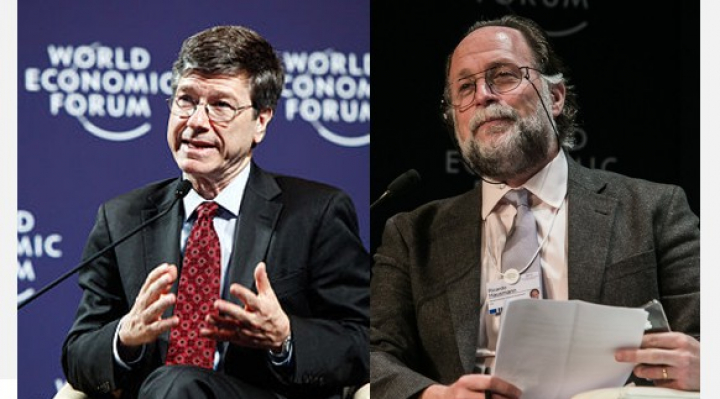
Jeffery Sachs (left) and Ricardo Hausmann
Between mid-1983 and mid-1984, a group of around 80 private businesspeople set out to draft a proposal to pull Bolivia out of its economic crisis. They met many times, agreeing that each meeting would focus on a specific topic.
On some issues, there was no debate. Everyone agreed that the fiscal deficit had to be drastically reduced, the role of the State in the economy had to be diminished, and the exchange rate had to be “realigned,” for example. When it came to foreign trade, there was consensus that trade policy should be open, with as few requirements as possible, and a single import tariff. But when it was proposed that the tariff be so low that smugglers would find it just as profitable to pay it as to continue smuggling (with its higher transportation costs, bribes, etc.), the representative of the National Chamber of Industries predictably opposed the idea vehemently. His arguments were the typical ECLAC-style ones: protection of the “infant industry,” Bolivia should aspire to industrialization, and so on. He lost.
Likewise, when the proposal to eliminate all controls on banking interest rates was raised, the representative of the Chamber of Commerce strongly objected. He lost too.
After several months, a consensus was reached on an economic program to save the “dying Bolivia.” The proposal was published in full as a special supplement of the newspaper Hoy on April 12, 1984 (perhaps also in other papers, but I only kept a copy of the Hoy supplement), under the title “Guidelines and Proposals from the Private Sector for an Economic Recovery Program.” The final draft was written by the Board of Directors of the Confederation of Private Businessmen of Bolivia (CEPB), which was then presided over by Fernando Illanes.
Not content with that, one of the businessmen raised, quite wisely, the question of whether everyone was sure the proposal was internally consistent. That is, was everyone certain that what was being proposed in one area did not contradict what was proposed in another? I don’t remember if it was that person or someone else, but it was also agreed that the proposal needed a kind of “seal of quality” from some prestigious academic institution or figure.
Some of the participants—or their advisors—had been students of Jeffrey Sachs at the John F. Kennedy School of Government at Harvard University. At the time, Sachs was not a well-known economist outside academic circles in the U.S. (some would say not even within them), but his Bolivian former students assured everyone he was brilliant and deeply interested in development issues. One fact alone convinced everyone: Jeffrey Sachs was the youngest economist ever to become a tenured professor in the history of Harvard—at age 28! (In the U.S. academic system, a professor typically attains tenure only after years of serving as an assistant and then an associate professor).
So, the CEPB sent a delegation to Boston to talk to Jeffrey. They laid out the seriousness of the crisis, the solutions proposed by the Bolivian private sector, and the need for academic validation. Jeffrey accepted the challenge on one condition: that he be accompanied by two of his students to help with statistical analysis. The CEPB agreed.
Thus, Jeffrey landed in La Paz a few weeks later, accompanied by Felipe Larraín and David Cohen. Felipe would later become Chile’s Minister of Finance, and David, last I tracked him, was an economics professor at a university in Paris. Two weeks later, Jeffrey gave his verdict: what the CEPB had proposed was internally consistent and the right path to tackle the economic crisis. He based his opinion on several numerical analyses, as far as data allowed. Given the time constraints, the calculations were quick.
If you compare the proposals published by the CEPB in April 1984 with Supreme Decree 21060, you will see a strong similarity. This reflects that the true “fathers” of DS 21060 were the CEPB Board members after the meetings of those 80 business leaders. Jeffrey played an important role, but not in the proposals themselves—only in validating them. And not because the CEPB members were geniuses, but because the recipe is classical and well-known. It also applies to the current crisis.
How do I know all this, and why bring it up now? Well, I don’t claim to be the creator of DS 21060—far from it—that club already has many members. But I was a privileged witness. In 1983, I was 23 years old and was hired as the first economist at the CEPB. When Jeffrey accepted the assignment, Fernando Illanes called me and said, “Amparo, I want you to stay close to Jeffrey and his team from the moment they land to the moment they leave. Help them get appointments with whoever they ask for and gather all the data they need, as long as it exists. Please give us verbal briefings every two days.”
So, during the two weeks of their visit, I attended every meeting that Jeffrey, Felipe, and David had. We started at 8 in the morning and ended late in the afternoon. Then we’d go to Jeffrey’s hotel and begin our follow-up analysis. Jeffrey had a very imaginative approach to doing “quick and dirty” calculations. He would come up with unconventional ways to estimate, for example, how much a devaluation would influence inflation and other similar issues.
Others have written about the relationship between Harvard and DS 21060 before—like Roberto Laserna, Raúl Peñaranda, and Juan José Toro. I’m telling this story now not just to set the historical record straight about the origins of DS 21060, but also because it parallels the recent Harvard meeting promoted by Marcelo Claure.
Just like back then, the current proposal from Harvard’s Growth Lab, led by Ricardo Hausmann, also follows the well-known and successful principles for resolving crises in developing countries. One of the key takeaways from the recent Harvard meeting was that the problem isn’t technical—it’s political. So there weren’t major disagreements, although there were important contributions that had been omitted in Hausmann’s initial pre-proposal presentation.
So, while in 1984 the proposal came from Bolivians and was validated by a Harvard professor, in 2025 it’s the reverse: the proposal came from Harvard and was validated by around 90 Bolivians who attended the meeting. The result was the same. That is, the commutative property applies to the relationship between Harvard and Bolivia.
Amparo Ballivián is an economist. She was a presidential pre-candidate in Bolivia.
Por Amparo Ballivián, Brújula Digital:
[Si quiere escuchar el resumen, use este link, gracias]
En 1984, empresarios bolivianos diseñaron un plan de ajuste (base del DS 21060) y lo validaron con Jeffrey Sachs. Hoy, Harvard (Ricardo Hausmann) propone soluciones similares para la crisis actual, ratificadas por 90 bolivianos. La receta es clásica: reducir déficit, liberalizar mercados y sincerar precios.
Jeffery Sachs (izq.) y Ricardo Hausmann
Entre mediados de 1983 y mediados de 1984 un grupo de unos 80 empresarios privados se dio a la tarea de elaborar una propuesta para sacar a Bolivia de la crisis económica en la que se encontraba. Se reunieron numerosas veces. Se acordó que en cada reunión se trataría un tema específico.
En algunos temas, no hubo discusión alguna. Todos coincidían en que se debía reducir drásticamente el déficit fiscal, reducir el rol del Estado en la economía y que se debía “sincerar” el tipo de cambio, por ejemplo. Cuando llegó el tema del comercio exterior, todos estaban de acuerdo en que la política comercial debía ser abierta, con la menor cantidad de requisitos posible y con un arancel de importación único. Pero cuando se propuso que esa tasa debía ser tan baja como para que al contrabandista le diera igual pagar el arancel o los costos del contrabando (mayor costo de transporte, coimas y otros), previsiblemente el representante de la Cámara Nacional de Industrias se opuso vehemente. Sus argumentos fueron los típicos cepalinos: protección a la “industria infantil”, Bolivia debía aspirar a ser un país industrial y adláteres. Perdió.
De igual manera, cuando se propuso eliminar todos los controles a las tasas de interés bancarias, el representante de la Cámara de Comercio objetó fuertemente. Perdió.
Después de varios meses, se llegó a un consenso sobre un programa económico para salvar a la “Bolivia que se moría”. La propuesta fue publicada, in extenso, en una separata del periódico Hoy, el 12 de abril de 1984 (tal vez también se publicó en otros periódicos, yo sólo guardo una copia de la separata de Hoy), bajo el título “Lineamientos y Proposiciones de la Empresa Privada para un Programa de Recuperación Económica”. El Directorio de la Confederación de Empresarios Privados de Bolivia (CEPB), por entonces presidida por Fernando Illanes, hizo la redacción final.
No contentos con ello, uno de esos empresarios planteó, con excelente tino, si es que estaban todos seguros que la propuesta era internamente consistente. Es decir, ¿estaban todos seguros que lo que se proponía en un tema no era incompatible con lo que se proponía en otro? No recuerdo si fue esa persona u otra, pero también se convino en que era necesario que la propuesta llevara una especie de “sello de calidad” de alguna institución o persona de prestigio académico internacional.
Algunos de los participantes, o sus asesores, habían sido alumnos de Jeffrey Sachs en la Escuela de Gobierno John F. Kennedy de la Universidad de Harvard. Por entonces, Sachs no era un economista muy conocido fuera del ámbito académico de EEUU (algunos dirán que ni siquiera dentro de él), pero sus exalumnos bolivianos aseguraban que era brillante y muy interesado en temas de desarrollo. Un solo dato sirvió para convencer a todos: Jeffrey Sachs era el economista más joven en obtener el cargo de “profesor titular” en toda la historia de Harvard, ¡a sus 28 años! (en el sistema universitario estadounidense se llega al cargo de profesor titular generalmente luego de haber pasado varios años como profesor asistente y, luego, como profesor asociado).
Así que la CEPB envió una delegación a Boston, para hablar con Jeffrey. Le plantearon la gravedad de la crisis, las soluciones que habían hecho públicas los empresarios privados bolivianos y la necesidad de que esas propuestas llevaran un aval académico. Jeffrey aceptó el reto, con la única condición de que lo acompañaran dos de sus alumnos, para ayudar en hacer los análisis estadísticos. La CEPB aceptó.
Es así que Jeffrey desembarcó en La Paz unas semanas después, acompañado de Felipe Larraín y David Cohen. Felipe luego fue Ministro de Finanzas de Chile y David, la última vez que le seguí el rastro, era profesor de economía en una universidad en París. Dos semanas después emitió su veredicto: lo que había propuesto la CEPB era internamente consistente y el camino adecuado para enfrentar la crisis económica. Sustentó su opinión en varios análisis numéricos, en la medida que existían los datos. Dadas las limitaciones de tiempo, fueron cálculos rápidos.
Si leen las propuestas publicadas por la CEPB en abril de 1984 y las contrastan con el Decreto Supremo 21060, verán una estrecha coincidencia. Lo cual refleja que, los genuinos “padres” del DS 21060 fueron los miembros del Directorio de la CEPB tras las reuniones de esos 80 empresarios. Jeffrey jugó un papel importante, pero no en las propuestas, sino en su validación. Y no es porque los miembros de la CEPB fueran unos genios, sino porque la receta es clásica y archiconocida. Y también se aplica a la actual crisis.
¿Cómo sé esto y porqué lo saco ahora? Pues yo no me doy de creadora del DS 21060, ni mucho menos, ese club ya tiene muchos miembros. Pero fui una testigo privilegiada. En 1983 yo tenía 23 años y fui contratada como economista (la primera) de la CEPB. Cuando Jeffrey aceptó el trabajo, Fernando Illanes me llamó y me dijo “Amparo, quiero que tú no te despegues de Jeffrey y su equipo desde que aterricen hasta que partan. Que los ayudes a conseguir las citas con quienes pidan y les consigas todos los datos que necesiten, en la medida en que existan. Por favor, haznos resúmenes verbales cada dos días”.
Es así que, durante las dos semanas que duró su visita, yo participé en todas las reuniones que tuvieron Jeffrey, Felipe y David. Empezábamos a las ocho de la mañana y terminábamos al terminar la tarde. Entonces nos íbamos al hotel de Jeffrey y empezábamos a hacer análisis posteriores. Jeffrey era una persona muy imaginativa para hacer cálculos “a la rápida”. Se le ocurría, por ejemplo, una forma poco convencional para saber cuánto influiría una devaluación en la inflación y otras cosas similares.
Otros han escrito antes sobre la relación entre Harvard y el 21060, como Roberto Laserna, Raúl Peñaranda y Juan José Toro. Yo saco este relato ahora no sólo para hacer conocer la verdad histórica sobre los orígenes del DS 21060, sino también porque tiene un paralelismo con la reciente reunión en Harvard, promocionada por Marcelo Claure.
Al igual que entonces, la propuesta actual del Harvard Growth Lab, que dirige Ricardo Hausmann, también responde a los muy conocidos y exitosos principios para resolver crisis en países en desarrollo. Entre las otras cosas que se acordaron en la reciente reunión en Harvard está que el problema no es técnico, es político. Así que no hubo grandes discusiones, aunque sí importantes aportes que habían sido omitidos en la presentación de la prepropuesta hecha por Hausmann.
Así que, si bien en 1984 la propuesta vino de los bolivianos y se le pidió validación a un profesor de Harvard, en 2025 la cosa fue a la inversa: la propuesta vino de Harvard y se les pidió validación a unos 90 bolivianos que asistimos a la reunión. El resultado fue el mismo. Es decir, la propiedad conmutativa se aplica a la relación entre Harvard y Bolivia.
Amparo Ballivián es economista. Fue precandidata a la presidencia de Bolivia.

 Bolivian Thoughts | Pensamientos Bolivianos (Bilingual/Bilingüe)