
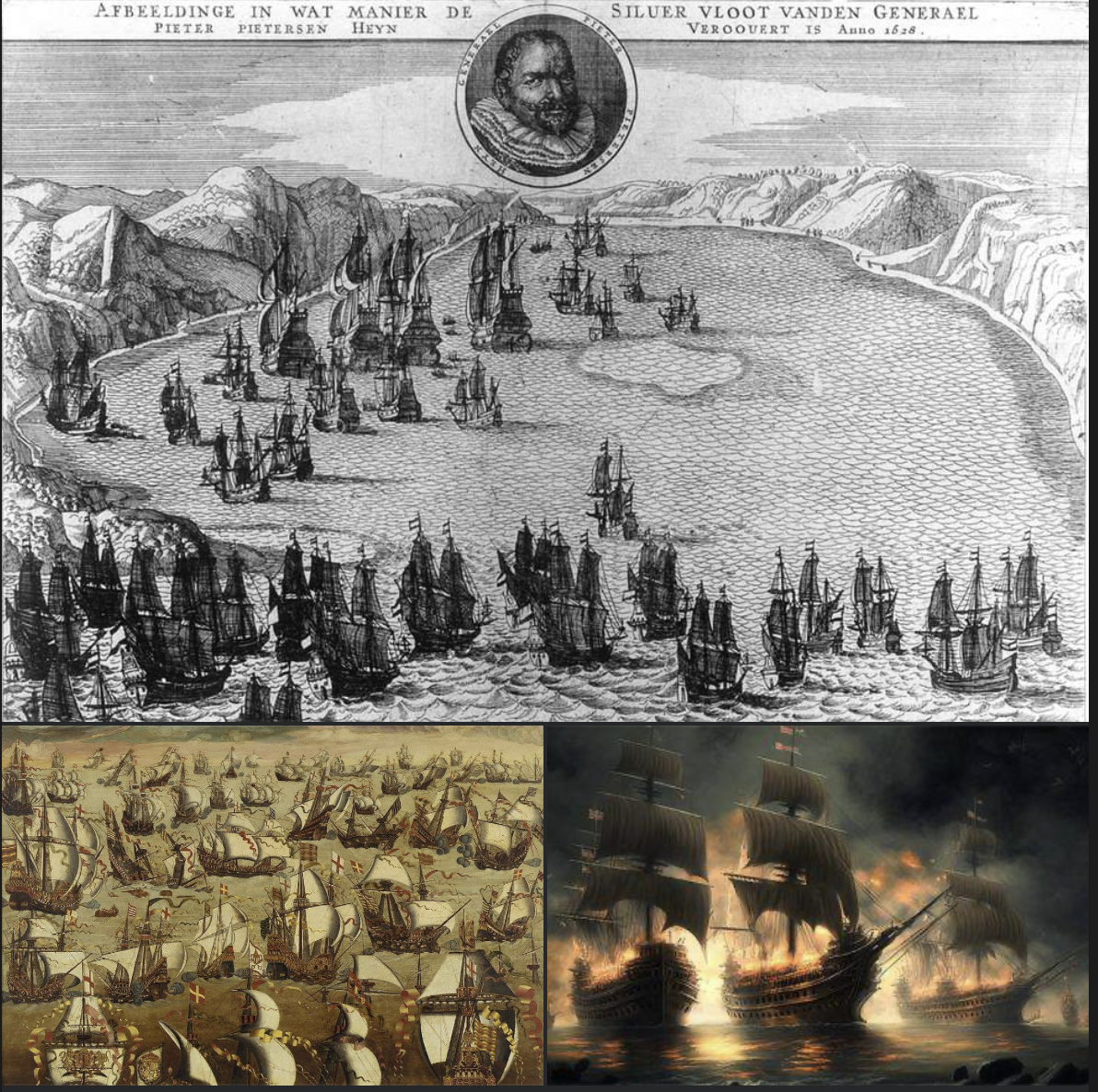
By History and Legend of the Imperial City of Potosí:
“FLEET OF THE INDIES, ALSO KNOWN AS THE SPANISH TREASURE FLEET, THE SILVER FLEET, OR SILVER VLOOT IN DUTCH, WAS THE NAVIGATION MECHANISM THROUGH WHICH THE INVALUABLE WEALTH OF THE IMPERIAL VILLA OF POTOSÍ WAS TRANSPORTED TO EUROPE AND ASIA.”
“The Armada of the South Sea or Spanish South Fleet” was composed of 6 galleons, 3 frigates, and 5 merchant ships, which arrived in Arica to collect more than 7,000 bars or ingots of Potosí silver and about 100,000 silver coins. They were then transported to the Port of Callao. When weather and wind conditions were favorable, they would weigh anchor to sail to Panama in a 20-day journey, provided there were no stops.
The timing of the navigation had to be precise, as they had to synchronize their arrival in Panama with the “Atlantic Fleet of the Galleons or the Mainland Fleet” arriving from Spain, which almost never happened. The galleons of the South Sea had to sometimes wait for months for the Spanish fleet’s arrival, with the risk of the treasure being attacked by English and Dutch pirates in Central America.
Once the Atlantic Fleet of the Galleons arrived, the enormous silver treasure was exchanged for European manufactures, and subsequently, the South Fleet returned to South America to patrol the coasts until it was time to make the next silver cargo delivery, as the treasure was sent to Spain twice a year. On the other hand, once the silver treasure was collected by the Atlantic Fleet of the Galleons or the Mainland Fleet, which was escorted by six or eight galleons and carried more than 20 merchant ships, it departed for Havana, where it was supposed to meet the fleet collecting riches from Mexico and North America, known as the “New Spain Fleet.” This fleet had less military power, as it only had 2 escort galleons and about 10 merchant ships.
In Havana, they waited for the escort warships coming from Spain, and when the entire enormous “Fleet of the Indies” was assembled, comprising about 8 galleons, 5 frigates, 30 merchant ships, and more than 10 warships, they departed on the return journey to Spain with all the treasures collected from America, and some ships headed to the Philippines for the exchange of silver with the Chinese Empire, embarking on a perilous journey full of pirates and storms that lasted four months, as the entire fleet traveled at the speed of the slowest and most heavily laden ships.
At the forefront of all the ships was the largest galleon or “Flagship” named “La Plata” because it carried the largest amount of treasure. During the night, it would light a large lantern at the stern to guide all the other ships, and at the rear traveled another galleon called the “Almiranta,” which protected the rear guard. However, there were also numerous heavily armed ships and galleons in the middle and at the extremes, guarding the merchant ships of the enormous Fleet of the Indies. Once the journey was completed, the fleet arrived at the ports of Seville in Spain and at the port of Manila in the Philippines, where thousands of coins and ingots of silver from the Imperial Villa of Potosí were unloaded to enrich the coffers of Spain, China, and, consequently, world trade.”
Por Historia y Leyenda de la Villa Imperial de Potosi:
“FLOTA DE INDIAS CONOCIDA TAMBIÉN COMO FLOTA DEL TESORO ESPAÑOL, FLOTA DE LA PLATA, SILVER FLEET EN INGLES O SILVER VLOOT EN HOLANDES, FUE EL MECANISMO DE NAVEGACIÓN MEDIANTE EL CUAL SE TRANSPORTABA A EUROPA Y ASIA LA INCALCULABLE RIQUEZA DE LA VILLA IMPERIAL DE POTOSÍ“
“La Armada del Mar del Sur o Flota del Sur Española” estaba compuesta de 6 galeones, 3 fragatas y 5 buques mercantes, las cuales llegaban a Arica y recogian mas de 7.000 barras o lingotes de plata potosina y 100.000 monedas de plata aproximadamente para luego ser transportadas al Puerto del Callao, cuando las condiciones climáticas y el viento eran favorables levaban anclas para zarpar a Panamá en un viaje de 20 dias si no existian escalas, los cálculos de tiempo de navegación debian ser precisos ya que debian sincronizarse en llegar a Panama juntamente con la “Flota Atlántica de los Galeones o de Tierra Firme” que llegaba de España, cosa que casi nunca ocurria, ya que los galeones del Mar del Sur debian esperar a veces meses a que llegue la flota española con el peligro de que el tesoro sea asaltado por piratas ingleses y holandeses en Centro América.
Una vez llegada la Flota Atlántica de los Galeones, intercambiaban el enorme tesoro de plata por manufacturas europeas y posteriormente la Flota del Sur retornaba a Sur América para patrullar las costas, hasta que sea tiempo de realizar el próximo viaje de entrega del cargamento de plata ya que se enviaba el tesoro a España dos veces al año. Por otro lado una vez que el tesoro de plata era recogido por la Flota Atlántica de los Galeones o de Tierra Firme que era custodiada por seis u ocho galeones y llevaba más de 20 buques mercantes partia a la Habana donde debía encontrarse con la flota que recogía las riquezas de Mexico y Norte América llamada “Flota de Nueva España” la cual tenia menos poder militarmente ya que solo poseía 2 galeones de escolta y unos 10 buques mercantes, en la Habana esperaban a los buques de guerra de escolta que llegaban de España y cuando toda la enorme “Flota de las Indias” ya estaba reunida abarcando unos 8 galeones, 5 fragatas, 30 buques mercantes y más de 10 buques de guerra, partían en viaje de retorno hasta España con todos los tesoros recogidos de América y otros partían hacia Filipinas para el intercambio de plata con el Imperio Chino, encaminandose en una travesia llena de peligros, piratas y tormentas que duraba cuatro meses, ya que toda la flota viajaba a la velocidad de los barcos más lentos y más cargados de riqueza.
Al frente de todos los barcos viajaba el galeón más grande o “Capitana” llamado de “La Plata” ya que llevaba la mayor cantidad de tesoros, la cual durante la noche encendia un gran farol a popa para guiar a todos los demás barcos y en la parte final viajaba otro galeón llamado la “Almiranta” que resguardaba la retaguardia, aunque también existian en medio y a los extremos una gran cantidad de buques y galeones fuertemente armados que resguardaban a los buques mercantes de la enorme Flota de Indias, una vez completada la travesia arribaban a los puertos de Sevilla en España y al puerto de Manila en Filipinas donde miles de monedas y lingotes de plata de la Villa Imperial de Potosí eran descargados para enriquecer las arcas de España, China y por ende el comercio mundial.”

 Bolivian Thoughts | Pensamientos Bolivianos (Bilingual/Bilingüe)