
By Mery Vaca, Sumando Voces, Luz Mendoza, Eju. tv:
Madidi: A study by the Ombudsman’s Office establishes “incompatibility” of mining with the category of Park or Natural Area in all analyzed cases
The current Bolivian regulations allow mining in protected areas, provided that related environmental standards are met and that mining does not affect the protection objectives of the area.
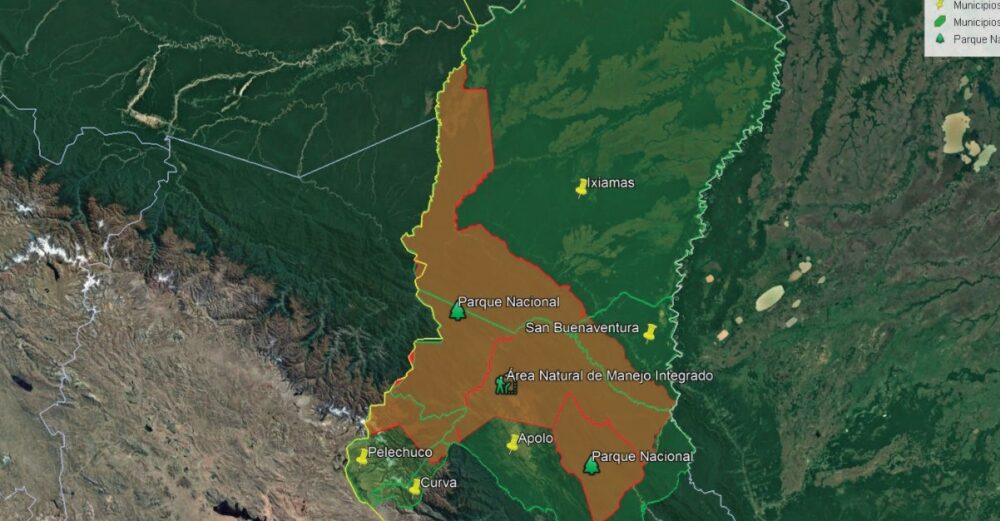
A report by the Ombudsman’s Office titled “Our Home Without Rights,” referring to Madidi Park, indicates that in all analyzed cases, there is incompatibility between mining activities and the category of National Park (NP) and National Integrated Management Area (ANMI). The analyzed cases total 61.
“Madidi NP–ANMI: all the Certificates of Compatibility of Uses (CCU) reviewed by the Ombudsman’s Office indicated the incompatibility of mining in both the National Park category and the Natural Integrated Management Area,” concludes the report, which was presented this week.
This means that mining activities cannot exist in Madidi, except in cases of so-called preconstituted areas, that is, those that existed before Madidi was declared a National Park.
However, the report states, “the number of preconstituted mining areas within Madidi National Park is significantly smaller compared to the number of mining contract applications seeking to establish operations in this protected area.”
In 2022, the Administrative Jurisdictional Mining Authority (AJAM) reported 195 mining contract applications in Madidi, compared to 31 preconstituted rights. In 2023, the same institution reported “an absolute restriction on processing mining areas within Madidi National Park, as well as the initiation of a comprehensive analysis of the mining applications, including the evaluation of the Certificates of Compatibility of Uses issued by the National Service of Protected Areas (SERNAP).”
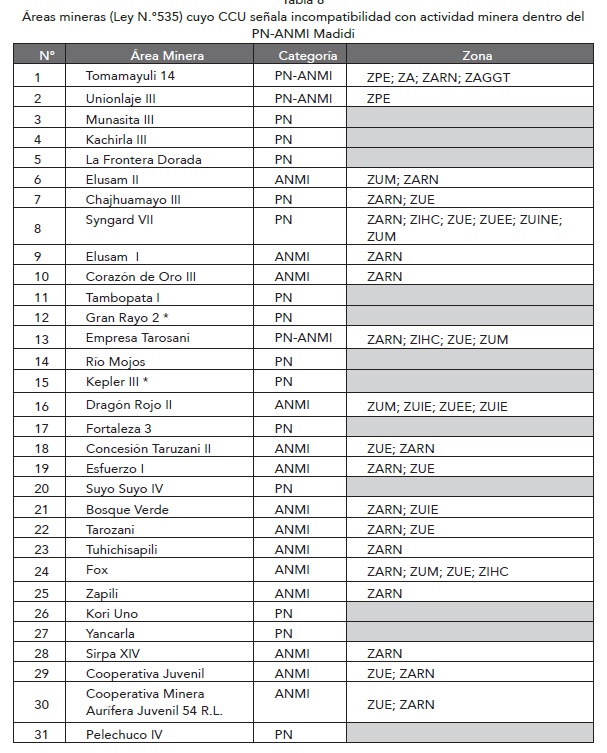
The Ombudsman’s report includes a table with 61 mining cases incompatible with the park, based on SERNAP information.
“As evidenced, the mining contract applications under Law No. 535 within Madidi National Park, whether located in the NP or ANMI category, or even in any zones established in the RGAP (General Regulations of Protected Areas), are incompatible with mining activities. In other words, the technical criteria provided by SERNAP and the Protected Areas Directorate indicate that no new mining activities can be established within Madidi National Park,” states the document accessed by Sumando Voces.
The current regulations allow mining in protected areas, provided that related environmental standards are met and the mining activities do not affect the area’s protection objectives. One of the requirements established by the regulation is the Certificate of Compatibility of Uses (CCU), a technical document issued by SERNAP that spatially determines the compatibility of a specific Activity, Work, or Project with the creation objectives, management tools, categorization, and zoning of a protected area.
However, despite the explicit prohibition of mining activities in the park, the reality is that they exist, and far from being an invisible activity, they are carried out with large amounts of machinery, personnel, and even armed individuals, according to the same report.
Quoting SERNAP, the document states that “there has been an increase in the number of people interested in mining exploitation within Madidi National Park, a situation evidenced by the number of individuals appearing at protected area offices, the increase in machinery entering the park, as well as the rise in fuel brought into the area.”
Nevertheless, SERNAP reportedly admitted that “its actions have been overwhelmed by the social mobilization accompanying the entry of machinery into the territory.”
Madidi National Park, established in 1995, is home to significant biodiversity due to its variety of ecological zones, ranging from 6,000 meters above sea level in the Apolobamba mountain range to the Amazonian lowlands at 300 meters. Within this protected area, over 9,000 species have been identified, including 40% of the country’s plant species, 48% of butterfly species, 50% of vertebrates, and 71% of bird species, according to the Ombudsman’s document.
“A Mirage of Development”
The report highlights that mining presents itself “as a mirage of development for families” in Madidi. However, “the potential impacts of open-pit mining combined with the effects of mercury use in alluvial gold extraction are not evaluated.”
It adds that the living conditions of indigenous and peasant families in Madidi are precarious, with limited access to sustainable development plans for improving health, education, communication, and dignified housing, among others.
The report also warns of armed individuals “positioned at the entrances to territories where mining takes place, restricting free movement, indicating a weak presence of competent authorities to exercise control and oversight.”
The document further cautions about the effects of mining on human rights, the rights of Mother Earth, and the environment in general.
It calls for the prohibition of mercury use in gold mining within protected areas and offers recommendations for authorities to develop policies addressing this issue.
Por Mery Vaca, Sumando Voces, Luz Mendoza, Eju. tv:
Madidi: Estudio de la Defensoría establece “incompatibilidad” de la minería con la categoría de Parque o Área Natural en todos los casos analizados
La normativa boliviana en vigencia admite la realización de minería en áreas protegidas, siempre que se cumpla las normas ambientales conexas y cuando la minería no afecte los objetivos de protección del área.
Un informe de la Defensoría del Pueblo, titulado “Nuestra casa sin derechos” referido al parque Madidi, indica que en todos los casos analizados, existe incompatibilidad entre la actividad minera y la categoría de Parque Nacional (PN) y Área Nacional de Manejo Integrado (ANMI). Los casos analizados son 61.
“PN –ANMI Madidi el total de los Certificados de Compatibilidad de Usos (CCU) conocidos por la Defensoría del Pueblo señalaba la incompatibilidad de la minería tanto en la categoría Parque Nacional como Área Natural de Manejo Integrado”, concluye el reporte que fue presentado esta semana.
Esto significa que no puede existir actividad minera en el Madidi, salvo en los casos de las denominadas áreas preconstituidas, es decir, aquellas que existían antes de que el Madidi fuera declarado Parque Nacional.
Sin embargo, dice el informe, “el número de áreas mineras preconstituidas al interior del Parque Nacional Madidi es bastante menor frente al número de trámites de contrato minero que pretenden instalarse en esta área protegida”.
En 2022, la Autoridad Jurisdiccional Administrativa Minera (AJAM) reportó que existían 195 trámites de contrato minero en el Madidi, frente a los 31 derechos preconstituidos y el 2023, la misma institución informó que “se había establecido una restricción absoluta para el trámite de áreas mineras al interior del Parque Nacional Madidi, además de que se había iniciado un proceso de análisis integral respecto a los trámites mineros iniciados, incluyendo la valoración de los Certificados de Compatibilidad de Usos emitidos por el Servicio Nacional de Áreas Protegidas (SERNAP)”.
El informe de la Defensoría acompaña un cuadro con 61 casos de trámites mineros que no son compatibles con el parque, elaborado con base en información del SERNAP.
“Como pudo evidenciarse, las solicitudes de contrato minero en el marco de la Ley N°535 dentro del Parque Nacional Madidi, sea que se ubiquen en la categoría PN o ANMI, e incluso, se ubiquen en cualquiera de las zonas establecidas en el RGAP (Reglamento General de Áreas Protegidas), son incompatibles con la actividad minera. Es decir, el criterio técnico emanado por el SERNAP y la Dirección del AP (Áreas Protegidas), es que no pueden instalarse actividades mineras nuevas dentro de Parque Nacional Madidi”, señala el documento, al que accedió Sumando Voces.
La normativa en vigencia admite la realización de minería en áreas protegidas, siempre que se cumpla las normas ambientales conexas y cuando la minería no afecte los objetivos de protección del área. Uno de los requisitos establecidos en la norma es el Certificado de Compatibilidad de Usos (CCU), el cual es un documento técnico emitido por el SERNAP que geo-espacialmente establece la compatibilidad de una determinada Actividad Obra o Proyecto con los objetivos de creación e instrumentos de gestión, con la categorización y zonificación de un área protegida.
Sin embargo, y pese a la prohibición expresa de que se establezcan actividades mineras en el parque, la realidad es que ésta existe y que, lejos de ser una actividad invisible, se exhibe con gran cantidad de maquinaria, gente y hasta personas armadas, según el mismo reporte.
Citando al SERNAP, el documento indica que “ha habido un incremento en el número de personas interesadas en trabajar la explotación minera en el Parque Nacional Madidi, situación que se evidencia en la cantidad de apersonamientos de interesados en oficinas del área protegida, aumento de maquinaría que ingresa al parque, así como de combustible”.
Sin embargo, el mismo SERNAP habría señalado que “sus acciones se han visto rebasadas ante la movilización social que acompaña el ingreso de maquinaría al territorio”.
El Parque Nacional Madidi, que fue creado el año 1995, alberga una importante biodiversidad, ello se debe a su variedad de pisos ecológicos distribuidos desde los 6.000 m.s.n.m., de la cordillera de Apolobamba, hasta las pampas amazónicas a una altura de 300 m.s.n.m. En esta AP se han logrado identificar más de 9.000 especies, además, en este territorio se halla el 40% de las especies de plantas, el 48% de especies de mariposas, el 50% de los vertebrados, así como el 71% de las aves del país, según el documento de la Defensoría.
“Un espejismo de desarrollo”
El reporte indica que la minería se posiciona “como un espejismo de desarrollo para las familias” del Madidi, sin embargo, “no se evalúa los impactos potenciales de la minería a cielo abierto sumada a los efectos del uso de mercurio en la concentración de oro aluvial”.
Agrega que las condiciones de vida de las familias indígenas y campesinas del Madidi son precarias, con pocas posibilidades de acceso a planes de aprovechamiento sustentable para la mejora de las salud, educación, comunicación, vivienda digna, etc.
Incluso, el reporte advierte sobre la presencia de personas que portan armamento “posicionadas en el ingreso a los territorios, donde se efectúa la minería, que impiden la libre circulación, lo que denota una escasa presencia de las autoridades competentes para ejercer control y fiscalización”.
El informe también alerta sobre los efectos de la minería sobre los derechos humanos, derechos de la madre tierra y el entorno en general.
Pide que se evite el uso de mercurio en la minería aurífera que se desarrolla en las áreas protegidas y hace recomendaciones para las autoridades planteen políticas en torno al tema.

 Bolivian Thoughts | Pensamientos Bolivianos (Bilingual/Bilingüe)