
By Marco Antonio Belmonte, Vision 360:
Ipsos Ciesmori Data
84% of those surveyed reported having difficulties obtaining dollars. Regarding fuel subsidies, 56% support the elimination of these subsidies, according to the Ipsos Ciesmori poll.
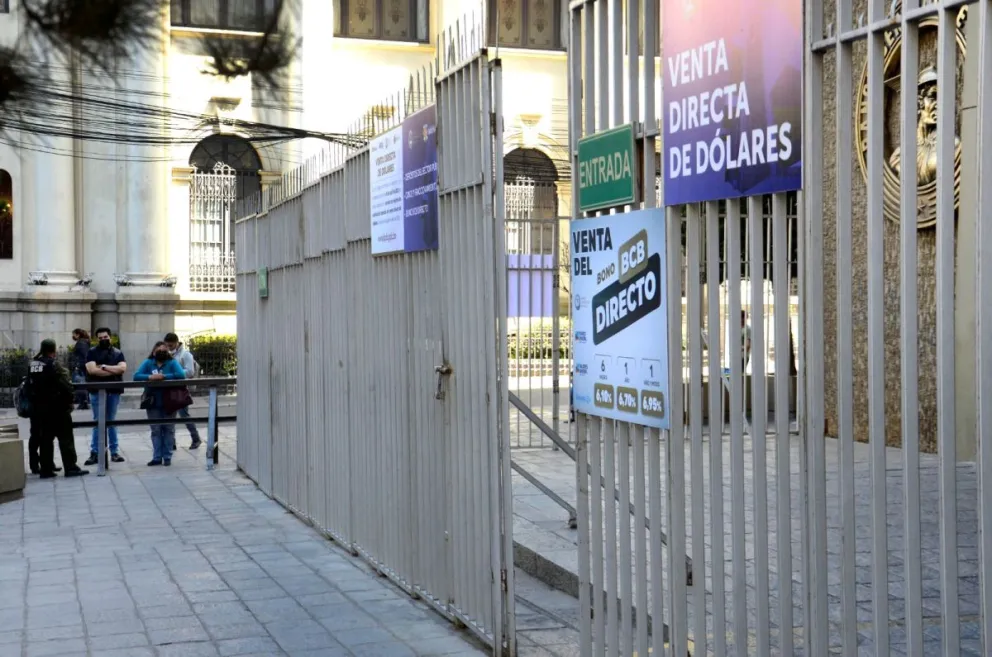
BCB decided last year to sell dollars directly. Photo: ABI
The lack of dollars is perceived as the factor most affecting the current economic situation, according to an Ipsos Ciesmori survey. More than half of those interviewed support the removal of fuel subsidies—some believe it should be done gradually, while others think it should happen all at once. This was revealed by the Public Opinion Monitor, third quarter 2024, conducted by the company through surveys in the central urban areas.
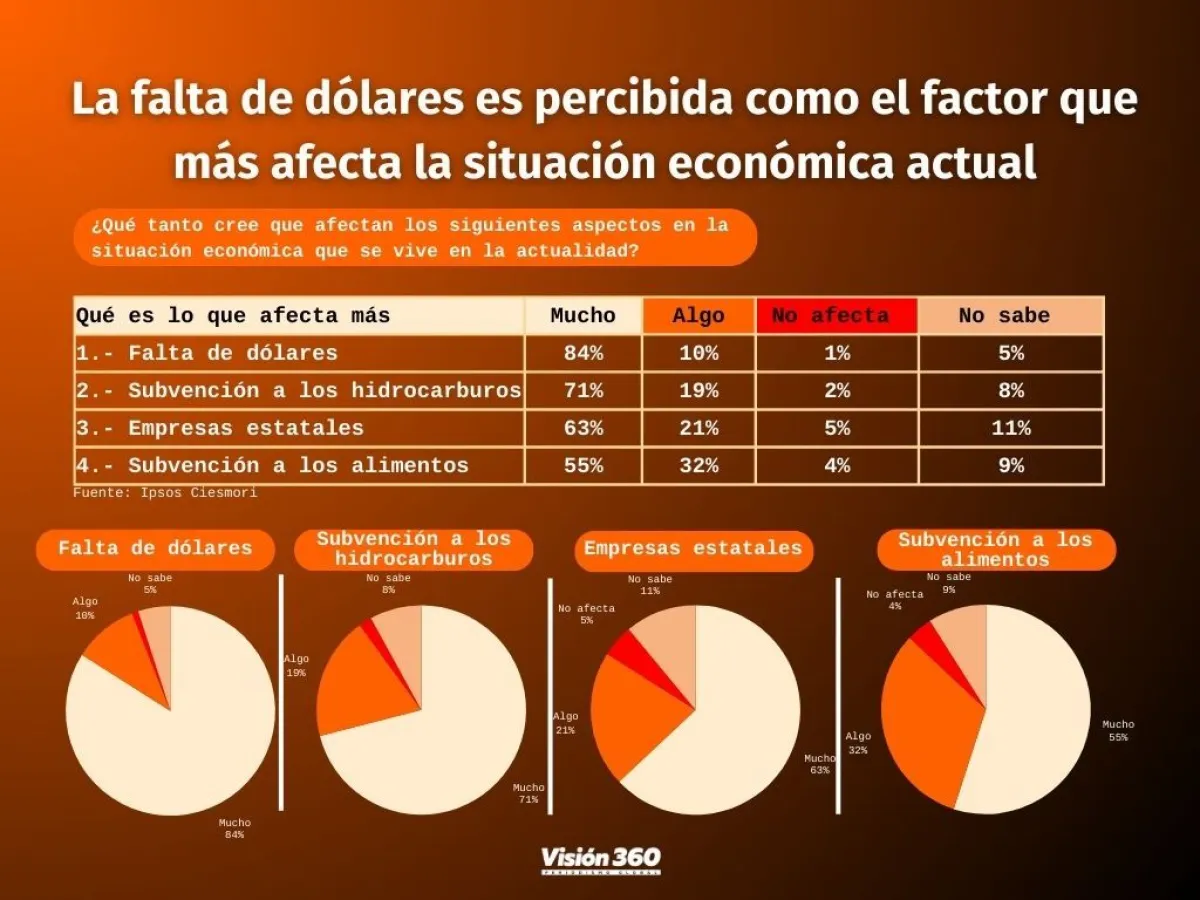
The survey asked, “How much do you believe the following aspects affect the current economic situation?”
84% of respondents said that the dollar shortage is the most impactful factor on the current economic situation. Additionally, 71% believe that fuel subsidies are a significant factor, 63% point to state-owned enterprises, and 55% highlight food subsidies.
Have you had trouble obtaining dollars in the last month?
In response to this question, 84% of survey participants—about two-thirds—indicated they had difficulties obtaining dollars in the past month, highlighting the currency shortage in the country.
56% of respondents said they faced significant challenges, 13% reported some difficulties, 29% stated they did not attempt to obtain dollars, and only 2% claimed they had no difficulties.
Fuel Subsidy
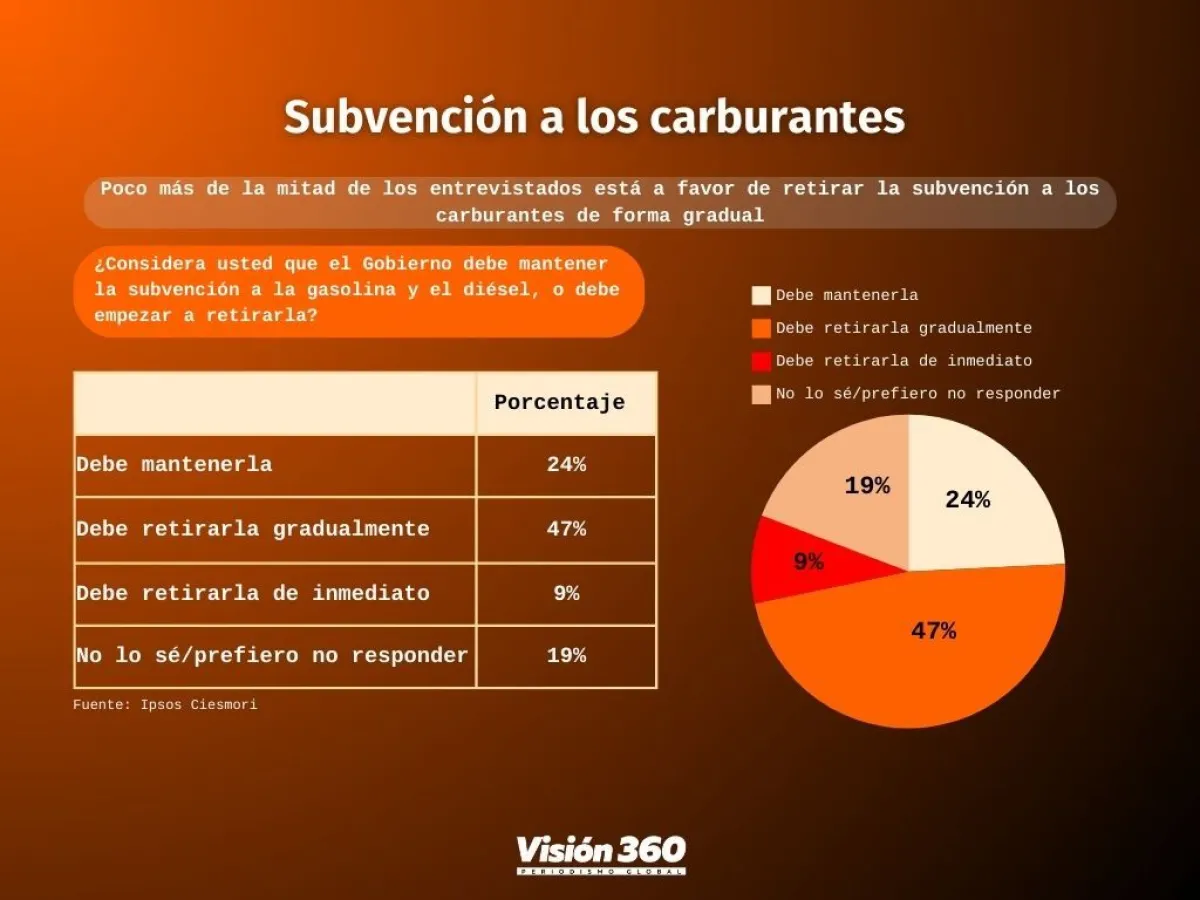
According to the Ipsos Ciesmori survey, more than half of respondents support gradually removing the fuel subsidy.
When asked, “Do you believe the government should maintain the gasoline and diesel subsidies, or start phasing them out?”
47% answered that the subsidy should be gradually removed, 9% said it should be eliminated immediately, 24% believed it should be maintained, and 19% were unsure or preferred not to respond.
In August this year, the Ministry of Hydrocarbons reported that the cost of the gasoline and diesel subsidy had already exceeded $2 billion by that month.
In 2023, the hydrocarbon subsidy closed at a cost of 12.678 billion bolivianos (over $1.8 billion), which was 65.8% higher than initially projected in the General State Budget (PGE), according to the Ministry of Economy.
Of this amount, 12.477 billion bolivianos were allocated to diesel and gasoline, while 202 million bolivianos were directed toward incentives and other expenses.
For 2024, the PGE has projected a subsidy cost of 9.803 billion bolivianos ($1.406 billion) for fuels.
On August 6, President Luis Arce proposed a referendum for the population to decide whether to continue the fuel subsidies.
The Survey
The Monitor of Public Opinion (MOP) is a systematic study conducted monthly by Ipsos Ciesmori in the four main cities of Bolivia. Its results are compared with global data from over 30 countries, providing a local context with a global perspective.
The sample size for the survey was 1,200 cases. The design and sample size provide a reference margin of error of ±2.72, according to the company.
Surveys were self-administered online via fixed internet connections, social networks, and mobile connections. Men and women aged 18 and older with internet access, either through computers, tablets, or cell phones, were surveyed. The fieldwork was conducted from July 5 to 17, August 9 to 16, and September 7 to 12.
Por Marco Antonio Belmonte, Vision 360:
Datos de Ipsos Ciesmori
El 84% de los entrevistados afirma que tuvo dificultades conseguir dólares. Sobre la subvención a los carburantes, el 56 por ciento apoya la eliminación de la subvneción, según la encuesta de Ipsos Ciesmori.
El BCB el año pasado decidió la venta directa de dólares. Foto:ABI
La falta de dólares es percibido como el factor que más afecta la situación económica actual, según una encuesta de Ipsos Ciesmori y más de la mitad de los entrevistados está a favor de retirar la subvención a los carburantes, algunos opinan que se debe hacer de forma gradual y otros pocos, de una vez. Así lo revela el Monitor de Opinión Pública, tercer trimestre 2024 elaborado por la empresa con encuestas en las ciudades del eje central.
¿Qué tanto cree que afectan los siguientes aspectos en la situación económica que se vive en la actualidad? Fue la pregunta que se realizó en la consulta sobre el eje económico.
Un 84% respondió que la falta de dólares es percibido como el factor que más afecta la situación económica actual. Otro 71% piensa que el otro factor es la subvención a los carburantes, un 63%, lo que ocurre con las empresas estatales, y un 55%, la subvención a los alimentos.
¿Ha tenido dificultades para conseguir dólares en el último mes?
En esta otra pregunta, el 84%, es decir dos tercios de los encuestados, afirmó que han tenido dificultades para conseguir dólares en el último mes, lo que refleja la escasez de divisas en el país.
Un 56% respondió que ha tenido muchas dificultades, un 13% dijo que tuvo algunas dificultades, un 29% respondió que no intentó conseguir dólares y solo un 2% manifestó que no tuvo dificultades.
Subvención a los hidrocarburos
Según la encuesta de Ipsos Ciesmori, más de la mitad de los encuestados está a favor de retirar la subvención a los carburantes de manera gradual.
¿Considera usted que el Gobierno debe mantener la subvención a la gasolina y el diésel, o debe empezar a retirarla?
Un 47% respondió que se debe retirar de forma gradual, un 9% manifestó que se tiene que retirar de inmediato, un 24% sostuvo que se debe mantener y un 19% no sabe o prefiere no responder.
En agosto de este año, el Ministerio de Hidrocarburos, informó que el costo de la subvención a la gasolina y diésel ya superaba los 2.000 millones de dólares hasta ese mes.
El año 2023, la subvención a los hidrocarburos cerró con un costo de 12.678 millones de bolivianos (Más de 1.800 millones de dólares), superior en 65,8% a lo proyectado inicialmente en el Presupuesto General del Estado, según información del Ministerio de Economía.
De este valor, 12.477 millones de bolivianos correspondió a diésel y gasolina y 202 millones de bolivianos a incentivos y otros.
Para este año en el PGE 2024, el Gobierno proyectó un costo de 9.803 millones de bolivianos (1.406 millones de dólares) como subvención a los carburantes.
El 6 de agosto el presidente Luis Arce, planteó un referendo para que la población decida o no la continuidad de la subvención a los hidrocarburos.
La encuesta
El Monitor de Opinión Pública (MOP) es un estudio sistemático realizado mensualmente por Ipsos Ciesmori en las 4 ciudades del Eje Troncal de Bolivia cuyos resultados se contrastan con los datos obtenidos por nuestra operación global en más de 30 países, lo cual permite tener una mirada enfocada en el contexto local y su relación con la coyuntura mundial.
El tamaño muestra de la encuesta fue de 1.200 casos. El diseño y tamaño muestral permiten observar los resultados con un margen de error referencial de + 2,72, según la empresa.
Se realizaron encuestas online autoadministradas, a través de conexiones fijas de internet, redes sociales y conexiones móviles. Se consultó a hombres y mujeres mayores de 18 años con conexión a Internet, ya sea mediante computadora, Tablet o celular. El trabajo de campo se hizo en julio, del 5 al 17; en agosto, del 9 al 16 y en septiembre, del 7 al 12.

 Bolivian Thoughts | Pensamientos Bolivianos (Bilingual/Bilingüe)