
The following piece is from “Proyecto Tuja” (Facebook), the link at the end is from the orignal book by Edmond Temple:
“Magnificent observer, the Englishman Edmond Temple (Knight of the Royal Order of Carlos II) left for posterity a chronicle of his passage through Potosí in 1830.
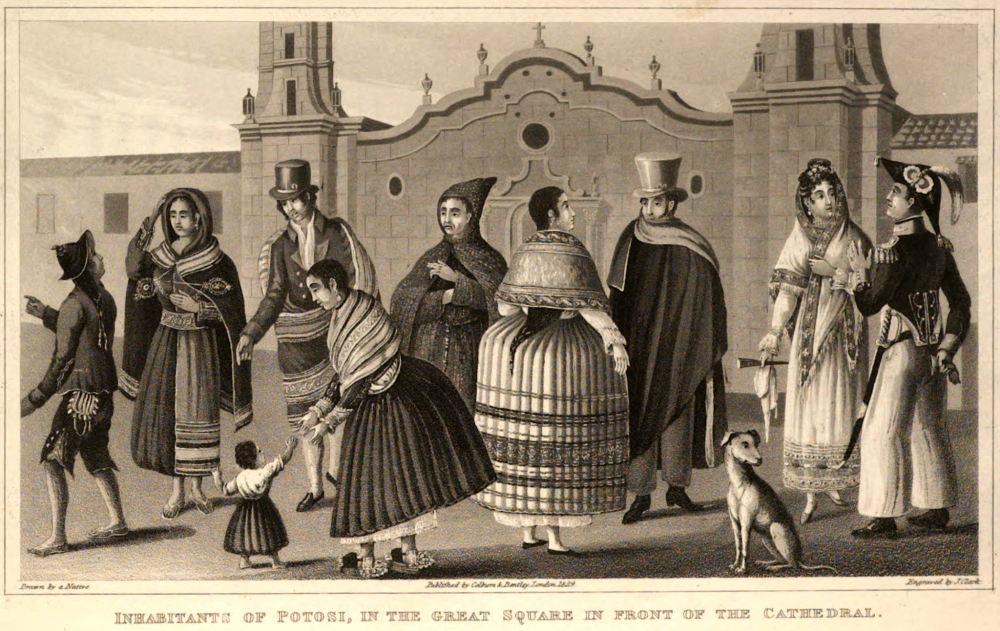
We extract some fragments from the book and an illustration found in it (the soldier depicted represents the Colombian forces present in Bolivia during those years).
Continuing my walk through the town, I visited the public market stalls, where I did not expect to see such abundance of everything in the midst of a barren mountainous desert. Beef, lamb, pork, and llama meat (which in taste resembles lean lamb and, being very cheap, is used by the poorest classes) could be obtained, but not like in the cities of Europe, it would be called prime meat.
There were abundant fruits and vegetables. There were many different varieties of potatoes, some of which I had never seen before. Potatoes constitute the main food of the Indians, or rather the principal ingredient of their diet; because they seem to comprehend the art of cooking infinitely better than the lower class of the Irish, who generally subsist on “potatoes and salt,” in many cases without a “drop of milk,” and sometimes, such is their poverty, without even a “grain of salt” to flavor their bland food.
The Indians prepare their round clay pot in a very tasty and substantial manner; their native llama provides them with meat, salt is obtained in various districts in immense blocks, and they have chili in abundance and like it very much.
To these ingredients is added, in considerably greater proportion, the potato, and also corn, whose excellence as food and the various forms in which it is prepared for both rich and poor in this country seem completely unknown in Europe.
I must not omit to mention a kind of food made from potatoes, called here chunu, which is considered a great delicacy and was held in high esteem in the days of the Incas. I am not sure of the exact method by which chunu is made, but the first process consists of completely freezing the potatoes, then crushing them and drying them in the sun, in which state they will keep uniformly for years and form a healthy and substantial mass.
Text and Illustration: book “Travels in various parts of Peru, including a year’s residence in Potosi”.”
https://books.google.com.pe/books?id=mBJjAAAAMAAJ&printsec=frontcover#v=onepage&q=Potosi&f=false
El siguiente artículo es de “Proyecto Tuja” (Facebook), el enlace al final es del libro original de Edmond Temple:
“Magnífico observador, el inglés Edmond Temple (Caballero de la Real Orden de Carlos II) dejó para la posteridad una crónica sobre su paso por Potosí, en 1830.
Extraemos unos fragmentos del libro y una ilustración que se halla en el libro (el militar que aparece, representa a las fuerzas colombianas que se hallaban en Bolivia aquellos años).
Continuando mi paseo por el pueblo visité las canchas del mercado público, donde no esperaba ver tanta abundancia de todo en medio de un árido desierto montañoso. Se podía conseguir carne de res, cordero, cerdo y llama (que en sabor se parece al cordero magro y, al ser muy barata, es utilizada por las clases más pobres), pero no como en las ciudades de Europa, se llamaría carne de primera.
Había abundantes frutas y verduras. Había muchas variedades diferentes de patatas, algunas de las cuales nunca había visto antes. Las papas constituyen el alimento principal de los indios, o más bien el ingrediente principal de su alimentación; porque parecen comprender el arte de la cocina infinitamente mejor que la clase baja de los irlandeses, que generalmente subsisten a base de “papas y sal”, en muchos casos sin un “sorbo de leche” y, a veces, tal es su pobreza. sin siquiera un “grano de sal” para saborear su comida empalagosa.
Los indios preparan su olla redonda de barro de una manera muy sabrosa y sustanciosa; su llama nativa les proporciona carne, la sal se obtiene en diversos distritos en bloques inmensos, el ají lo tienen en abundancia y le gustan mucho.
A estos ingredientes se añade en proporción considerablemente mayor la papa, y también maíz, cuya excelencia como alimento y las diversas formas en que se prepara tanto para ricos como para pobres en este país parecen totalmente desconocidas Europa.
No debo omitir mencionar una especie de alimento hecho de papa, y llamado aquí chunu, que se considera un gran manjar y se tenía en gran estima en los días de los Incas. No estoy seguro del método exacto mediante el cual se elabora el chun, pero el primer proceso consiste en congelar completamente las patatas, luego machacarlas y secarlas al sol, en cuyo estado se mantendrán uniformes durante años y formarán una masa saludable y sustancial.
Texto e Ilustración: libro “Travels in various parts of Peru, including a year’s residence in Potosi”.”
https://books.google.com.pe/books?id=mBJjAAAAMAAJ&printsec=frontcover#v=onepage&q=Potosi&f=false

 Bolivian Thoughts | Pensamientos Bolivianos (Bilingual/Bilingüe)