
Journalism under multidimensional violence
In Bolivia, restriction on freedom of expression is high
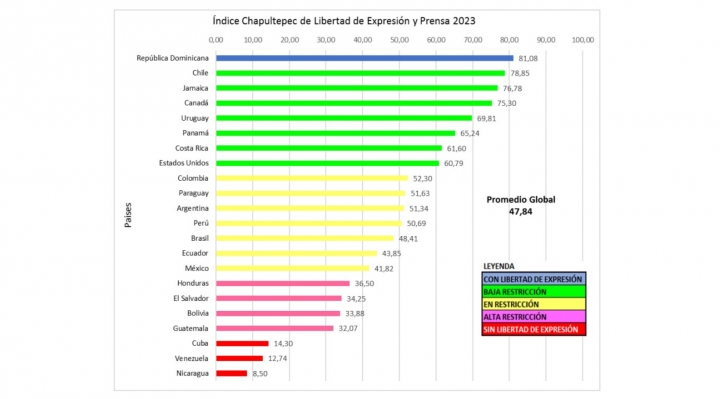
“Bolivia gets worse in 2023.” With that phrase begins the executive summary of the Chapultepec Index for the last year referring to the country and which is titled “Journalism under multidimensional violence.” This barometer, which measures institutional actions on freedom of expression and the press in 22 countries in the Americas, indicates that Bolivia has fallen from “partial restriction to high restriction,” after the closure of the newspaper Página Siete, physical attacks on journalists, the judicialization of cases and cyberbullying.
In the comparative table it has fallen from 16th place to 18th place among the 22 countries analyzed, with a score of 33.88 compared to the 42.72 it obtained last year. Below Bolivia are only Guatemala, Cuba, Venezuela and Nicaragua. These last three countries, according to the index, do not have freedom of expression.
Regarding Bolivia, the report indicates that “the deterioration of the conditions of the exercise of freedom of expression and of the press has followed a negative and alarming trend under contexts of increasing violence, permanent threat, coercion and persecution of journalistic work from the constituted powers that be and their allies.”
Adds that “stigmatizing speeches, threats, judicial actions and acts of violence against journalists are part of the strategy of the State, its associates and irregular groups in search of a gradual silencing of questioning voices and warnings against the corruption, the violation of fundamental rights and crime.”
And, among the examples of this situation, cites the closure of the newspaper Página Siete, which occurred on June 29 of this year. “Along with the official advertising blockade, these operations have led to the closure of one of the country’s main print media and the dismissal of several journalists,” says.
The Chapultepec Index is prepared by the Inter-American Press Association (IAPA), which, in turn, is an organization made up of more than 1,300 print media, television stations, radio stations and digital natives, as well as press associations, service provider companies and individuals.
The report was presented a week ago and, on this occasion, it cites among its sources the 2022 Situation Report, from the Unitas network, which was published in July of this year.
POLITICAL CONTEXT
The report states that Bolivia has faced an economic crisis in the last year, a division of the ruling party for leadership and has been the scene of a fight by social, political and civic sectors against the abuse of power. These aspects “have generated the conditions conducive to exercising multiple violence against those who work to inform,” the report indicates.
The document indicates that “the police action has permanently committed abuses, or has remained indifferent – like the judicial body – in the face of physical and verbal attacks from sectors related to the MAS (arcistas or evistas) directed towards journalists or media.”
And the report cites a new element: the attack from cyberspace, which includes cyber boycotts of independent information sites, strong threats and stigmatization and hate campaigns against journalists, disinformation and constant harassment by digital warriors.
THE CASES
The report points out the most relevant cases, which are the following:
Political pressures and economic and tax enclosures: “The closing of one of the newspapers critical of the government, due to threats, tax coercion and financial asphyxiation has deteriorated the dangerous scenario through which Bolivia today drops places in the index of freedom of expression and of the press.” Also cites the case of the newspaper Los Tiempos.
Kidnapping of journalists in Las Londras: “So far there have been no sanctions of any kind; the main accused were acquitted.”
Acts of physical violence against journalists: In the 28 days of civic strike in Santa Cruz, at least 20 cases of violence against journalists were recorded. In demonstrations in La Paz, journalists were also attacked.
Cyberbullying: Cites the 1,600 accounts dismantled by Meta and a report by Chequea Bolivia that shows the negativity of messages against journalists on social networks.
Judicialization of cases against journalists: Lists cases of judges who asked journalists to reveal their sources and even cases of journalists who were arrested. (Brújula Digital/Sumando Voces)
Periodismo bajo violencia multidimensional
En Bolivia restricción a la libertad de expresión es alta
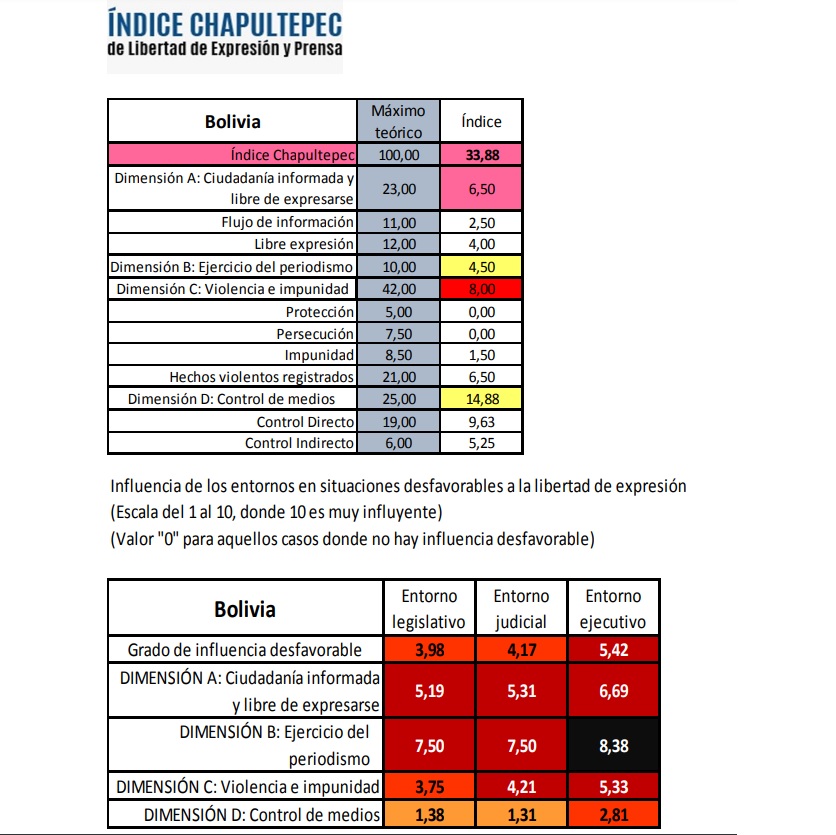
“Bolivia empeora este 2023”. Con esa frase inicia el resumen ejecutivo del Índice Chapultepec del último año referido al país y que se titula «Periodismo bajo violencia multidimensional». Este barómetro, que mide las acciones institucionales de libertades de expresión y de prensa en 22 países de las Américas, indica que Bolivia ha caído de una “parcial restricción a una alta restricción”, tras el cierre del periódico Página Siete, las agresiones físicas a periodistas, la judicialización de casos y el ciberacoso.
En la tabla comparativa ha caído del puesto 16 al puesto 18 entre los 22 países analizados, con una puntuación de 33,88 frente al 42,72 que obtuvo el año pasado. Debajo de Bolivia sólo se encuentran Guatemala, Cuba, Venezuela y Nicaragua. Estos tres últimos países, según el índice, no tienen libertad de expresión.
Respecto a Bolivia, el informe señala que “el deterioro de las condiciones del ejercicio de la libertad de expresión y de prensa ha seguido una tendencia negativa y alarmante bajo contextos de violencia creciente, amenaza permanente, coacciones y persecución a la tarea periodística desde los poderes constituidos y sus aliados”.
Agrega que “los discursos estigmatizadores, las amenazas, acciones judiciales y los hechos de violencia en contra de periodistas forman parte de la estrategia del Estado, de sus allegados y de grupos irregulares en busca de un paulatino silenciamiento de voces cuestionadoras y de alerta ante la corrupción, la vulneración de derechos fundamentales y la criminalidad”.
Y, entre los ejemplos de esta situación cita el cierre del periódico Página Siete, ocurrido el 29 de junio de este año. “Junto al cerco publicitario oficial, estas operaciones han dado lugar al cierre de uno de los principales medios escritos del país y al despido de varios periodistas”, indica.
El Índice Chapultepec es elaborado por la Sociedad Interamericana de Prensa (SIP) que, a su vez, es una organización integrada por más de 1.300 medios impresos, televisoras, radios y nativos digitales, además de asociaciones de prensa, empresas proveedoras de servicios e individuos.
El informe fue presentado hace una semana y, en esta ocasión, cita entre sus fuentes el Informe de Situación 2022, de la red Unitas, que fue publicado en julio de este año.
CONTEXTO POLÍTICO
El informe da cuenta que Bolivia ha enfrentado el último año una crisis económica, una división del partido oficialista por el liderazgo y ha sido escenario de una lucha de sectores sociales, políticos y cívicos en contra del abuso de poder. Estos aspectos “han generado las condiciones propicias para ejercer violencia múltiple en contra de quienes trabajan informando”, indica el informe.
El documento indica que “la acción policial, de modo permanente ha cometido abusos, o bien se ha mantenido indiferente -al igual que la instancia judicial- ante ataques físicos y verbales de sectores afines al MAS (arcistas o evistas) dirigidos hacia periodistas o medios”.
Y el reporte cita un elemento nuevo: el ataque desde el ciberespacio, que incluye boicot cibernético a sitios de información independiente, fuertes amenazas y campañas de estigmatización y odio hacia periodistas, desinformación y acoso constante por parte de los guerreros digitales.
LOS CASOS
El informe señala los casos más relevantes, que son los siguientes:
Presiones políticas y cercos económicos y tributarios: “El cierre de uno de los periódicos críticos del gobierno, por amenazas, coacciones tributarias y asfixia financiera ha deteriorado el peligroso escenario por el que hoy Bolivia desciende escaños en el índice de libertad de expresión y de prensa”. Cita también el caso del periódico Los Tiempos.
Secuestro de periodistas en Las Londras: “Hasta el momento no ha habido sanciones de ningún tipo; los principales acusados fueron absueltos”.
Hechos de violencia física contra periodistas: En los 28 días de paro cívico en Santa Cruz se registraron al menos 20 casos de violencia contra periodistas. En movilizaciones de La Paz también fueron atacados los periodistas.
Ciberacoso: Cita las 1.600 cuentas desmanteladas por Meta y un informe de Chequea Bolivia que muestra la negatividad de los mensajes contra periodistas en redes sociales.
Judicialización de casos contra periodistas: Enumera los casos de jueces que pidieron a los periodistas revelar sus fuentes y hasta casos de periodistas que fueron apresados. (Brújula Digital/Sumando Voces)
https://www.eldiario.net/portal/2023/11/21/en-bolivia-restriccion-a-la-libertad-de-expresion-es-alta/

 Bolivian Thoughts | Pensamientos Bolivianos (Bilingual/Bilingüe)