
Christian K. Caruzo, Breitbart:
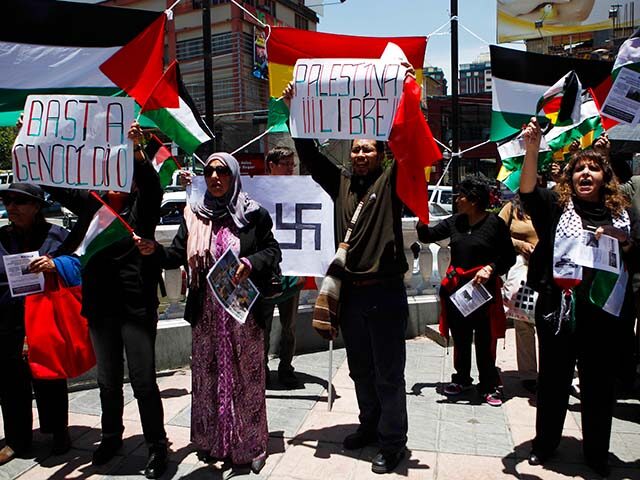
Los manifestantes sostienen carteles de protesta que dicen en español “Basta de genocidio”, izquierda y “¡Palestina libre!”. mientras protestan contra las operaciones militares de Israel en la franja de Gaza, en La Paz, Bolivia, el viernes 23 de noviembre de 2012. (Foto AP/Juan Karita)
Experto: Bolivia es el “proyecto más exitoso” de Irán en América Latina
Joseph Humire, director ejecutivo del Centro para una Sociedad Libre y Segura (SFS), afirmó que Bolivia es el “proyecto más exitoso” de Irán en América Latina en una entrevista publicada el viernes por el medio argentino Infobae.
Humire advirtió que, durante los últimos 40 años, Irán ha estado trabajando para aumentar su influencia en América Latina y ha logrado éxitos significativos en países gobernados por socialistas. Si bien hay gobiernos en América Latina que están aliados con Irán, enfatizó, los pueblos latinoamericanos no lo están.
“La gente no ve a Irán como un actor relevante, sino como un actor lejano, y eso es un error fatal”, afirmó Humire. “Irán ha estado trabajando en este proyecto durante 40 años y ya ha penetrado profundamente en la región. Este año enviaron un buque de guerra, su presidente, y ahora están mostrando su fuerza diplomática”.
“Venezuela, Nicaragua, Cuba y Bolivia son los gobiernos que están haciendo su trabajo en la región”, observó Humire.
“Irán ha tenido muy claros sus objetivos desde la llegada de los ayatolás al poder, y sabe que para avanzar en Oriente Medio y el mundo en general, su obstáculo es Estados Unidos. En la región es Israel, pero a nivel global es Estados Unidos. Y para obstaculizar a Estados Unidos tienen que fortalecer su capacidad en América Latina”, continuó.
Irán, bajo los auspicios de los gobiernos socialistas del hombre fuerte Evo Morales (2006-2019) y el actual presidente Luis Arce, ha logrado profundizar sus vínculos con Bolivia en la última década. Bolivia estableció formalmente vínculos con Irán en 2007, durante el primer mandato presidencial de Morales.
En julio, Bolivia negoció un acuerdo con Irán para la compra de drones iraníes durante una visita oficial del ministro de Defensa boliviano, Edmundo Novillo, a Teherán. Novillo y el ministro de Defensa iraní, Mohammad Reza Ashtiani, firmaron un memorando de entendimiento no revelado, supuestamente sobre defensa y seguridad. Novillo dijo que esperaba que su viaje a Irán allanara el camino para una cooperación de amplio alcance:
Ashtiani afirmó en ese momento que las relaciones entre Irán y países latinoamericanos “de ideas afines” son un “ejemplo de países independientes”, y describió el fortalecimiento de los vínculos de Irán con Bolivia como una “necesidad estratégica”.
Novillo respondió afirmando que Irán “es un modelo para que Bolivia alcance la libertad de las naciones”.
El gobierno de Arce anunció el martes que había cortado todos los lazos diplomáticos con Israel. La decisión, explicó la Cancillería boliviana, fue en respuesta a la operación “desproporcionada” de Israel contra Hamás tras el ataque terrorista del 7 de octubre y la invasión de Israel cometida por el grupo terrorista yihadista financiado por Irán. Bolivia, bajo el gobierno de Morales, había cortado relaciones con Israel en enero de 2009, también en un momento en el que Israel se vio obligado a enfrentar la amenaza que representa Hamás contra sus ciudadanos.
En su entrevista con Infobae, Humire analizó la ruptura de relaciones diplomáticas de Bolivia con Israel y las consecuencias de la creciente influencia del régimen islámico en América Latina, región que Humire describió como actualmente “dominada por gobiernos simpatizantes de Irán”.
“La decisión del gobierno boliviano es algo que creo sienta un precedente que otros países seguirán porque América Latina está dominada por gobiernos cercanos a Irán”, explicó. “Algunos abiertamente –como Venezuela, Bolivia, Nicaragua y Cuba– y otros no tanto, pero sí siguen su línea política, me refiero a Gustavo Petro en Colombia, [Luiz Inácio] Lula en Brasil y Gabriel Boric en Chile. “
“También podemos mencionar al gobierno de Alberto Fernández en Argentina; Cristina Fernández de Kirchner siempre ha sido muy amiga de Irán. Bolivia fue el primer país en tomar esta decisión, Venezuela también lo haría, pero no tiene embajada en Israel. Bolivia es el proyecto más exitoso de Irán en la región”, continuó.
La vicepresidenta saliente y expresidenta Cristina Fernández de Kirchner fue acusada formalmente en 2015 de haber ayudado a encubrir la participación de Irán en el atentado de 1994 contra la Asociación Mutual Argentino-Israelí (AMIA), que mató a 85 personas. El atentado a la AMIA fue el ataque terrorista más mortífero en el hemisferio occidental antes de los atentados del 11 de septiembre de 2001. El caso fue desestimado de forma controvertida en 2021.
El caso contra Fernández de Kirchner fue llevado inicialmente por el fiscal argentino Alberto Nisman, quien fue encontrado muerto la víspera de la audiencia correspondiente en el Congreso. Las autoridades argentinas dictaminaron que su muerte fue un suicidio.
Cuando se le preguntó por qué considera que Bolivia es el proyecto más exitoso de Irán, Humire explicó que Bolivia como país no recibe “nada” de la asociación de Irán con la nación sudamericana, pero el gobierno – es decir, el partido gobernante Movimiento Al Socialismo (MAS) – sí se beneficia.
“El MAS ha estado alineado con Irán desde el principio, desde la época de Evo Morales. Reciben mucho apoyo de Irán en todo lo relacionado con cómo utilizar el sistema para mantenerse en el poder”, afirmó Humire. “Irán les ha aconsejado cómo manejar a la oposición, cómo militarizar sus fronteras, cómo armar a las milicias. Sobre cómo posicionarse como actor regional frente a sus vecinos. En ese aspecto Irán es importante no para Bolivia, sino para el MAS, que tiene aspectos revolucionarios”.
El director ejecutivo del SFS razonó que Bolivia está utilizando la actual guerra de Israel como pretexto para adoptar una postura más agresiva.
“Todo lo que está pasando en Israel es un proyecto iraní, por lo que todas las alianzas que Teherán tiene en el mundo van a empezar a activarse contra Israel”, aseveró Humire. “Están haciendo esto para hacerle un favor a Irán, y no es para ganar algo a cambio, sino porque Irán es la razón por la cual el MAS ha podido permanecer en el poder durante más de 17 años, con una interrupción de uno en el medio.”
En 2019, Morales buscó continuar gobernando Bolivia por un tercer mandato presidencial a pesar de que Bolivia tenía un límite de mandato presidencial de dos mandatos. A Morales se le permitió postularse después de que argumentó con éxito que el límite de dos mandatos era una “violación de sus derechos humanos”.
Morales renunció voluntariamente en noviembre de 2019 y huyó a México en medio de pruebas pruebas evidentes de fraude electoral. Jeanine Áñez, que en ese momento era la segunda vicepresidenta de la Cámara de Senadores de Bolivia, prestó juramento como presidenta mientras todos los que la precedieron en la línea de sucesión presidencial huyeron a México con Morales.
Áñez gobernó brevemente durante casi un año, durante el cual restableció los lazos de Bolivia con Israel. Áñez optó por no presentarse a las elecciones presidenciales de 2020, en las que resultó elegido el socialista Luis Arce. La expresidente cumple actualmente una condena de diez años por presuntamente haber dado un “golpe de estado” contra Morales.
Humire continuó la entrevista explicando que el acuerdo de drones de Bolivia con Irán marcó la “formalización” de la relación entre ellos, y agregó que Irán ha estado proporcionando formalmente consultorías a Bolivia desde 2010, aunque de manera “muy limitada” en términos de capacitación.
“Este acuerdo es para formalizarlo en la industria de defensa. Entiendo que lo discutieron en el viaje a Teherán, y creo que no lo firmaron todavía porque querían calibrar la reacción antes de hacerlo, pero la cooperación ya existe”, dijo Humire. “Los acuerdos sólo sirven para legitimar. Quieren ver la reacción si envían drones y misiles. Aún los van a enviar, pero no lo formalizan. Creo que van a formalizar los drones”.
Infobae preguntó a Humire si las posturas de países como Argentina, Colombia y Chile también ayudan a fortalecer la injerencia de Irán en la región sin necesidad de asumir una alianza tan estrecha como la de Bolivia. Colombia y Chile retiraron a sus embajadores en Israel el martes, citando razones similares a las de Bolivia, mientras que Argentina condenó a Israel por sus acciones contra Hamás en la franja de Gaza.
Humire respondió que no considera neutrales a esos tres países, pero están tratando de ser “cuidadosos”.
En lo que respecta a Chile, Humire dijo que Chile no sólo ha permitido que aviones iraníes sancionados aterricen dentro de sus fronteras, sino que el presidente Gabriel Boric ha expresado abiertamente su intención de abrir una embajada chilena en territorio controlado por la Autoridad Palestina.
“Creo que está mucho más en sintonía con Irán de lo que muestra”, dijo Humire.
Humire afirmó que el presidente colombiano de extrema izquierda, Gustavo Petro, es muy cercano a Irán.
“Hay embajadores iraníes de otros países de América Latina que viajaron a Colombia porque Petro está en el gobierno”, dijo. “Se está convirtiendo en un epicentro de Irán en la región”.
Petro y Boric están en Washington esta semana para una cumbre económica con el presidente Joe Biden.
Cuando se trata de Argentina, Humire dijo que el país tiene un “doble discurso”, debido al atentado a la AMIA y la próxima segunda vuelta de las elecciones presidenciales del 19 de noviembre. Humire citó como ejemplo el caso de un avión de carga venezolano-iraní incautado por las autoridades argentinas. Se sospecha que el avión, y su piloto en ese momento, tienen vínculos con el Cuerpo de la Guardia Revolucionaria Islámica (CGRI)-Fuerza Qods, una organización terrorista designada por Estados Unidos y ala oficial de las fuerzas armadas iraníes.
“Pero con el avión iraní la Justicia no hizo nada para seguir adelante. ¿Tienen todos los elementos, pero dejan libre a los pasajeros y la carga? La única razón por la que el avión sigue en el país es por presiones de Estados Unidos”, afirmó Humire. “Creo que [el presidente saliente] Alberto Fernández no está alejado de ellos y conocemos la historia de Cristina Kirchner. El Memorando de Entendimiento con Irán que firmó fue una traición a la patria, luego de los ataques terroristas que sufrió el país”.
“El fiscal Nisman lo denunció y está muerto”, recordó.
“Estos tres países están muy cerca de Irán, pero no tienen el capital político para mostrar todas sus cartas”, continuó. “Bolivia, en cambio, es un país con poca legitimidad y no tiene que responder ante la comunidad internacional”.
Por último, se le preguntó a Humire por qué cree que los latinoamericanos en general no prestan especial atención a las consecuencias de la presencia de Irán en la región, más aún a la luz de acontecimientos recientes como el ataque terrorista de 1994 a Argentina, la venta de pasaportes por parte del régimen socialista de Maduro a Hezbollah, y la reciente incautación del avión de carga venezolano-iraní.
“Si le preguntas al pueblo venezolano, al pueblo nicaragüense, te dirán que Maduro y Ortega son los peores del mundo. Pero tienen que entender que detrás de todo esto está Irán”, respondió Humire. “Mientras Irán crezca, esos regímenes seguirán en el poder. Lo mismo ocurre con China y Rusia, pero Irán tiene un papel más importante porque tiene mucha experiencia en términos de guerras asimétricas”.
Christian K. Caruzo es un escritor venezolano y documenta la vida bajo el socialismo.
Expert: Bolivia Is Iran’s ‘Most Successful Project’ in Latin America
Joseph Humire, executive director of the Center for a Secure Free Society (SFS), asserted that Bolivia is Iran’s “most successful project” in Latin America in an interview published by the Argentine news outlet Infobae on Friday.
Humire warned that, for the past 40 years, Iran has been working to increase its influence in Latin America and has achieved significant success in countries governed by socialists. While there are governments in Latin America that are allied with Iran, he emphasized, the Latin American people are not.
“The people do not see Iran as a relevant actor, but as a distant actor, and that is a fatal mistake,” Humire asserted. “Iran has been working on this project for 40 years, and it has already penetrated deeply into the region. This year they sent a warship, their president, and now they are showing their diplomatic muscle.”
“Venezuela, Nicaragua, Cuba and Bolivia are the governments that are doing their work in the region,” Humire observed.
“Iran has been very clear about its objectives since the arrival of the Ayatollahs to power, and knows that in order to advance in the Middle East and the world in general, its obstacle is the United States. In the region it is Israel, but globally it is the United States. And to hinder the United States they have to strengthen their capacity in Latin America,” he continued.
Iran, under the auspices of the socialist governments of strongman Evo Morales (2006-2019) and current President Luis Arce, has managed to deepen its ties with Bolivia in the past decade. Bolivia formally established ties with Iran in 2007 during Morales’ first presidential term.
In July, Bolivia brokered a deal with Iran for the purchase of Iranian drones during an official visit by Bolivian Defense Minister Edmundo Novillo to Tehran. Novillo and Iranian Defense Minister Mohammad Reza Ashtiani signed an undisclosed memorandum of understanding reportedly on defense and security. Novillo said he hoped his trip to Iran would pave the way for wide-ranging cooperation.
Ashtiani stated at the time that relationships between Iran and “like-minded” Latin American countries are an “example of independent countries,” describing the strengthening of Iran’s ties with Bolivia as a “strategic necessity.”
Novillo responded by claiming that Iran “is a model for Bolivia to achieve the freedom of nations.”
Arce’s government announced on Tuesday that it had severed all diplomatic ties with Israel. The decision, the Bolivian Foreign Ministry explained, was in response to Israel’s “disproportionate” operation against Hamas following the October 7 terrorist attack and invasion of Israel committed by the Iranian-funded jihadist terrorist group. Bolivia, under Morales, had previously cut ties with Israel in January 2009, also at a time in which Israel was forced to confront the threat Hamas poses against its citizens.
In his interview with Infobae, Humire analyzed Bolivia’s rupture of diplomatic relations with Israel and the consequences of the growing influence of the Islamic regime in Latin America, a region Humire described as currently “dominated by governments sympathetic to Iran.”
“The decision of the Bolivian government is something that I believe sets a precedent that other countries will follow because Latin America is dominated by governments that are close to Iran,” he explained. “Some openly – like Venezuela, Bolivia, Nicaragua and Cuba – and others not so much, but they do follow their political line, I am referring to Gustavo Petro in Colombia, [Luiz Inácio] Lula in Brazil, and Gabriel Boric in Chile.”
“We can also mention the government of Alberto Fernández in Argentina; Cristina Fernandez de Kirchner has always been very friendly with Iran. Bolivia was the first country to make this decision, Venezuela would do it too, but it does not have an embassy in Israel. Bolivia is Iran’s most successful project in the region,” he continued.
Outgoing vice president and former President Cristina Fernández de Kirchner was formally charged in 2015 with having helped cover up Iran’s involvement in the 1994 bombing of the Argentine-Israeli Mutual Association (AMIA), which killed 85 people. The AMIA bombing was the deadliest terrorist attack in the Western Hemisphere prior to the September 11, 2001, attacks. The case was controversially dismissed in 2021.
The case against Fernández de Kirchner was initially pursued by Argentine prosecutor Alberto Nisman, who was found dead on the eve of the corresponding congressional hearing. Argentine authorities ruled his death a suicide.
When asked why he considers Bolivia to be Iran’s most successful project, Humire explained that Bolivia as a country receives “nothing” from Iran’s partnership with the South American nation but the government – namely, the ruling Movement Towards Socialism (MAS) party – does benefit.
“MAS has been aligned with Iran since the beginning, since the time of Evo Morales. They receive a lot of support from Iran in everything related to how to use the system to stay in power,” Humire stated. “Iran has advised them on how to handle the opposition, how to militarize their borders, how to arm militias. On how to position itself as a regional actor in the face of its neighbors. In that aspect Iran is important not for Bolivia, but for MAS, which has revolutionary aspects.”
The SFS executive director reasoned that Bolivia is using Israel’s current war as a pretext to have a more aggressive stance.
“Everything that is happening in Israel is an Iranian project, so all the alliances that Tehran has in the world are going to start activating against Israel,” Humire asserted. “They are doing this to do Iran a favor, and it is not to gain something in return, but because Iran is the reason why MAS has been able to stay in power for more than 17 years now, with an interruption of one in between.”
In 2019, Morales sought to continue ruling over Bolivia for a third presidential term despite Bolivia having a two-term presidential term limit. Morales was allowed to run after he successfully argued that the two-term limit was a “violation of his human rights.”
Morales voluntary resigned in November 2019 and fled to Mexico amidst glaring evidence of electoral fraud. Jeanine Áñez, who at the time was the second Vice-President of the Bolivian Chamber of Senators, was sworn in as president as everyone before her in the presidential line of succession fled to Mexico with Morales.
Áñez briefly ruled for almost a year, during which she restored Bolivia’s ties with Israel. Áñez chose not to run in 2020’s presidential election, in which socialist Luis Arce was elected. The former president is currently serving a ten-year sentence for allegedly having staged a “coup” against Morales.
Humire continued the interview by explaining that Bolivia’s drone deal with Iran marked the “formalization” of the relationship between them, adding that Iran has been formally providing consultancies to Bolivia since 2010, albeit at a “very limited” manner in terms of training.
“This agreement is to formalize it in the defense industry. I understand that they discussed it on the trip to Tehran, and I think they didn’t sign it yet because they wanted to gauge the reaction before doing it, but the cooperation already exists,” Humire said. “The agreements only serve to legitimize. They want to see the reaction if they send drones, missiles. They are still going to send them, but they do not formalize it. I think they are going to formalize the drones.”
Infobae asked Humire if the stances of countries like Argentina, Colombia, and Chile also help strengthen Iran’s interference in the region without the need to assume such a close alliance like Bolivia’s. Colombia and Chile both withdrew their ambassadors to Israel on Tuesday, citing similar reasons to Bolivia, while Argentina condemned Israel for its actions against Hamas on the Gaza strip.
Humire answered that he does not consider those three countries neutral, but they are trying to be “careful.”
When it comes to Chile, Humire said that not only has Chile allowed sanctioned Iranian airplanes to land within its borders, but that President Gabriel Boric has openly expressed his intention to open a Chilean embassy in territory controlled by the Palestinian Authority.
“I think he is much more in tune with Iran than he shows,” Humire said.
Humire asserted that Colombian far-left President Gustavo Petro is very close to Iran.
“There are Iranian ambassadors from other countries in Latin America who traveled to Colombia because Petro is in government,” he said. “It is becoming an epicenter of Iran in the region.”
Petro and Boric are both in Washington this week for an economic summit with President Joe Biden
When it comes to Argentina, Humire said that the country has a “double discourse,” due to the AMIA bombing and the upcoming November 19 presidential runoff election. Humire cited the case of a Venezuelan-Iranian cargo airplane seized by Argentine authorities as an example. The airplane, and its pilot at the time, are suspected to have ties with the Islamic Revolutionary Guard Corps (IRGC)-Qods Force, a U.S.-designated terrorist organization and official wing of the Iranian armed forces.
“But with the Iranian plane, Justice did nothing to move forward. They have all the elements, but they let the passengers and the cargo go free? The only reason why the plane is still in the country is because of pressure from the United States,” Humire asserted. “I think [outgoing President] Alberto Fernandez is not distant from them, and we know the history of Cristina Kirchner. The Memorandum of Understanding with Iran that she signed was a betrayal of the homeland, after the terrorist attacks that the country suffered.”
“Prosecutor Nisman denounced it and he is dead,” he recalled.
“These three countries are very close to Iran, but they do not have the political capital to show all their cards,” he continued. “Bolivia, on the other hand, is a country with little legitimacy and does not have to answer to the international community.”
Lastly, Humire was asked why he thinks Latin Americans in general do not pay special attention to the consequences of the Iran’s presence in the region — more so in light of recent events such as the 1994 terrorist attack on Argentina, the socialist Maduro regime selling passports to Hezbollah, and the recent seizure of the Venezuelan-Iranian cargo plane.
“If you ask the Venezuelan people, the Nicaraguan people, they will tell you that Maduro and Ortega are the worst in the world. But they have to understand that behind all this is Iran,” Humire answered. “As long as Iran grows, those regimes will remain in power. The same happens with China and Russia, but Iran has a more important role because it has a lot of experience in terms of asymmetric wars.”
Christian K. Caruzo is a Venezuelan writer and documents life under socialism.

Iran’s Defense Minister Brigadier General Mohammad Reza Ashtiani and his Bolivian counterpart Edmundo Novillo Aguilar signed the defense and security MoU on July 20, 2023. (Islamic Republic News Agency)

 Bolivian Thoughts | Pensamientos Bolivianos (Bilingual/Bilingüe)