
Pagina Siete reports coca crops in Chapare is extending to Yapacani, see below map:
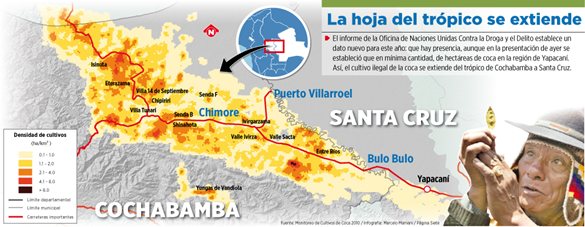
Reports warns that 22% of the coca leaf are inside the National Parks of the Chapare, Cochabamba. Around 39 hectares are reported in Yapacani, Santa Cruz; report was delivered yesterday to the Bolivian government. [remember that in the past, coca growers always “claimed” that they had no presence in Yapacani; this region is a stronghold of current government; current president holds the leadership of the coca growers of the Chapare, a strong political arm who made possible this government in the last two national elections].
http://www.paginasiete.bo/2011-09-13/Nacional/NoticiaPrincipal/4Nac003-13092011.aspx
La Razon reports coca crop is invading National Parks, see chart below:
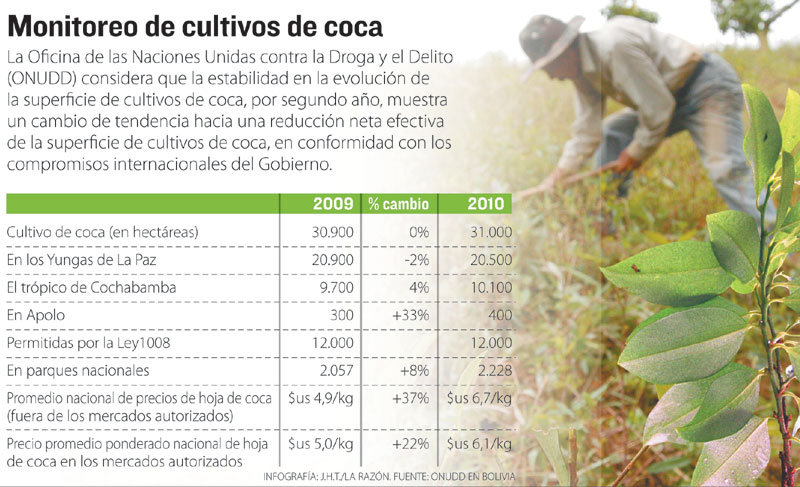
The last two rows of the chart above, are the average national prices for coca leaf outside and inside authorized markets respectively. Bolivia supplies 20% of coca leaf behind Colombia and Peru.
http://www.la-razon.com/version.php?ArticleId=137424&EditionId=2651
El Dia reports today that there are over 19,000 illegal hectares of coca in Bolivia. Colombia has 57,000 hectares. Peru has 61,200 hectares. Bolivia has the third place of coca production with 31,000 hectares, according to UNODC. The USA government, reported back in 9/15/2010, that Bolivian coca crops grew to 32,000 hectares in 2008 to 35,000 in 2009; data for 2010 will become available by the end of this week. The USG has decertified Bolivia for that reason, thus ATPDEA is no longer available to allow Bolivian textiles export to the USA.
EFE news agency reports that as of 2010, there was a 22% increase in coca crop production nationwide, from the time current Bolivian president assumed office (2006), .
Los Tiempos reports that Isiboro- Sécure and Carrasco National Parks have around 2,228 hectares of coca crops, they represent 22% of the region. Coca grew by 9% for Isiboro Secure and 6% in Carrasco. The UN report is usually handed in July, it was delayed until now because of an airplane crash in Yungas, La Paz; inside there were two of their officials who were recollecting data in the area.
Coca crop production is extremely tied to narcotraffick, cocaine production; money laundering, violence; assassinations; land takeovers; corruption at all levels. Bolivia is sadly following the path of Colombia, thirty years ago.

 Bolivian Thoughts | Pensamientos Bolivianos (Bilingual/Bilingüe)