By Tanya Imaña, El Deber:

Bolivia Discovers a New Wildcat Species, Leopardus tilcayo
Leopardus tilcayo was identified through genomic studies and has been recorded in the Yungas. Researchers warn about the threats facing its habitat
Bolivia has a new species of wildcat recognized by science. It is Leopardus tilcayo, a small feline recorded in the Yungas whose identification was made possible through genomic studies that revealed evolutionary differences from other tiger cats in South America.
The discovery, published in the scientific journal Current Biology**,** is considered significant by researchers because, they noted, it had been nearly a century since a new cat species had been described.
The research began with a specimen that arrived at the Senda Verde wildlife sanctuary between 2017 and 2018. Its appearance raised questions among scientists because of several differences compared with tiger cats known from other regions.

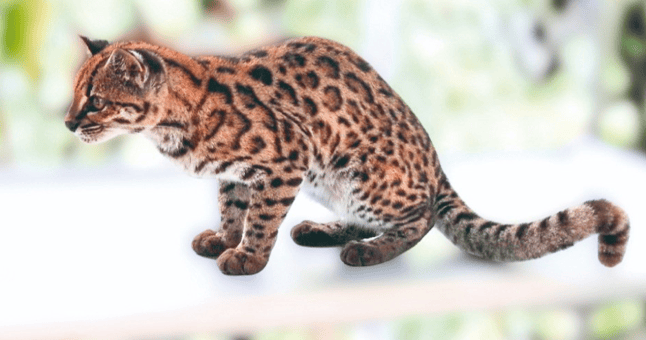
Paola Nogales, a biologist specializing in genomic evolution, explained that the Bolivian specimens display particular characteristics, including larger spots, a fuller tail, and some differences in body size.
Initial genetic tests produced unusual results, prompting the team to expand the study. Beginning in 2020, Nogales and biologist and PhD in Ecology and Evolution Enzo Aliaga worked on the molecular analyses, and an international team later joined the research.
The researchers compared complete genomes from tiger cats in Venezuela, Colombia, Brazil, Peru, and Bolivia.They also used samples preserved in museums, some of which had been collected decades ago.
The results determined that the Bolivian lineage constitutes a different species and that it diverged evolutionarily from other tiger cats approximately 1.4 million years ago. “If you look at them morphologically, they are quite similar, but genomically, when you look at their DNA, they are quite different,” Nogales explained.
Leopardus tilcayo is smaller than a domestic cat, has rounded ears, a long and bushy tail, and a spotted coat. So far, it has been recorded in the Yungas of La Paz.
Identifying it can be difficult because it belongs to a group of very similar felines. Even camera traps can cause confusion with species such as the margay, which shares part of its habitat.
For this reason, researchers plan to continue using genetic tools, camera traps, and DNA analysis from feces collected in the field to determine its distribution and presence.
It is still unknown how many individuals exist in Bolivia, what their habits are, or what their reproductive characteristics are.

DNA studies were conducted on tiger cats from different countries
A Conservation Challenge
The discovery also raises concern about the condition of the forests where the feline lives. Researchers identify deforestation, burning to clear land for cultivation, and the expansion of gold mining in the Yungas region as threats.
Aliaga said that protecting the new feline also means preserving its habitat and the species that form part of its diet.
The scientific identification will allow Leopardus tilcayo to receive its own conservation-status assessment. Nogales explained that, because the species was only recently distinguished, it will be necessary to determine its threat category based on specific information about its populations and distribution.
The study also highlights the need to strengthen scientific research in Bolivia. Aliaga and Nogales said that part of the work was financed with their own resources and that they relied on support from the genetics laboratory of the Institute of Chemical Research at the Universidad Mayor de San Andrés.
For the researchers, the discovery demonstrates that Bolivia still has much to uncover and that understanding its biodiversity is essential to protecting it.

DNA studies were conducted on tiger cats from different countries
A Wildcat
Physical Characteristics
Smaller than a domestic cat, with a bushy tail, rounded ears, and a spotted coat.
Habitat
Forests of the northern and southern Yungas in the department of La Paz. Further research will determine its distribution.
Scientific Name
Leopardus tilcayo belongs to the tigrinus complex.
Por Tanya Imaña Serrano, El Deber:
Descubren en Bolivia una nueva especie de gato silvestre, el leopardus Tilcayo
El Leopardus tilcayo fue identificado mediante estudios genómicos y tiene registros en los Yungas. Los investigadores advierten sobre las amenazas que enfrenta su hábitat
Bolivia tiene una nueva especie de gato silvestre reconocida por la ciencia. Se trata del Leopardus tilcayo, un pequeño felino registrado en los Yungas y cuya identificación fue posible gracias a estudios genómicos que revelaron diferencias evolutivas con otros gatos tigre de Sudamérica.
El descubrimiento, publicado en la revista científica Current Biology, es considerado relevante por los investigadores porque, indicaron, hacía cerca de un siglo que no se describía una nueva especie de gato.
La investigación comenzó a partir de un ejemplar que llegó al centro de custodia Senda Verde entre 2017 y 2018. Su apariencia generó dudas entre los científicos, debido a algunas diferencias respecto de los gatos tigre conocidos en otras regiones.
Paola Nogales, bióloga investigadora especializada en evolución genómica, explicó que los ejemplares bolivianos presentan características particulares, como manchas más grandes, una cola más pomposa y algunas diferencias en el tamaño corporal.
Las primeras pruebas genéticas mostraron resultados inusuales, por lo que el equipo amplió el estudio. Desde 2020, Nogales y el biólogo, doctorado en Ecología y Evolución, Enzo Aliaga trabajaron en los análisis moleculares y posteriormente se incorporaron a un equipo internacional.
Los investigadores compararon genomas completos de gatos tigre de Venezuela, Colombia, Brasil, Perú y Bolivia. También utilizaron muestras conservadas en museos, algunas recolectadas hace décadas.
Los resultados determinaron que el linaje boliviano constituye una especie diferente y que se separó evolutivamente de otros gatos tigre hace aproximadamente 1,4 millones de años. “Si uno los ve morfológicamente son bastante similares, pero genómicamente, viendo su ADN, son bastante diferentes”, explicó Nogales.
El Leopardus tilcayo es más pequeño que un gato doméstico, tiene orejas redondeadas, una cola larga y abundante y un pelaje con manchas. Hasta ahora existen registros en los Yungas, en La Paz.
Su identificación puede resultar difícil porque pertenece a un grupo de felinos muy similares. Incluso las cámaras trampa pueden generar confusiones con especies como el margay, que comparte parte del hábitat.
Por ello, los investigadores prevén continuar utilizando herramientas genéticas, cámaras trampa y análisis de ADN obtenido de excretas encontradas en el campo para determinar su distribución y presencia.
Todavía no se conoce cuántos ejemplares existen en Bolivia, cuáles son sus hábitos ni sus características reproductivas.
Se realizaron estudios de ADN de gatos tigre de diferentes países
Reto para la conservación
El descubrimiento también genera preocupación por el estado de los bosques donde vive el felino. Los investigadores mencionan como amenazas la deforestación, las quemas para habilitar terrenos para el cultivo y el crecimiento de la minería de oro en la región de los Yungas.
Aliaga señaló que proteger al nuevo felino implica conservar también su hábitat y las especies que forman parte de su alimentación.
La identificación científica permitirá que el Leopardus tilcayo tenga una evaluación propia de su estado de conservación. Nogales explicó que, al haber sido diferenciado recientemente, será necesario determinar su categoría de amenaza a partir de información específica sobre sus poblaciones y distribución.
El estudio también pone sobre la mesa la necesidad de fortalecer la investigación científica en Bolivia. Aliaga y Nogales señalaron que parte del trabajo fue financiado con recursos propios y que recurrieron al apoyo del laboratorio de genética del Instituto de Investigaciones Químicas de la Universidad Mayor de San Andrés.
Para los investigadores, el hallazgo demuestra que Bolivia todavía tiene mucho por descubrir y que conocer su biodiversidad es fundamental para protegerla.
Se realizaron estudios de ADN de gatos tigre de diferentes países
Un gato silvestre
Características físicas
Tamaño menor al de un gato doméstico, cola pomposa, orejas redondeadas y pelaje moteado
Hábitat
Bosques de Nor y Sud Yungas, en el departamento de La Paz. Nuevas investigaciones determinarán su distribución
Nombre científico
El Leopardus tilcayo pertenece al complejo tigrinus.
https://eldeber.com.bo/pais/todo-debe-saber-leopardus-tilcayo_1789862657


Leave a Reply