By Milenka Parisaca, Opinion:
Caripaya’s Colonial Church Declared Bolivia’s National Cultural Heritagea

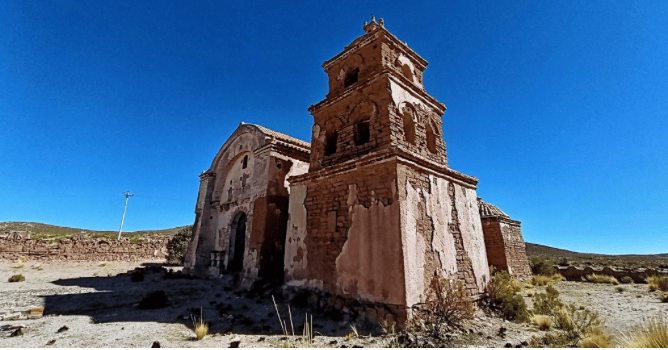
The colonial church of Caripaya, located in the municipality of Corque, Oruro, preserves architectural and artistic elements dating back to the Spanish colonial era. | Photos: GAMC.
Oruro, November 16, 2026 (ABI).- Stone and stucco altarpieces, remnants of mural paintings, historic canvases, and a 17th-century wooden organ are among the artistic treasures preserved inside the colonial church of Caripaya, in the municipality of Corque, Oruro. The temple has been declared an Immovable Tangible Cultural Heritage Site of the Bolivian State under Law 1792.
The Ministry of the Presidency announced the declaration on Sunday as part of government initiatives aimed at protecting the country’s cultural heritage.
“The Government promotes initiatives that protect cultural heritage, strengthen road integration, and encourage the country’s development. Law 1792: Declares the Colonial Church of Caripaya, in Corque, Oruro, an Immovable Tangible Cultural Heritage Site,” the ministry stated through its social media accounts.
The legislation was approved by the Plurinational Legislative Assembly on October 21 and promulgated by President Rodrigo Paz on November 9 at the Casa Grande del Pueblo, before being published in the Official Gazette.


The law recognizes the historical, architectural, artistic, aesthetic, cultural, and religious significance of the building, located in the community of Caripaya, Carangas Province, and closely linked to the history of the Jach’a Karangas region.
Its origins are associated with the evangelization process during the Spanish colonial period, when religious temples were built in various communities across the Bolivian highlands. These structures served not only religious purposes but also left behind evidence of the architecture and artistic expressions of that era.
During the colonial period, the territory of Corque and its surrounding areas formed part of important trade routes along which people and goods traveled between the highlands, the former city of La Plata — now Sucre — and Peru. This movement connected local communities with other major centers of the colonial era.
Among the church’s most distinctive features are its altarpieces carved from stone and stucco, as well as the carved stonework incorporated into its architecture.

The temple also preserves remnants of mural paintings and historic canvases, examples of the artistic heritage found in rural churches dating from the 17th and 18th centuries.
Adding to this collection is a 17th-century wooden organ, evidence of the presence of musical instruments in religious spaces during that period. These objects form part of the historical, architectural, and cultural legacy of the Carangas communities.
The heritage declaration responds to the need to protect the building from deterioration caused by the passage of time. Legal recognition is intended to help preserve its architectural features and the artistic treasures it houses.
Article 2 of Law 1792 stipulates that the Executive Branch, through the competent cultural heritage authority, must coordinate conservation, protection, and promotion initiatives for the temple with the Oruro Departmental Government and the Corque Municipal Government, in accordance with their respective responsibilities and applicable regulations.
//MPC/EO
Por Milenka Parisaca Carrasco, Opinion:
La iglesia colonial de Caripaya ya es Patrimonio Cultural Material Inmueble de Bolivia
La iglesia colonial de Caripaya, ubicada en el municipio de Corque, Oruro, conserva elementos arquitectónicos y artísticos de la época virreinal. | Fotos: GAMC.
Oruro, 16 de noviembre de 2026 (ABI).- Sus retablos de piedra y estuco, vestigios de pintura mural, lienzos históricos y un órgano de madera del siglo XVII forman parte del legado artístico que resguarda la iglesia colonial de Caripaya, en el municipio de Corque, Oruro. El templo fue declarado Patrimonio Cultural Material Inmueble del Estado mediante la Ley 1792.
El Ministerio de la Presidencia difundió en la víspera la declaratoria como parte de las iniciativas gubernamentales orientadas a proteger el patrimonio cultural del país.
“El Gobierno impulsa iniciativas que protegen el patrimonio cultural, fortalecen la integración vial y promueven el desarrollo del país. Ley 1792: Declara Patrimonio Cultural Material Inmueble a la Iglesia Colonial de Caripaya, en Corque, Oruro”, destacó esa cartera de Estado a través de sus redes sociales.
La norma fue sancionada por la Asamblea Legislativa Plurinacional el 21 de octubre y promulgada por el presidente Rodrigo Paz el 9 de noviembre en la Casa Grande del Pueblo, antes de su publicación en la Gaceta Oficial.
La ley reconoce el valor histórico, arquitectónico, artístico, estético, cultural y religioso de esta edificación, ubicada en la comunidad de Caripaya, provincia Carangas, y vinculada a la historia de la región de los Jach’a Karangas.
Su origen está relacionado con el proceso de evangelización durante el periodo virreinal, cuando se levantaron templos religiosos en distintas comunidades del altiplano. Estas construcciones no solo cumplieron una función religiosa, sino que también dejaron huellas de la arquitectura y las expresiones artísticas de aquella época.
El territorio de Corque y sus alrededores formaba parte de rutas de importancia durante la Colonia, por donde circulaban personas y mercancías entre el altiplano, la antigua ciudad de La Plata —hoy Sucre— y el Perú. Ese tránsito conectó a las comunidades de la región con otros centros del periodo virreinal.
Entre los elementos que distinguen a la iglesia sobresalen sus retablos labrados en piedra y estuco, además de los trabajos de piedra tallada que forman parte de su arquitectura.
El templo también conserva vestigios de pintura mural y lienzos históricos, muestras del patrimonio artístico presente en las iglesias rurales de los siglos XVII y XVIII.
A ese conjunto se suma un órgano de madera del siglo XVII, que da cuenta de la presencia de instrumentos musicales en los espacios religiosos de la época. Estos bienes constituyen parte del legado histórico, arquitectónico y cultural de las comunidades de Carangas.
La declaratoria responde a la necesidad de proteger esta edificación frente al deterioro causado por el paso del tiempo. El reconocimiento legal busca contribuir a la preservación de sus características arquitectónicas y de los bienes artísticos que alberga.
El artículo 2 de la Ley 1792 establece que el Órgano Ejecutivo, a través de la instancia competente en patrimonio cultural, coordine con la Gobernación de Oruro y la Alcaldía de Corque acciones de conservación, protección y promoción del templo, de acuerdo con sus atribuciones y la normativa vigente.
//MPC/EO


Leave a Reply