By Germaine Barriga, Vision 360:
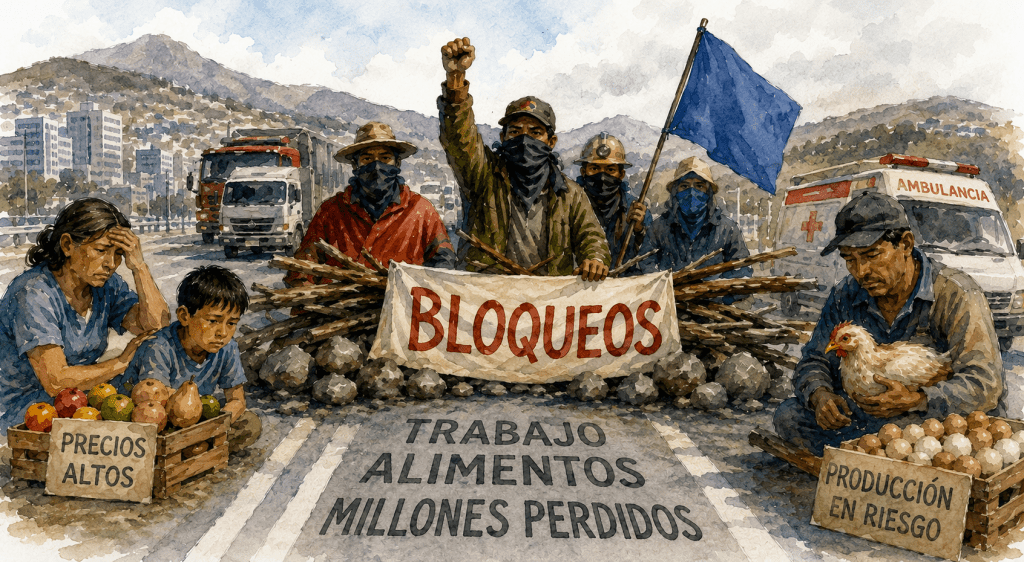
IBCE: Nine Business Sectors Support Extending the State of Exception
The consultation was conducted virtually with representatives from the agricultural, forestry, export, import, commercial, industrial, services, tourism, and customs brokerage sectors.
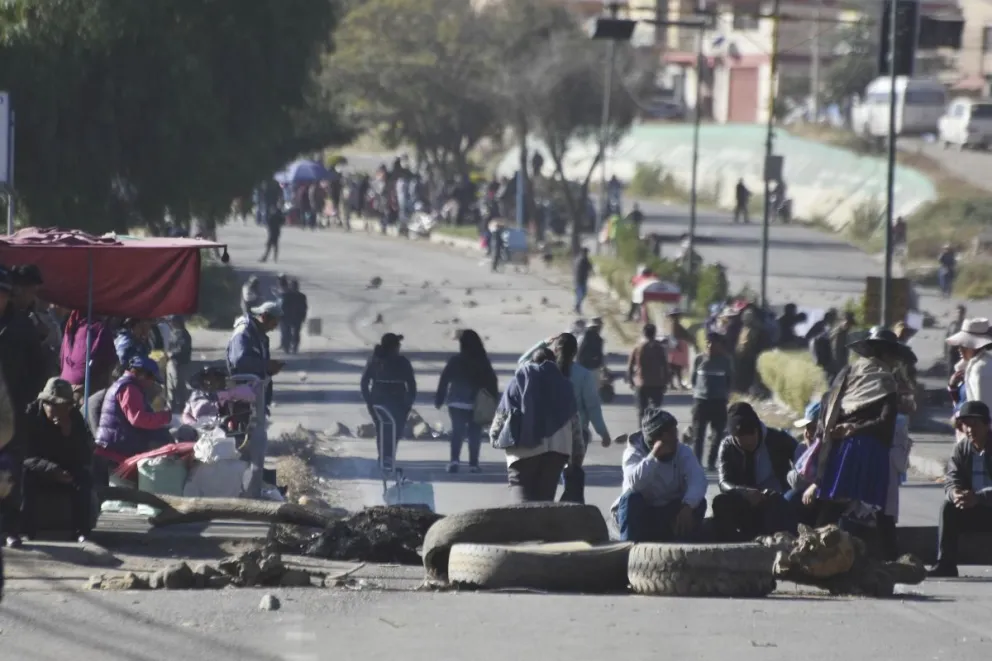
Road blockades between May and June caused economic losses and loss of human lives. Photo: APG
As the three-month period of the state of exception declared by the national government approaches, more voices are supporting an extension of the measure in response to threats from social groups that have announced the resumption of protests against the partial removal of the diesel subsidy.
An opinion survey conducted by the Bolivian Institute of Foreign Trade (IBCE) among representatives of the agricultural, forestry/timber, export, import, commercial, industrial, services, tourism, and customs brokerage sectors shows, on the one hand, rejection of road blockades and, on the other, support for extending the state of exception.
IBCE General Manager Gary Rodríguez presented the survey results in the city of Santa Cruz and referred to the road blockades that lasted from May 2 through June of this year, causing substantial losses to the national economy and the loss of human lives, according to an institutional press release.
On May 2, the Bolivian Workers’ Central (COB) called for an indefinite nationwide road blockade. The measure succeeded in isolating several departments, which found themselves cut off and deprived of basic goods, creating a health and humanitarian emergency.
The state of exception was established by Supreme Decree 5636 and came into effect on July 20. The justification was the internal unrest affecting the entire national territory and the need to establish extraordinary measures aimed at protecting strategic routes, ensuring the supply of food, fuel, medicines, and essential goods for the population, as well as safeguarding airports, energy plants, telecommunications networks, hospitals, water systems, and logistics centers.
Among the reasons for supporting a possible extension of the state of exception, Rodríguez noted that economic losses caused by the blockades exceeded $3 billion. Investment, production, trade, exports, imports, tourism, transportation, services, jobs, family incomes, state revenues, and Bolivia’s international image were all affected. In addition, 22 lives were lost as a result of the refusal of protesters to allow ambulances, food, medicines, and oxygen to pass through the blockades.
Regarding the survey, he explained that the IBCE board commissioned an open poll to gauge public perception, which expressed opposition to road blockades, support for extending the state of exception, and the need to approve an anti-blockade law. The survey was conducted digitally through 10 closed-ended questions at the initiative of the board, which is made up of organizations representing these sectors.
After processing 1,362 responses received between September 7 and 10, 2026, the results were as follows: 98% said that blockades harm Bolivia’s development and international image; 97% said they violate the rights to free movement and work; and 96% rejected blockades as a form of pressure because they had been affected by one and believe that blocking roads is a crime and that those responsible should be sanctioned.
Meanwhile, 95% of respondents believe dialogue should prevail instead of blockades and that an Anti-Blockade Law is urgently needed in the country. Finally, 81% said the State of Exception should be extended.
“The public perception gathered in the survey is clear: Bolivia needs an Anti-Blockade Law that not only imposes criminal penalties but also requires compensation for the economic damage caused by blockaders, as well as by those who instigate and finance them, whether individuals or legal entities,” he stated.
He argued that extending the State of Exception is urgent both to approve such legislation and to move forward with the structural changes the country requires. Otherwise, “violence will end up consuming people’s economy,” because Bolivia cannot withstand another shutdown. “It cannot be that a handful of violent individuals harm millions of citizens.”
Rodríguez expressed concern over the high level of social conflict in the country, which, in his view, creates “uncertainty and undermines stabilization and growth,” harming the population with lower incomes, who become poorer every day.
In this regard, he stated that, according to official data, there are more than 5 million poor people in the country, nearly 2 million living in extreme poverty, suffering from hunger and precarious living conditions.
He warned that, given this painful reality, when Bolivia most needs social peace, it is troubling to hear the “drums of war” announcing new road blockades once the State of Exception comes to an end.
Por Germaine Barriga Velarde, Vision 360:
IBCE: nueve sectores empresariales respaldan la ampliación del estado de excepción
La consulta fue realizada virtualmente a representantes de los sectores agropecuario, forestal, exportador, importador, comercial, industrial, de servicios, turismo y de despachos aduaneros.
Los bloqueos de carreteras entre mayo y junio, provocaron pérdidas económicas y vidas humanas. Foto: APG
A poco de cumplirse los tres meses del estado de excepción dictado por el Gobierno nacional, suman las voces que respaldan una ampliación de esa medida ante las amenazas de sectores sociales que anuncian la reanudación de las protestas en contra de la eliminación parcial de la subvención del diésel.
Un sondeo de opinión realizado por el Instituto Boliviano de Comercio Exterior (IBCE) a representantes de los sectores agropecuario, forestal/maderero, exportador, importador, comercial, industrial, servicios, turismo y despachos aduaneros muestra, por un lado, el rechazo a los bloqueos de carreteras y su respaldo a una prórroga del estado de excepción.
El gerente general del IBCE, Gary Rodríguez, presentó los resultados de este sondeo en la ciudad de Santa Cruz y se refirió a los bloqueos que se extendieron desde el 2 de mayo y junio de este año, que provocaron cuantiosas pérdidas a la economía nacional y la pérdida de vidas humanas, informa una nota de prensa de esa institución.
El 2 de mayo, la Central Obrera Boliviana (COB) convocó al bloqueo de carreteras indefinido en el país. La medida logró aislar a varios departamentos, que se vieron cercados y sin el abastecimiento de los productos básicos, situación que provocó una emergencia sanitaria y humanitaria.
El estado de excepción fue dictado por el Decreto Supremo 5636 y entró en vigencia el 20 de julio. El argumento fue la conmoción interna en todo el territorio nacional y la necesidad de establecer las medidas extraordinarias destinadas a la protección de rutas estratégicas, seguridad de abastecimiento de alimentos, combustibles, medicamentos e insumos esenciales para la población; seguridad de aeropuertos, plantas energéticas, redes de telecomunicaciones, hospitales, sistemas hídricos y centros logísticos.
Entre los argumentos para respaldar una eventual ampliación del estado de excepción, Rodríguez mencionó que, debido a los bloqueos, las pérdidas económicas superaron los $us 3.000 millones. Hubo una afectación de la inversión, producción, comercio, exportación e importación, turismo, transporte, servicios, empleos e ingresos de las familias, recaudaciones del Estado, así como de la imagen-país en el exterior, y la pérdida de 22 vidas, a consecuencia de la negativa de los sectores movilizados a dejar pasar ambulancias, alimentos, medicamentos y oxígeno.
Con relación al sondeo realizado, precisó que el directorio del IBCE tuvo la iniciativa de encargar un sondeo abierto para conocer la percepción ciudadana, que se manifestó en contra de los bloqueos, a favor de una ampliación de la medida de excepción y de la necesidad de aprobar una ley antibloqueos. La consulta fue realizada digitalmente, con 10 preguntas cerradas, a iniciativa de su directorio, conformado por entidades que representan a los sectores.
El resultado, luego de procesar 1.362 respuestas recibidas entre el 7 y 10 de septiembre de 2026, fue el siguiente: un 98% dijo que el bloqueo perjudica al desarrollo y a la imagen de Bolivia en el exterior; un 97%, que atenta contra el derecho a la libre circulación y al trabajo; el 96% rechazó los bloqueos como medida de presión porque fue afectada por algún bloqueo, y entiende que bloquear es un delito y está de acuerdo con sancionar a los bloqueadores.
Mientras que el 95% de los que respondieron al sondeo cree que debería primar el diálogo en vez de bloquear y cree que es urgente una Ley Antibloqueos en el país; finalmente, el 81% dijo que el Estado de Excepción debe prorrogarse.
“La percepción ciudadana recogida en el sondeo es clara: Bolivia precisa una Ley Antibloqueos que no solo sancione penalmente, sino, que obligue al pago del daño económico que causen los bloqueadores, así como los instigadores y financiadores, sean personas naturales o jurídicas”, afirmó.
Consideró que la extensión del Estado de Excepción es urgente, tanto para aprobar dicha ley como para avanzar con los cambios estructurales que precisa el país, de lo contrario, “la violencia terminará comiéndose la economía de la gente”, porque el país no aguanta Bolivia un paro más, “no puede ser que unos cuantos violentos perjudiquen a millones de ciudadanos”.
Rodríguez expresó su preocupación por la alta conflictividad que se registra en el país que, desde su punto de vista, provoca “incertidumbre y atenta contra la estabilización y el crecimiento”, perjudicando a la población con menores ingresos, que cada día se vuelven más pobres.
Al respecto, sostuvo que, de acuerdo con datos oficiales, hay más de 5 millones de pobres en el país, casi 2 millones viviendo en situación de extrema pobreza, pasando hambre y con una condición de vida precaria.
Advirtió que, ante esta lacerante realidad, cuando lo que más precisa Bolivia es paz social, duelen los “tambores de guerra” que anuncian nuevos bloqueos tras que acabe el Estado de Excepción.


Leave a Reply