By Juan José Toro, Brújula Digital:
Although Bolivia was born as a Republic in August 1825, it continued minting and using Spanish colonial currency (bearing the image of Ferdinand VII) until 1827 due to bureaucracy, design changes, and the implicit resistance of royalist officials at the Potosí Mint.

Data: Juan José Toro / Illustration: AI
The Republic had been born in August 1825, but it still did not have its own currency. This statement seems contradictory. The Assembly that founded the Republic of Bolívar had decreed, on August 17, 1825, what the new state’s currency should look like. The obverse would feature Cerro Rico of Potosí and a rising sun; the reverse would display the Tree of Liberty, five stars, and two alpacas. The words “Republic” and “Bolívar” would complete the identification of the new sovereignty.
But decreeing a currency was one thing; minting it was another, far more complicated matter.
On August 17, the coat of arms, flag, and cockade were also designed and immediately put into use. The currency, however, remained the same as during the colonial period throughout 1825: the Spanish eight-real coin bearing the image of Ferdinand VII. Then came 1826. History moved forward, and the Republic of Bolívar, now renamed Bolivia, continued to organize itself, yet it was still minting Spanish currency.
Were there difficulties in producing the new coinage? Yes, but minting had changed rapidly in the recent past.
Río de la Plata Coins
During the crisis of the Spanish monarchy, the Mint had been forced to modify its coinage according to political and military events. Until 1813 it produced pieces bearing the image of Charles IV, but the occupation of the Imperial City by Manuel Belgrano’s army radically altered the situation. The Government Junta of Buenos Aires had approved the minting of its own currency in April of that year, and when the forces from the Río de la Plata took Potosí, the Mint began producing coins with new symbols: a sun on the obverse and the coat of arms of the United Provinces on the reverse, accompanied by the phrase “Union and Liberty.”
The experience was short-lived. After Belgrano’s defeat, the royalists retook Potosí and Spanish coinage returned, this time bearing the image of Ferdinand VII. In 1815, Juan José Rondeau’s army once again occupied the Imperial City and restored patriotic coinage, with the corresponding modifications. When the Río de la Plata forces were expelled again, Ferdinand’s coinage returned and would not be replaced until the end of colonial rule.
The Mint, therefore, was not an institution detached from politics. It was one of its most important material stages. Whoever controlled Potosí could also control the monetary symbols through which power was represented.
Minting coins was a complex process, but because the second Potosí Mint possessed the necessary technology, rapid changes were made in 1813 and 1815, both to produce what would become the first coins of present-day Argentina and to return to Spanish coinage.
Why, then, did Bolivia’s first republican coins take so long?
The Long-Awaited Bolivian Currency
Throughout 1826, the Potosí Mint continued producing coins bearing the image of Ferdinand VII and the arms of Spain. The state that had proclaimed its independence still used, in practice, the currency of the monarch from whom it had just separated. This was not merely a technical issue. Currency was one of the most visible signs of who exercised sovereignty.
There were complications, largely caused by Sucre’s subsequent observations regarding the original 1825 design. But there was also a detail that was difficult to overlook: royalist officials remained at the Mint, hoping that the political situation would change once again, as it had in 1813 and 1815, when patriotic forces had been expelled by the king’s armies.
León Galindo, who had been appointed Prefect of Potosí and Superintendent of the Mint in May 1826, had to insist. His persistence became President Sucre’s instrument for minting the first Bolivian currency and thereby breaking the last link connecting the new nation to Spain.
On November 16, 1826, he ordered the accountant to immediately open the dies necessary for minting gold and silver coins beginning on January 1 of the following year. The order was unequivocal: no excuses from the engravers would be accepted.
But while the administrative machinery struggled to move forward, the original project had already changed.
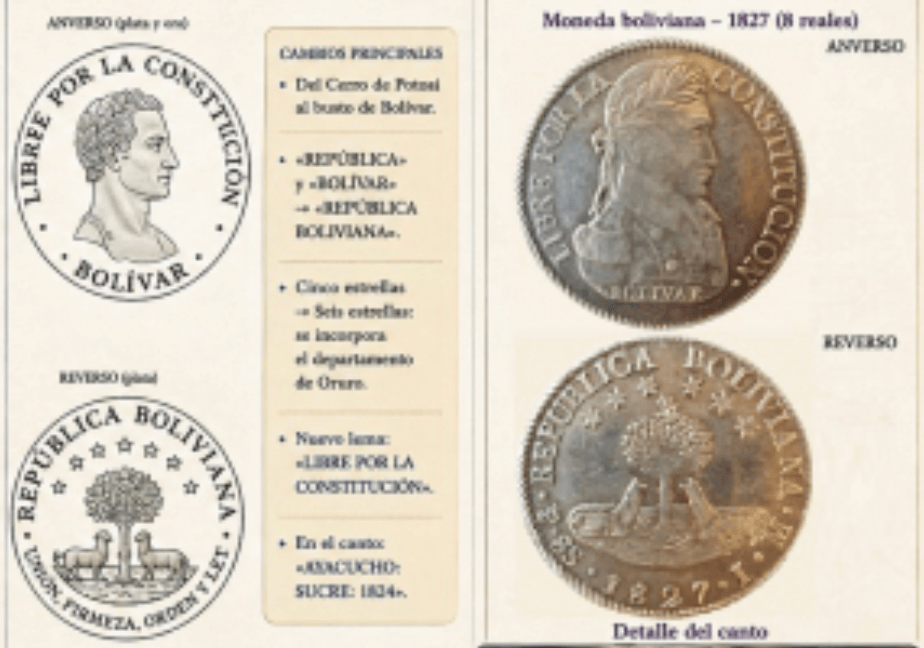
On November 14, 1826, the General Constituent Congress approved a new design. Silver coins would retain the Tree of Liberty and the stars on the reverse, but would bear the inscription “Bolivian Republic” around them. The obverse would feature a heroic bust of Simón Bolívar accompanied by the phrase “Free Through the Constitution.” Gold coins would likewise bear the Liberator’s bust and, on the reverse, the arms of the Republic. All would also include an inscription commemorating the battle that defeated the Spanish Empire: “Ayacucho: Sucre: 1824.”
The coin was thus beginning to serve as an instrument of political memory as well.
Documents preserved at the National Mint Museum make it possible to follow the process almost day by day. In December 1826, officials reported that the punches and dies were nearly complete and that samples of the new coins were being prepared for submission to President Sucre. They even discussed seemingly minor details, such as whether inscriptions should appear in relief or incuse, and how the word “Ayacucho” should be read on the edge of the coins.
Sucre’s intervention demonstrates the extent to which the new currency was also a symbolic construction. Upon receiving the samples, he approved the design but observed that Bolívar’s bust appeared disproportionate. He ordered it to be improved and instructed that the Liberator be shown in military uniform and wearing a laurel crown, avoiding the use of a mantle because it resembled the images of former kings.
It is a revealing detail. The Republic was not merely replacing one image with another; it was trying to establish its own iconography while differentiating the new power from the monarchy that had just disappeared.
The manufacturing process, however, continued to be delayed.
The prefect had to exert pressure on Mint employees. On April 4, 1827, he even asked them whether they loved President Sucre and whether they believed the government fulfilled its duties and enforced the law. Their response, issued three days later, was unanimous: the employees declared their admiration for the Grand Marshal of Ayacucho and presented him as a guarantor of liberty, security, and citizens’ rights.
The scene is almost paradoxical. In a Mint still inherited from the colonial regime, officials were being questioned about their loyalty to the republican government while efforts were underway to launch the production of the currency meant to embody that new sovereignty. The documents cited, found on pages 156v and 157r of file CdM 59 in the Historical Archive of Potosí, suggest that as late as April 1827 the coins still being minted were Spanish ones bearing the image of Ferdinand VII.
The republican currency would finally arrive that year, but it was not exactly the one decreed in August 1825.
The first design had included five stars because there were then five departments. When Oruro became the sixth, the new coin incorporated a sixth star. Spanish symbols and the image of Ferdinand VII were also replaced by Bolívar’s likeness. The Republic finally began to appear in metal.
And therein lies perhaps the greatest paradox of this story.
Bolivia’s political independence was proclaimed in 1825, but its monetary independence did not occur immediately. For a time, the old currency continued to circulate and be minted in Potosí. The change in sovereignty literally had to pass through the dies of the Mint.
That is why the first republican coin is much more than a numismatic piece. It is a historical document. Engraved upon it were the territory—represented by Cerro Rico of Potosí—the new political organization—the stars—liberty—the tree—the memory of Ayacucho, and finally the figure of Bolívar.
The Republic had ceased to be merely a declaration written on a document. It could now be carried in one’s pocket. Sucre’s determination had prevailed through Galindo’s persistence.
The currency decreed in 1825 took time to arrive, changed its design, and had to overcome the resistance of an institution still marked by its colonial past. Yet when it finally emerged from the dies of Potosí, it accomplished something that no decree alone could achieve: it transformed independence into an everyday object.
This time, sovereignty had weight in silver.
Juan José Toro is a journalist and historian.
Por Juan José Toro Montoya, Brújula Digital:
Aunque Bolivia nació como República en agosto de 1825, continuó acuñando y utilizando la moneda colonial española (con la efigie de Fernando VII) hasta 1827 debido a burocracia, cambios en el diseño y la resistencia implícita de funcionarios realistas en la Casa de Moneda de Potosí.
Datos: Juan José Toro/Ilustración: IA
La República había nacido en agosto de 1825, pero todavía no tenía moneda propia. Esta afirmación parece una contradicción. La Asamblea que fundó la República Bolívar había decretado, el 17 de agosto de 1825, cómo debía ser la moneda del nuevo Estado. Tendría el Cerro de Potosí y un sol naciente en el anverso; en el reverso aparecerían el árbol de la libertad, cinco estrellas y dos alpacas. Las palabras “República” y “Bolívar” completarían la identificación de la nueva soberanía.
Pero una cosa era decretar la moneda y otra, bastante más complicada, acuñarla.
El 17 de agosto también se habían diseñado el escudo, la bandera y la escarapela, que comenzaron a ser utilizados, pero la moneda fue la misma del periodo virreinal durante todo 1825: el real de a 8 español con la efigie de Fernando VII. Llegó 1826, la historia siguió su curso y la República Bolívar, ya con el nombre de Bolivia, siguió estructurándose, pero en ese año seguía acuñando moneda española.
¿Había dificultades para acuñar la nueva moneda? Sí, pero la amonedación había cambiado rápidamente en el pasado inmediato.
Monedas rioplatenses
Durante la crisis de la monarquía española, la Casa de Moneda había tenido que modificar sus acuñaciones según los acontecimientos políticos y militares. Hasta 1813 produjo piezas con la imagen de Carlos IV, pero la ocupación de la Villa Imperial por el ejército de Manuel Belgrano cambió radicalmente esa situación. La Junta de Gobierno de Buenos Aires había aprobado en abril de ese año la acuñación de moneda propia y, cuando los rioplatenses tomaron Potosí, la Casa de Moneda comenzó a producir piezas con nuevos símbolos: el sol en el anverso y el escudo de las Provincias Unidas en el reverso, acompañado por la expresión “Unión y Libertad”.
La experiencia duró poco. Derrotado Belgrano, los realistas recuperaron Potosí y volvió la moneda española, esta vez con la efigie de Fernando VII. En 1815, el ejército de Juan José Rondeau volvió a ocupar la Villa Imperial y restableció la acuñación patriota, con las modificaciones correspondientes. Expulsados nuevamente los rioplatenses, regresó la moneda fernandina, que ya no sería reemplazada hasta el final del régimen colonial.
La Casa de Moneda, entonces, no era una institución ajena a la política. Era uno de sus escenarios materiales más importantes. Quien controlaba Potosí podía controlar también los signos monetarios con los que se representaba el poder.
Acuñar moneda era un proceso complejo pero, como la segunda casa de amonedación potosina tenía la tecnología necesaria, en 1813 y 1815 se hizo cambios rápidos, tanto para producir las que serían las primeras monedas de la actual Argentina, como para retornar a la acuñación española.
¿Por qué, entonces, tardaron tanto las primeras monedas republicanas de Bolivia?
La ansiada moneda boliviana
Durante 1826, la Casa de Moneda de Potosí continuó produciendo piezas con la efigie de Fernando VII y las armas de España. El Estado que había proclamado su independencia seguía utilizando, en la práctica, la moneda del monarca del que acababa de separarse. No era solamente un problema técnico. La moneda era uno de los signos más visibles de quién ejercía la soberanía.
Había complicaciones, provocadas, en gran medida, por las observaciones sobrevinientes de Sucre al diseño original de 1825, pero también un detalle que era difícil no notar: en la Casa de Moneda permanecían funcionarios realistas que esperaban que la situación política vuelva a cambiar, como había ocurrido en 1813 y 1815, cuando los patriotas fueron echados por los ejércitos del rey.
León Galindo, que era prefecto de Potosí y superintendente de la Casa de Moneda desde mayo de 1826, tuvo que insistir. Su persistencia se convirtió en el instrumento del presidente Sucre para acuñar la primera moneda boliviana y, así, romper el último eslabón que unía al nuevo país con España.
El 16 de noviembre de 1826 ordenó al contador que se abrieran inmediatamente los troqueles necesarios para la acuñación de oro y plata desde el primero de enero del año siguiente. La orden era terminante: no se admitiría disculpa alguna de los talladores.
Pero mientras la maquinaria administrativa intentaba ponerse en movimiento, el proyecto original ya había cambiado.
El Congreso General Constituyente aprobó el 14 de noviembre de 1826 un nuevo diseño. La plata conservaría en el reverso el árbol de la libertad y las estrellas, pero llevaría alrededor la inscripción “República Boliviana”. En el anverso aparecería el busto de Simón Bolívar “a la heroica”, acompañado por la frase “Libre por la Constitución”. Las monedas de oro llevarían igualmente el busto del Libertador y, en el reverso, las armas de la República. Todas tendrían además una inscripción que recordaría la batalla que derrotó al imperio español: “Ayacucho: Sucre: 1824”.
La moneda, por tanto, comenzó a convertirse también en un instrumento de memoria política.
Los documentos conservados en la Casa Nacional de Moneda permiten seguir casi día por día el proceso. En diciembre de 1826 los funcionarios informaban que los punzones y matrices estaban prácticamente terminados y que se preparaban muestras de las nuevas piezas para que fueran remitidas al presidente Sucre. Incluso se discutían detalles aparentemente menores, como si las inscripciones debían quedar en relieve o en hueco y cómo debía leerse el nombre “Ayacucho” en el canto de las monedas.
La intervención de Sucre demuestra hasta qué punto el nuevo dinero era también una construcción simbólica. Al recibir las muestras, aprobó el diseño, pero observó que el busto de Bolívar aparecía desproporcionado. Ordenó perfeccionarlo y dispuso que el Libertador apareciera con uniforme y corona de laurel, evitando el manto porque este recordaba a las efigies de los antiguos reyes.
Es un detalle revelador. La República no solamente estaba sustituyendo una imagen por otra: estaba tratando de establecer una iconografía propia y, al mismo tiempo, de diferenciar al nuevo poder de la monarquía que acababa de desaparecer.
La fabricación, sin embargo, siguió demorándose.
El prefecto tuvo que ejercer presión sobre los empleados de la Casa de Moneda. El 4 de abril de 1827 llegó incluso a preguntarles si amaban al presidente Sucre y si consideraban que el Gobierno cumplía sus deberes y hacía cumplir las leyes. La respuesta, emitida tres días después, fue unánime: los empleados declararon su admiración por el Gran Mariscal de Ayacucho y lo presentaron como garantía de libertad, seguridad y derechos ciudadanos.
La escena resulta casi paradójica. En una Casa de Moneda todavía heredada del régimen virreinal, los funcionarios eran interrogados sobre su fidelidad al Gobierno republicano mientras se intentaba poner en marcha la fabricación de la moneda que debía materializar esa nueva soberanía. Los documentos citados, que se encuentran en las páginas 156v y157r del expediente CdM 59 del Archivo Histórico de Potosí permiten deducir que, para entonces, abril de 1827, la moneda que se seguía acuñando era la española, con la efigie de Fernando VII.
La moneda republicana terminaría llegando, ese año, pero tampoco fue exactamente la que se había decretado en agosto de 1825.
El primer diseño había previsto cinco estrellas porque entonces eran cinco los Departamentos. Cuando Oruro se convirtió en el sexto, la nueva moneda incorporó una sexta estrella. También se sustituyeron los símbolos españoles y la efigie de Fernando VII por la imagen de Bolívar. La República, finalmente, comenzó a aparecer en metal.
Y allí está quizá la mayor paradoja de esta historia.
La independencia política de Bolivia fue proclamada en 1825, pero su independencia monetaria no se produjo de inmediato. Durante un tiempo, la antigua moneda siguió circulando y siendo acuñada en Potosí. El cambio de soberanía necesitó, literalmente, pasar por los troqueles de la Casa de Moneda.
Por eso, la primera moneda republicana es mucho más que una pieza numismática. Es un documento histórico. En ella quedaron grabados el territorio —representado por el Cerro de Potosí—, la nueva organización política —las estrellas—, la libertad —el árbol—, la memoria de Ayacucho y, finalmente, la figura de Bolívar.
La República había dejado de ser solamente una declaración escrita en un acta. Ahora podía llevarse en el bolsillo. La voluntad de Sucre se había impuesto a través de la insistencia de Galindo.
La moneda que se había decretado en 1825 tardó en llegar, cambió de diseño y tuvo que vencer la resistencia de una institución todavía marcada por el pasado virreinal, pero, cuando finalmente salió de los troqueles de Potosí, produjo algo que ningún decreto podía conseguir por sí solo: convirtió la independencia en un objeto cotidiano.
La soberanía, esta vez, pesaba en plata.
Juan José Toro es periodista e historiador.
https://brujuladigital.net/sociedad/2026/09/04/cronicala-moneda-que-si-fuejuan-jose-toro-65921


Leave a comment