By Brujula Digital:
Millennium Warns of Organized Crime Expansion and “Institutional Capture” in Bolivia
A report identifies drug trafficking, illegal mining, smuggling, and money laundering among the country’s main illicit economies and proposes reforms to the police, judiciary, and Financial Intelligence Unit.

Seized drugs in Bolivia / File photo / APG
The Millennium Foundation warned on Thursday about the expansion of illicit economies and institutional capture in Bolivia and proposed a series of reforms aimed at strengthening the state against organized crime.
The assessment is contained in the report “A Minefield: Illicit Economies, Institutional Capture, and the Erosion of the Social Fabric,” prepared by Henry Oporto and Ricardo Calla. It was presented alongside the regional study “Cracks in the System,” produced by the Center for Democracy Studies (CSD) and the Millennium Foundation.
According to the report, drug trafficking, illegal gold mining, smuggling, money laundering, and arms trafficking expanded in Bolivia between 2006 and 2025. The authors argue that these activities grew in a context where the state was captured by political factions, labor groups, and corporate interests.
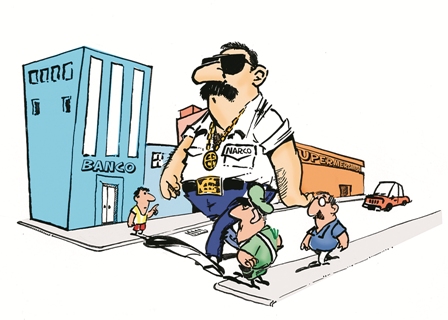
The study notes the identification of at least 17 drug-trafficking clans in 2025, the cases involving so-called “narco-generals” within the police force, and the penetration of corruption networks into the justice system. It also recalls that Bolivia was placed back on the Financial Action Task Force (FATF) gray list in June 2025 due to shortcomings in combating money laundering.
Oporto stated that the country needs a “professional and depoliticized” police force, an independent judiciary, and a Financial Intelligence Unit (FIU) with genuine autonomy.
The report proposes four main reform areas: professionalizing and depoliticizing the police; restoring the independence of the judiciary and the Public Prosecutor’s Office; strengthening the FIU and anti-money-laundering mechanisms; and approving a Transparency and Access to Public Information Law as well as a State Procurement Law.
The regional study, which examines 24 countries, also argues that Bolivia has institutions that function “on paper” but possess limited capabilities due to political pressure, lack of resources, and institutional fragility.
The report further analyzes the reopening of anti-drug cooperation with the United States, the European Union, and neighboring countries following the DEA’s return to Bolivia, while warning of the sovereignty dilemmas that this new phase may create.
BD/RPU
Por Brújula Digital:
Milenio alerta sobre avance del crimen organizado y “captura institucional” en Bolivia
Un informe identifica al narcotráfico, la minería ilegal, el contrabando y el lavado de dinero entre las principales economías ilícitas y plantea reformas a la Policía, la justicia y la UIF.
Droga incautada en Bolivia/Archivo/APG
La Fundación Milenio alertó este jueves sobre el avance de las economías ilícitas y la captura institucional en Bolivia, y planteó una serie de reformas para fortalecer al Estado frente al crimen organizado.
El diagnóstico está contenido en el informe “Un campo minado: economías ilícitas, captura institucional y erosión del tejido social”, elaborado por Henry Oporto y Ricardo Calla, presentado junto con el estudio regional “Grietas en el sistema”, del Centro de Estudios de la Democracia (CSD) y la Fundación Milenio.
El informe señala que entre 2006 y 2025 se expandieron en Bolivia el narcotráfico, la minería ilegal de oro, el contrabando, el lavado de dinero y el tráfico de armas. Según los autores, estas actividades crecieron en un contexto de captura del Estado por facciones político-partidarias, grupos sindicales e intereses corporativos.
El estudio menciona la identificación de al menos 17 clanes narcotraficantes en 2025, los casos de los llamados “narcogenerales” dentro de la Policía y la penetración de redes de corrupción en la justicia. También recuerda que Bolivia ingresó nuevamente en junio de 2025 a la lista gris del Grupo de Acción Financiera Internacional (GAFI) por deficiencias en la lucha contra el lavado de activos.
Oporto afirmó que el país necesita una Policía “profesional y despolitizada”, una justicia independiente y una UIF con autonomía real.
El informe propone cuatro líneas de reforma: profesionalizar y despolitizar la Policía; recuperar la independencia del sistema judicial y del Ministerio Público; fortalecer la UIF y los mecanismos contra el lavado de dinero; y aprobar una Ley de Transparencia y Acceso a la Información Pública y una Ley de Contrataciones Estatales.
El estudio regional, que analiza 24 países, sostiene además que en Bolivia existen instituciones que funcionan “en el papel”, pero que tienen capacidades limitadas debido a presiones políticas, falta de recursos y precariedad institucional.
El informe también analiza la reapertura de la cooperación antidrogas con Estados Unidos, la Unión Europea y países vecinos tras el retorno de la DEA a Bolivia, y advierte sobre los dilemas de soberanía que plantea esa nueva etapa.
BD/RPU


Leave a comment