By Gonzalo Chávez, Brujula Digital:
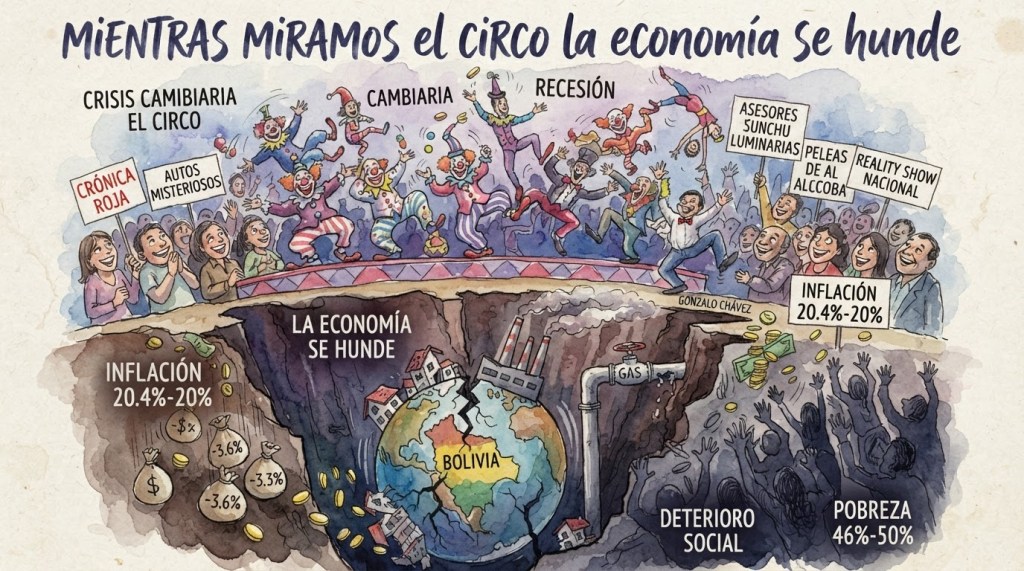
While the country sinks into the darkest depths of crime news and political squabbling, the economic and social crisis advances quietly. Every morning brings a new episode: accusations, mysterious cars, celebrity advisers from nowhere, fiery censures accompanied by tears, bedroom disputes, allegations and counter-allegations of every kind. A remarkable national reality show.
The small problem is that, while we argue about who said what, who bought what, who slept with whom, whose child might be whose, and who should resign, the economy keeps working. And lately, it has been working against us. That is what the Central Bank of Bolivia’s Second Quarter 2026 Inflation and Monetary Policy Report tells us. A diagnosis that is unusually blunt.
In both the short and long term, Bolivia is actually facing three simultaneous crises: a foreign exchange and currency crisis, a crisis of the growth model, and a social crisis, to mention only the most important ones and make the most of the limited space in this column. Of course, I have not forgotten the environmental, institutional, political, ethical, and other crises. Surely someone more qualified than I am can delve deeper into those issues. But let us focus on our subject: the economic and social crises.
The first major warning sign is the recession. Bolivia is now experiencing its third consecutive year of economic contraction, and for 2026 estimates place GDP decline between -3.3% and -3.6%. We are not facing a simple cyclical cold: the old economic engine has run out of fuel—literally and metaphorically. Excluding the recession caused by the COVID pandemic in 2020 (-8.8%), this would be the sharpest decline since the mid-1980s, specifically 1982 (-3.9%) and 1983 (-4.0%).
For years, growth was driven by two major engines: gas revenues and public spending. The first lost power as gas production declined; the second continued operating through growing fiscal deficits and money creation. Now both engines are exhausted, and a third one—based on private investment, non-traditional exports, and productivity—has yet to emerge with sufficient strength.
It is like discovering, halfway down the highway, that the car had two engines and both were being held together with fiscal duct tape.
The second concern is inflation. We closed 2025 at 20.4%, the highest level in three decades. For 2026 there is a curious range of forecasts: from roughly 9% to more than 20%. In other words, there are projections to suit every taste. One of them will surely be right.
Behind this technical debate lies a much less amusing reality: inflation is the most regressive tax that exists. Those who hold dollars, property, or financial assets can defend themselves. Those who earn in bolivianos and spend much of their income on food simply watch their salary grow thinner without ever needing a gym membership.
And here one of the paradoxes of stabilization appears. A more restrictive monetary policy—such as increasing reserve requirements—can help reduce inflation, and it is necessary. But if the dose is excessive in an economy already in recession, we may end up celebrating slower price increases while sales, production, and employment also decline.
Patient stabilized. Economy sedated.
The third crisis is probably the most troubling because it occurs far from press conferences: social deterioration.
Some celebrate that Bolivia maintains a relatively low unemployment rate. Wonderful. There is only one small detail: in an economy where around eight out of ten urban workers are informal, losing a job does not necessarily mean becoming statistically unemployed. More often, it means selling something on the street, driving a taxi, working fewer hours, or accepting any activity that allows survival.
Thus we have a uniquely Bolivian statistical marvel: quality employment can fall without unemployment rising much. Citizens are worse off, but the indicator maintains its good manners.
The truly dramatic figure lies in incomes. Since 2019, real labor income has reportedly lost approximately one-third of its purchasing power. Nominal wages may even have increased, but what matters is not how many bolivianos appear on the paycheck, but how many kilos of meat, rice, bread, or medicines can be purchased with them.
And all of this ultimately flows into the variable that should concern us far more than the political scandal of the week: poverty.
In 2025, poverty reached approximately 44.7% of the population and, depending on inflation’s behavior, could range between 46% and 50% in 2026. We are potentially talking about between five and a half and six million Bolivians living below the monetary poverty line.
That is why the economic debate cannot be reduced to a fight between those who want adjustment and those who do not. Adjustment is inevitable because the fiscal, monetary, and exchange-rate imbalances accumulated over years are also inevitable. The real discussion is how, when, and who pays the bill.
Monetary discipline is needed, yes, but accompanied by a credible fiscal rule. Fuel prices that are currently administered need to be adjusted gradually, while providing targeted protection to those who genuinely need assistance.
International reserves must be rebuilt and external financing recovered, but conditions must also be created for investment, production, and exports. We need to formalize the economy without committing the bureaucratic genius of killing the informal worker first and then congratulating them for registering with the tax authorities.
Above all, we need credibility. Economic credibility is not built by announcing every week that everything will be wonderful next quarter, nor by buying an electric Audi. It is built by setting reasonable goals and achieving them. As the conclusion of the Central Bank of Bolivia’s document reminds us, it is better to consistently meet modest objectives than to announce spectacular goals that later become part of the nation’s vast collection of good intentions.
Meanwhile, we can continue to be fascinated by crime stories, the car of the week, the adviser of the month, and the political fight of the day. As the wonderful Diablada Chiru Chiru says: “Keep feeding the fire, fireman. Keep feeding the fire.” The economy will not be offended; it will simply keep sending the bill.
Stay strong, devils!
Gonzalo Chávez is an economist.
Por Gonzalo Chávez, Brujula Digital:
Mientras el país se sumerge en las profundidades más oscuras de la crónica roja y la politiquería, la crisis económica y social avanza silenciosamente. Cada mañana tenemos un nuevo episodio: denuncias, autos misteriosos, asesores sunchu luminarias, censuras a fuego y lágrimas, peleas de alcoba, acusaciones y contraacusaciones de todo tipo. Un formidable reality show nacional.
El pequeño problema es que, mientras discutimos quién dijo qué, quién compró qué, quién se cepilló a quién, cuyo hijito sería, y quién debería renunciar, la economía sigue trabajando. Y últimamente trabaja en nuestra contra. Así lo anuncia el reporte de inflación y política monetaria del Banco Central de Bolivia del segundo trimestre del 2026. Un diagnóstico raramente descarnado.
En el corto plazo y largo plazo, Bolivia enfrenta, en realidad, tres crisis simultáneas: una crisis cambiaria y de divisas, una crisis del modelo de crecimiento y una crisis social, para mencionar las más importantes y aprovechar el corto espacio de esta columna. Por supuesto que no me olvido de la crisis ambiental, institucional, política, ética y otras. Seguramente alguien más preparado que yo podrá profundizar sobre estos temas. Pero vamos a lo nuestro. Las crisis económicas y sociales.
La primera gran señal es la recesión. Bolivia transita su tercer año consecutivo de contracción económica y para 2026 las estimaciones sitúan la caída del PIB entre -3,3 % y -3,6 %. No estamos frente a un simple resfriado coyuntural: el viejo motor económico se quedó sin gasolina. Literal y metafóricamente. Retirando la recesión causada por la pandemia del Covid en 2020, -8,8 %. Esta es la caída más fuerte desde mediados de los años 80, específicamente en 1982 (-3,9 %) y 1983 (-4,0 %).
Durante años crecimos apoyados en dos grandes motores: la renta del gas y el gasto público. El primero perdió potencia con la caída de la producción gasífera; el segundo continuó funcionando crecientemente con déficit públicos y emisión monetaria. Ahora ambos motores están agotados y todavía no aparece con suficiente fuerza un tercero basado en inversión privada, exportaciones no tradicionales y productividad.
Es como descubrir, en plena carretera, que el automóvil tenía dos motores y ambos estaban sostenidos con cinta adhesiva fiscal.
La segunda preocupación es la inflación. Cerramos 2025 con 20,4 %, la más alta en tres décadas. Para 2026 existe una curiosa amplitud de pronósticos: desde aproximadamente 9 % hasta más de 20 %. Es decir, tenemos proyecciones para todos los gustos. Alguna seguramente acertará.
Pero detrás de esta discusión técnica existe una realidad bastante menos divertida: la inflación es el impuesto más regresivo que existe. Quien tiene dólares, propiedades o activos financieros puede defenderse. Quien cobra en bolivianos y gasta buena parte de su ingreso en comida simplemente observa cómo su salario adelgaza sin necesidad de gimnasio.
Y aquí aparece una de las paradojas de la estabilización. Una política monetaria más restrictiva, aumento del encaje legal, puede ayudar a bajar la inflación, y es necesaria. Pero si se exagera la dosis en una economía que ya está en recesión, podemos terminar celebrando que los precios suben más lentamente mientras las ventas, la producción y el empleo también bajan.
Paciente estabilizado. Economía sedada. La tercera crisis es probablemente la más preocupante porque ocurre lejos de las conferencias de prensa: el deterioro social.
Algunos celebran que Bolivia mantiene una tasa de desempleo relativamente baja. Magnífico. Solo existe un pequeño detalle: en una economía donde alrededor de ocho de cada 10 trabajadores urbanos son informales, perder un empleo no necesariamente significa convertirse estadísticamente en desempleado. Muchas veces significa vender algo en la calle, manejar un taxi, trabajar menos horas o aceptar cualquier actividad que permita sobrevivir.
Tenemos así una maravilla estadística muy boliviana: puede caer el empleo de calidad sin que aumente demasiado el desempleo. El ciudadano está peor, pero el indicador conserva buenos modales.
El dato verdaderamente dramático está en los ingresos. Desde 2019, el ingreso laboral real habría perdido aproximadamente un tercio de su poder adquisitivo. El salario nominal puede incluso haber aumentado, pero lo importante no es cuántos bolivianos aparecen impresos en la papeleta, sino cuántos kilos de carne, arroz, pan o medicamentos pueden comprarse con ellos.
Y todo termina desembocando en la variable que debería preocuparnos mucho más que el escándalo político de la semana: la pobreza.
En 2025 alcanzó aproximadamente 44,7 % de la población y, dependiendo del comportamiento de la inflación, podría ubicarse entre 46 % y 50 % en 2026. Estamos hablando potencialmente de entre cinco millones y medio y seis millones de bolivianos por debajo de la línea de pobreza monetaria.
Por eso el debate económico no puede reducirse a una pelea entre quienes quieren ajuste y quienes no quieren ajuste. El ajuste es inevitable porque los desequilibrios fiscales, monetarios y cambiarios acumulados durante años también lo son. La verdadera discusión es cómo, cuándo y quién paga la factura.
Se necesita disciplina monetaria, sí, pero acompañada de una regla fiscal creíble. Se necesita sincerar gradualmente los precios administrados de los combustibles, pero protegiendo de manera focalizada a quienes realmente necesitan ayuda.
Se necesita reconstruir reservas internacionales y recuperar financiamiento externo, pero también crear condiciones para inversión, producción y exportaciones. Y necesitamos formalizar la economía sin cometer la genialidad burocrática de matar al informal para después felicitarlo por haberse inscrito en Impuestos.
Sobre todo, necesitamos credibilidad. Y la credibilidad económica no se construye anunciando cada semana que todo estará maravilloso el próximo trimestre ni comprando un Audi eléctrico. Se construye fijando metas razonables y cumpliéndolas. Como recuerda la conclusión del documento del Banco Central de Bolivia, es mejor cumplir sostenidamente objetivos modestos que anunciar objetivos espectaculares que después terminan incorporándose al extenso patrimonio nacional de buenas intenciones.
Mientras tanto, podemos continuar fascinados con la crónica roja, el automóvil de la semana, el asesor del mes y la pelea política del día. Como dice la maravillosa diablada el Chiru Chiru: “métale leña nomás fogonero. Métale leña nomás (Bis)”. La economía no se ofenderá, simplemente seguirá pasando la factura. ¡Fuerza satanases!
Gonzalo Chávez es economista.
https://brujuladigital.net/opinion/mientras-miramos-el-circo-la-economia-se-hunde


Leave a comment