By Ronald MacLean-Abaroa, Brujula DIgital:
Bolivia Was Too Big for Us
After 20 years of dismantling state institutions—guided by a Plurinational Constitution intended to lead the country toward Socialism, from which many hoped the last election would free us—we are concerned that the current government still lacks a clear direction or vision for Bolivia’s future.
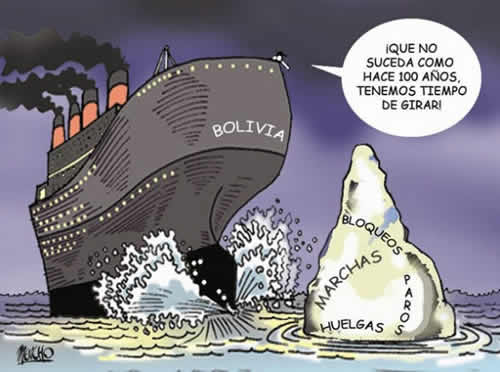
At the same time that it has abolished the Ministry of Development Planning and Environment, the government body once responsible for providing economic guidance and strategic content to the executive branch, one could say that a lost traveler has just thrown away the compass.
Like the MAS governments before it, the current administration appears to believe that Bolivia’s problems can be solved primarily with money: funds to finance subsidies, cover deficits, and so on. Money is viewed as the fuel that keeps the economy running. Consequently, its efforts have focused on obtaining loans at any cost, taking advantage of the wave of optimism generated among voters in order to continue spending and refinance debt more cheaply. All power to the checkbook!
The socialist/statist economic model—which remains unchanged—does not work, no matter how much money is poured into it. It is incapable of creating wealth or prosperity; it can only spend and redistribute what others have created, until there is nothing left.
What is essential now is a complete change in the logic of the economic team—a 180-degree turn—by providing the government with the best human capital: professional, capable, and honest people. Money will follow them, and that is what is needed to generate investment and employment.
The new model—the “vehicle” that can pull us out of the mire in which we were left and still remain—must be designed and operated by Bolivians themselves, through an institution equivalent to the former Ministry of Planning and Coordination, which helped guide the country out of its deepest crisis in 1985.
The later design of the Ministry of Sustainable Development represented an institutional advance. It transformed the initial model of indicative government planning—with its elements of dirigisme, centralism, and technocratic top-down control—into a completely different vision of the relationship between the state and society. In this vision, the individual stands at the center of development, enjoying rights and freedom; the environment is a resource to be preserved; and democratic institutional participation becomes the source of inspiration and legitimacy for shaping Bolivia’s future.
Paradoxically, I believe the ministry’s most complete and mature achievement came during the constitutional government of Hugo Banzer Suárez. Building on the important reforms of previous administrations, particularly that of Gonzalo Sánchez de Lozada, we implemented the broadest mechanism of popular participation in state decision-making: the National Dialogue 2000.
Based on Bolivia’s 315 municipalities, a total of 1,260 municipal representatives participated. Through negotiation tables, they reached consensus on how the resources generated by international debt relief for Bolivia—as a Heavily Indebted Poor Country (HIPC)—should be used.
That ministry served as a modern mechanism for aggregating citizens’ aspirations, building the consensus needed to unite a diverse nation. It was the government institution responsible for organizing the construction of a “national vision,” a shared destiny, a common North Star capable of mobilizing the country. This vision emerged from a structured, orderly, and inclusive dialogue rooted in local communities and municipalities, to which the government was expected to respond—not the other way around.
The recent elimination of the Ministry of Planning—that is, the institution responsible for foresight, participation, inclusion, and policy consensus—creates a serious vacuum in what should be an open, pluralistic, and participatory government committed to growth that ensures the sustainable use and preservation of natural resources for future generations.
Its abolition amounts to surrendering to the simplistic notion that “the cashier should run the company,” depriving the government of its most important forum for discussion and coordination, its principal source of guidance, and its institutional mechanism for debate and consensus-building.
This was the institution where economic policy was debated in relation to the country’s development, where ideas were challenged and refined, and whose minister chaired the economic cabinet. It was the state’s economic compass.
Its elimination carries the risk of perpetuating discretion, vertical decision-making, and the supremacy of the “power of the checkbook” over collective, rational, and informed analysis—precisely the contribution that this ministry was historically meant to provide as a guiding principle of economic governance and development.
Ronald MacLean Abaroa served as Bolivia’s Foreign Minister, Mayor, Minister of Planning and Coordination, Minister of Finance, and Minister of Sustainable Development and Planning.
Por Ronald MacLean-Abaroa, Brujula DIgital:
¡Bolivia nos quedó grande!
¡Bolivia nos quedó grande!
Después de 20 años de desinstitucionalización del Estado –regidos por una “hoja de ruta” basada en una Constitución Plurinacional de camino al Socialismo, de lo cual pensábamos librarnos en la última elección– vemos con preocupación que el gobierno actual aún no encuentra su Norte ni proyecta una idea clara de a dónde nos dirigimos.
Al mismo tiempo que acaba de deshacerse del Ministerio de Planificación del Desarrollo y Medio Ambiente, la otrora cartera que debía dar guía y contenido económico al Ejecutivo, alguien diría que el extraviado acaba de botar la brújula.
Y es que, al igual que los gobiernos del MAS, el actual parece creer que el problema de Bolivia se resuelve, principalmente, con plata: dinero para pagar subvenciones, cubrir déficits, etc. Concibe al dinero como una suerte de combustible para que funcione la economía. Por tanto, sus esfuerzos se han concentrado en tomar préstamos a toda costa, aprovechando la ola de optimismo que generó en el electorado para seguir gastando y sirviendo deuda más barata. ¡Todo el poder a la chequera al viento!
El modelo económico socialista/estatista, que no hemos cambiado, no sirve por más dinero que le pongan. Es incapaz para crear riqueza o prosperidad; solo funciona para gastar y redistribuir lo que otros crearon, hasta que se les acabe.
Lo imprescindible ahora es cambiar la lógica del equipo económico, un giro de 180 grados, dotando al gobierno del mejor capital humano, de gente profesional, capaz y honesta, detrás de la cual vendrá el dinero, que falta para generar inversiones y empleo.
El nuevo modelo, “vehículo”, que nos saque del fango en el que nos dejaron y aún estamos, debemos diseñarlo y operarlo los bolivianos, en base a un ministerio equivalente al de Planeamiento y Coordinación de la época, cuando salimos de la mayor crisis, en 1985.
El diseño del entonces Ministerio de Desarrollo Sostenible fue un avance institucional que transformó la inicial planificación gubernamental indicativa –con rasgos de dirigismo, centralismo y verticalidad tecnocrática– a una visión totalmente distinta del Estado y la sociedad; donde la persona individual ocupa el centro del desarrollo con derechos y libertad; donde el medio ambiente es un factor a conservar; donde la participación democrática institucional es la fuente de inspiración y voluntad en la construcción de los escenarios y visiones del futuro de Bolivia.
Paradójicamente, creo que el fruto más completo y maduro que dio ese ministerio, que tomó forma a lo largo de varias décadas bajo la dirección de destacados hombres públicos, fue precisamente bajo el gobierno constitucional de Hugo Banzer Suárez, cuando rescatando las importantes reformas de los gobiernos anteriores, y del de Gonzalo Sánchez de Lozada principalmente, pusimos en práctica el más amplio mecanismo de participación popular para la toma de decisiones del Estado: el Diálogo Nacional 2000.
En base a los 315 municipios, participaron un total de 1260 munícipes, que consensuaron en mesas de negociación, cuál debiera ser el destino del uso de los fondos del perdón de la deuda externa a Bolivia, como país pobre altamente endeudado (HIPC).
Ese ministerio fue precisamente el mecanismo moderno de agregación de aspiraciones ciudadanas para construir el consenso necesario e impulsar la voluntad de articular una nación diversa como la nuestra. Fue la cabeza de gobierno que organizó la construcción de una “visión de país”, de un destino común, de un Norte que movilice a la nación, nacido de un diálogo estructurado, ordenado e inclusivo de la base social, desde sus municipios, al que debía responder el gobierno. Y no al revés.
La reciente eliminación del Ministerio de Planificación, es decir, del mecanismo de pre-visión, participación, inclusión y consenso de políticas públicas, deja un grave vacío en lo que debiera ser un gobierno abierto, plural y participativo que promueva un crecimiento que asegure la sostenibilidad de los recursos naturales y su preservación para las próximas generaciones.
Su eliminación es una claudicación frente a la idea facilista de que “el cajero maneje la empresa”, despojando al gobierno de su más importante foro de discusión y coordinación; de su instancia de orientación, de su órgano de discusión y de consenso.
Esta era la instancia donde se debatía la política económica en función del desarrollo del país; donde se contrastaban las ideas y cuyo ministro presidía el gabinete económico. La brújula económica del Estado.
Su eliminación conlleva el peligro de mantener la discrecionalidad, el verticalismo y la preeminencia del “poder supremo de la chequera” por encima del análisis colegiado, racional e informado, históricamente llamado a ser aportado por ese Ministerio como principio rector de la gobernanza económica y de desarrollo.
Ronald MacLean Abaroa fue canciller, alcalde y ministro de Planeamiento y Coordinación, Hacienda; y Desarrollo Sostenible y Planificación de Bolivia.
https://brujuladigital.net/opinion/el-ministerio-del-ministerio-


Leave a Reply