By Marco Mendoza, La Razon:
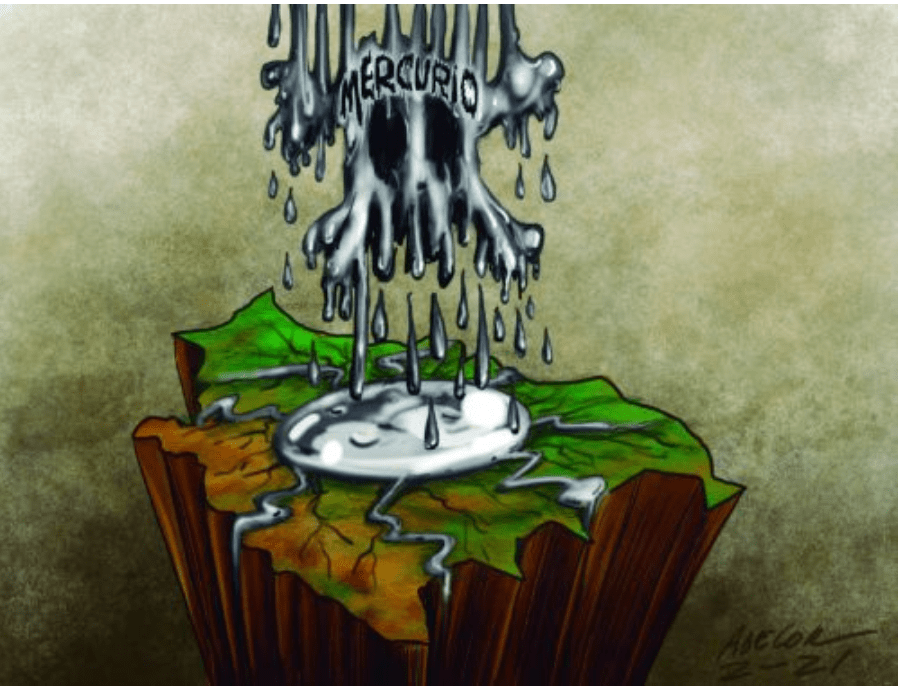
The reason is the same as always: high mercury contamination that affects health
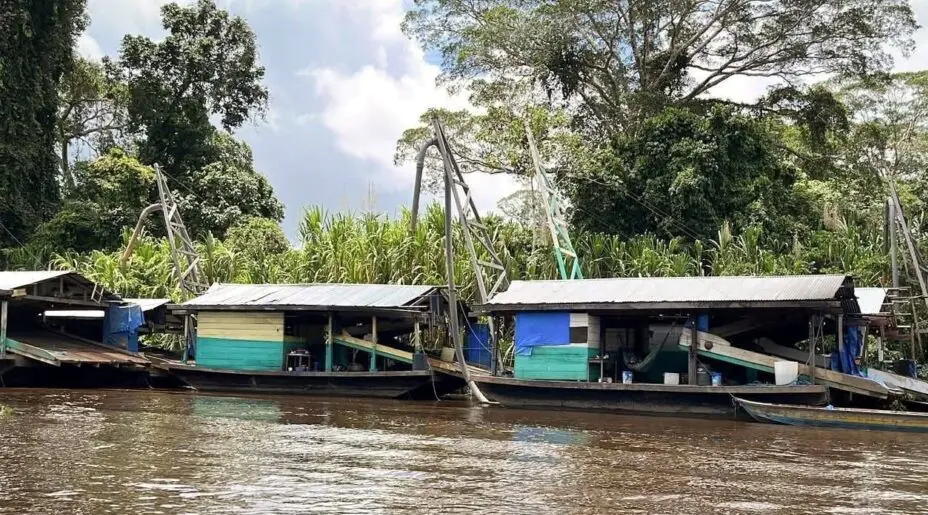
The dredges pollute the rivers / Agro-Environmental Tribunal
Indigenous organizations in the department of Pando have issued an ultimatum until September 30, 2026, demanding the removal of all barges and dredges dedicated to gold mining along the Madre de Dios River.
“We must think about our children and future generations. We must leave them a dignified territory with a healthy environment,” said Lucio Ayala Siripi, president of the Multiethnic Indigenous Territory TIM II, emphasizing the importance of preserving lands and nature for those who will come after us.
His statement delivers a powerful message about the importance of preserving both a healthy environment and a healthy territory.
Unfortunately, over time, both have been severely affected by legal and illegal mining activities that contaminate rivers, territories, and the lives of people who have always lived in harmony with nature and the environment.
Against this increasingly complex backdrop, driven by the expansion of illegal mining across river basins nationwide, the Indigenous peoples of Pando have issued an ultimatum demanding the complete removal of barges and dredges used for gold mining throughout the entire course of the Madre de Dios River.
The reason is the same as always: high levels of mercury contamination affecting the health of Indigenous communities, wildlife, and their livelihoods.
In addition, communities belonging to the Tacana, Kabineño, Ese Ejja, Yaminawa, Machineri, and Pacahuara peoples, supported by the Indigenous Peoples’ Organization of Pando (CIPOAP) and the Multiethnic Indigenous Territory II (TIM II), announced the formation of community defense committees to protect their territories, water sources, food supplies, and, above all, their health.
“During an emergency assembly held in the Tacana Indigenous community of Trinidacito, it was decided to adopt these measures in defense of our territory and in response to the impacts of mining activities,” explained Javier Fernández, president of CIPOAP.
The Indigenous leader stated that several communities also decided to organize community defense committees to confront the advance of illegal mining.
“The communities’ concern is primarily focused on mercury and other heavy metal contamination affecting the waters of the Madre de Dios River and the resources upon which Indigenous families depend, such as fishing and access to clean water,” Fernández explained.
He also revealed that a study conducted in 2025 reportedly identified high mercury levels in hair samples taken from residents of Indigenous communities. The study also warned of contamination in food and fish consumed by Indigenous families, placing them in a highly vulnerable situation and directly affecting their traditional means of subsistence.
After analyzing the consequences of gold mining in their territories, CIPOAP decided to give mining companies, barge operators, and other mining workers until September 30 to remove their barges, dredges, machinery, and equipment from the banks of the Madre de Dios River and the associated Indigenous territories in Pando.
Community defense committees against illegal mining have been established in Loreto, Trinidacito, 2 de Agosto, 6 de Agosto, Sinaí, Portachuelo Alto, Portachuelo Medio, Portachuelo Bajo, Galilea, Exaltación, Santa Elena, and other riverside communities within the Multiethnic Indigenous Territory (TIM), as well as dispersed settlements.
Another measure adopted states that Indigenous community members currently employed by mining companies or engaged in mining activities must return to their communities of origin. The resolution warns that once the deadline expires, communities may adopt “direct action measures” against any barges or dredges that remain in place.
“As an organization, we have determined that once the deadline expires, we will proceed with the eviction of mining activities that contaminate our rivers and affect our livelihoods,” Fernández stated.
The Indigenous peoples’ complaints were reinforced by an aerial survey conducted in August over the Orthon and Madre de Dios rivers, which confirmed the expansion of gold mining activities in Pando.
“During the overflight, dozens of dredges and mining barges were identified, some apparently operating, although their legal status is unknown,” said departmental assembly member José Luis Suárez, who coordinated the survey with support from the Bolivian Air Force and the Bolivian Navy.
Suárez explained that the inspection was carried out after receiving reports of dredges allegedly operating without authorization on the Orthon River.
“During the inspection, seven vessels were observed in that sector. We need support from AJAM to carry out our oversight work in the department, because this is not only an environmental issue; it also concerns royalty revenues,” Suárez argued.
The assembly member also reported counting approximately five dredges on the Orthon River and at least 30 on the Madre de Dios River during the August survey, although it remains unclear whether they have the legal authorization to operate.
Enforcement Actions
According to a report from the Mining Administrative Jurisdiction Authority (AJAM), more than 50 enforcement operations have been carried out in municipalities across all nine departments, including remote areas, conflict zones, and locations where illegal mining activities had been reported.
AJAM conducted operations in La Paz, Potosí, Oruro, Chuquisaca, Tarija, Beni, Pando, Cochabamba, and Santa Cruz.
The interventions included inspections and verification of mining activities operating outside legal regulations, suspensions, restoration of mining areas, prior consultation processes, and the activation of administrative and legal actions under the institution’s national authority.
According to AJAM’s January 2026 report, a significant portion of its efforts focused on the Bolivian Amazon. Along the Puerto Sena–Manuripi National Wildlife Reserve corridor in Pando, AJAM worked alongside prosecutors in an operation that led to the intervention of three dredges used in illegal alluvial gold extraction. One was handed over to the National Protected Areas Service (SERNAP), another was disabled, and a third was sunk in accordance with established protocols.
Similarly, three barges linked to unauthorized mining activities were seized and destroyed on the Toromonas River within Madidi National Park. In February, enforcement efforts expanded into Beni and La Paz.
In the Mandarinas sector of Cerro San Simón, in the municipality of Baures, AJAM and the Bolivian Navy dismantled an illegal mining camp where ten Brazilian nationals were identified alongside heavy machinery, fuel supplies, and infrastructure intended for alluvial gold extraction.
Despite these actions, Indigenous representatives believe that government measures remain insufficient compared to the scale of illegal mining. They are demanding stronger and more concrete actions to stop these activities, which threaten their livelihoods.
Warning Signs of Minamata Syndrome
Minamata syndrome, or Minamata disease, is a severe and permanent neurological disorder caused by methylmercury poisoning (organic mercury).
“Consumption of methylmercury through food causes severe neurological damage and also affects the development of the fetal nervous system during pregnancy,” explained Ruth Alípaz, co-founder of the National Coordinator for the Defense of Indigenous, Peasant, and Protected Territories of Bolivia (Contiocap).
However, the organization stressed that although there are signs suggesting the possible presence of the syndrome and clear risks, some actors continue to claim “without any scientific backing that the syndrome does not exist in the Amazon.”
Contiocap therefore called on the state to immediately apply the precautionary principle, initiate diagnosis and treatment for those who may be affected, and implement emergency contingency measures.
The organization also recalled that on March 14, 2022, it filed a formal complaint before the Inter-American Commission on Human Rights (IACHR) regarding the seriousness of mercury contamination affecting Indigenous populations, an issue that at the time was largely unknown both nationally and internationally.
Having identified indications of the syndrome’s presence, and under the health-related principle that shifts the burden of proof, the next immediate step should be for the state to apply the precautionary principle and undertake urgent efforts for diagnosis, treatment, and contingency planning.
Alípaz also noted that the Bolivian state has ratified several binding international agreements, including ILO Convention 169, the Minamata Convention aimed at reducing and ultimately eliminating mercury use in gold extraction, and the Escazú Agreement on access to environmental information.
Por Marco Mendoza, La Razón:
El motivo es el mismo de siempre, una alta contaminación por mercurio que afecta la salud
Las dragas contaminan los ríos/Trib. Agroambiental
Las organizaciones indígenas del departamento de Pando dieron un ultimátum hasta el 30 de septiembre de 2026 para el retiro de todas las balsas y dragas dedicadas a la minería aurífera en el río Madre de Dios.
“Debemos pensar en nuestros hijos y nuestras futuras generaciones, debemos dejarles un territorio digno con un medio ambiente sano”, aseguró Lucio Ayala Siripi, presidente del Territorio Indígena Multiétnico TIM II, que destacó la importancia de preservar los territorios y la naturaleza para quienes vendrán después.
Esta reflexión da un mensaje poderoso sobre la importancia de la preservación de un medio ambiente y un territorio sano.
Lastimosamente con el paso del tiempo estos dos aspectos se vieron seriamente afectados por la explotación minera entre ilegal y legal que contaminan ríos, territorios y vidas de quienes siempre estuvieron ahí en armonía con la naturaleza y el medio ambiente.
Con este panorama, cada vez más complicado por el aumento de la minería ilegal en diversas cuencas a escala nacional, es que los pueblos indígenas de Pando dieron un ultimátum para el retiro total de balsas y dragas dedicadas a la minería aurífera en el todo el curso del río Madre de Dios.
El motivo es el mismo de siempre, una alta contaminación por mercurio que afecta la salud de las comunidades indígenas, la fauna y sus medios de vida.
Además, las comunidades de los pueblos Tacana, Kabineño, Ese Ejja, Yaminawa, Machineri y familias Pacahuara, respaldados por la Central Indígena de Pueblos Originarios de Pando (CIPOAP) y el Territorio Indígena Multiétnico II (TIM II), anunciaron la conformación de comités de defensa comunal para proteger territorios, fuentes de agua, alimentos y principalmente su salud.
“En una asamblea de emergencia realizada en la comunidad indígena Tacana de Trinidacito se determinó asumir estas medidas en defensa de nuestro territorio y el efecto de la explotación minera”, explicó el presidente de la Central Indígena de pueblos de Pando CIPOAP, Javier Fernández.
El representante indígena aseguró que varias comunidades además decidieron organizar comités de defensa comunal frente al avance de la minería ilegal.
“La preocupación de las comunidades se centra principalmente en la contaminación por mercurio y otros metales pesados que, afectan las aguas del río Madre de Dios y los recursos de los que dependen las familias indígenas como la pesca y el acceso al agua”, explicó el presidente de la CIPOAP.
Además, reveló que, tras un estudio realizado en 2025, se habrían identificado altos niveles de mercurio en muestras de cabello de habitantes de comunidades indígenas, además de advertir la presencia de contaminación en alimentos y pescado destinados al consumo de las familias indígenas lo que los pone en un nivel muy elevado de vulnerabilidad afectando de forma directa su sistema de subsistencia.
Luego de un análisis de las consecuencias de la explotación aurífera en sus territorios, es que la organización indígena CIPOAP determinó dar un plazo hasta el 30 de septiembre para que las empresas mineras, balseros y operadores retiren sus balsas, dragas, maquinaria y demás herramientas de las orillas y del territorio indígena vinculado al río Madre de Dios, en Pando.
Además, se formaron los comités de defensa comunal frente a la minería ilegal en las comunidades de Loreto, Trinidacito, 2 de Agosto, 6 de Agosto, Sinaí, Portachuelo Alto, Portachuelo Medio, Portachuelo Bajo, Galilea, Exaltación y Santa Elena, además de otras comunidades ribereñas del Territorio Indígena Multiétnico (TIM) y comunidades dispersas.
Otra de las determinaciones asumidas es que los comunarios indígenas que actualmente trabajan en empresas o actividades mineras deberán retornar a sus comunidades de origen. La resolución advierte que, una vez cumplido el plazo establecido, las comunidades podrían adoptar “medidas de hecho” contra las balsas y dragas que permanezcan en el lugar pasada la fecha límite.
“Como organización determinamos que una vez que se cumpla el plazo se procederá al desalojo de las actividades mineras que, que contaminan nuestros ríos y afectan nuestros medios de vida”, indicó Fernández.
Las denuncias de los pueblos indígenas fueron verificadas en mediante la realización de un sobrevuelo en el mes de agosto sobre los ríos Orthon y Madre de Dios que confirmó la expansión de la actividad aurífera en Pando.
“Durante el sobrevuelo que realizamos fueron identificadas decenas de dragas y balsas mineras, algunas aparentemente en funcionamiento, cuya situación legal se desconoce”, aseguró el asambleísta departamental José Luis Suárez, que fue quién gestionó el sobrevuelo con apoyo de autoridades de la Fuerza Aérea Boliviana y la Armada Boliviana.
Suárez explicó que la verificación se realizó después de recibir denuncias sobre dragas que presuntamente estarían operando sin autorización en el río Orthon.
“Durante la inspección observó siete embarcaciones en ese sector. Necesitamos apoyo de la AJAM para realizar nuestro trabajo de fiscalización en nuestro departamento, porque no solo tiene que ver con el tema ambiental, tiene que ver con el tema de regalías”, argumentó Suárez.
Además, el asambleísta departamental señaló haber contabilizado durante el sobrevuelo realizado en agosto aproximadamente cinco dragas en el río Orthon y al menos 30 en el Madre de Dios de las cuales se desconoce si tiene el respaldo legal para trabajar.
Control
De acuerdo con un informe de la Autoridad Jurisdiccional Administrativa Minera (AJAM) sobre el fortalecimiento de las acciones de control se realizaron más de 50 operativos, en municipios de los nueve departamentos y en zonas de difícil acceso, áreas de alta conflictividad y lugares donde se denunciaron actividades de explotación ilegal
La AJAM desplegó acciones en La Paz, Potosí, Oruro, Chuquisaca, Tarija, Beni, Pando, Cochabamba y Santa Cruz.
Las intervenciones comprendieron inspecciones y verificaciones de actividades mineras al margen de la normativa, suspensiones, restituciones de áreas mineras, procesos de consulta previa y la activación de acciones administrativas y legales, de acuerdo con las competencias de la institución a escala nacional.
De acuerdo con el reporte enero de 2026, la AJAM concentró parte importante de su despliegue en la Amazonía boliviana. En el tramo Puerto Sena–Reserva Nacional de Vida Silvestre Manuripi, en Pando, participó junto al Ministerio Público en una inspección que permitió intervenir tres dragas utilizadas para la explotación ilegal de oro aluvial una fue entregada al SERNAP, otra inutilizada y una tercera hundida, conforme a los protocolos establecidos.
Paralelamente, en el río Toromonas, dentro del Parque Nacional Madidi, se intervinieron y destruyeron tres barcazas vinculadas a actividades mineras sin autorización. En febrero, el despliegue llegó a Beni y La Paz.
En el sector Mandarinas del Cerro San Simón, municipio de Baures, la AJAM y la Armada Boliviana intervinieron un campamento minero ilegal donde fueron identificados diez ciudadanos brasileños, además de maquinaria pesada, combustible e infraestructura destinada a la explotación de oro aluvial.
A pesar de estos datos los representantes de los pueblos indígenas consideran que las acciones de las autoridades no son suficientes frente a la magnitud de la minería ilegal, piden acciones más concretas para frenar estas actividades ilegales que afectan sus fuentes de subsistencia.
Alerta de indicios del síndrome de Minamata
El síndrome o enfermedad de Minamata es un trastorno neurológico grave y permanente causado por una intoxicación por metilmercurio (mercurio orgánico).
“El consumo de metilmercurio a través de alimentos causa daños neurológicos severos, además afecta el desarrollo del sistema nervioso al feto durante el embarazo”, explicó la cofundadora de la Coordinadora Nacional de Defensa de Territorios Indígenas Originarios, Campesinos y Áreas Protegidas de Bolivia (Contiocap), Ruth Alípaz.
Sin embargo, la organización remarcó que, si bien existen indicios de la existencia del síndrome y hay peligros, hay actores que afirman, “sin ningún respaldo científico, que el síndrome no existe en la Amazonia”.
En ese sentido, Contiocap pidió al Estado asumir el “principio de precaución” inmediatamente para iniciar con el diagnóstico y tratamiento de los que estarían afectados; así como, las medidas de contingencia.
Asimismo, la organización aclaró que el 14 de marzo del 2022 presentaron una denuncia formal sobre la gravedad de la contaminación por mercurio en poblaciones indígenas ante la Comisión Interamericana de Derechos Humanos (CIDH), que hasta ese momento era un tema desconocido nacional e internacionalmente.
Al identificar indicios de la presencia de este síndrome, y por el principio de inversión de la prueba en salud, el siguiente paso inmediato es que el Estado asuma la aplicación del principio de precaución y de forma inmediata se desarrollen los esfuerzos para el diagnóstico, tratamiento y medidas de contingencia.
Alípaz recordó que el Estado boliviano ratificó acuerdos y convenios internacionales que son de cumplimiento obligatorio en materia de Derechos como el Convenio 169 de la Organización Internacional del Trabajo, el Convenio de Minamata para reducir el uso del mercurio hasta su eliminación en la extracción del oro, y el Acuerdo de Escazú sobre acceso a información ambiental.


Leave a Reply