By César del Castillo, El Deber:
Critical Minerals Could Reposition Bolivia in Global Geopolitics

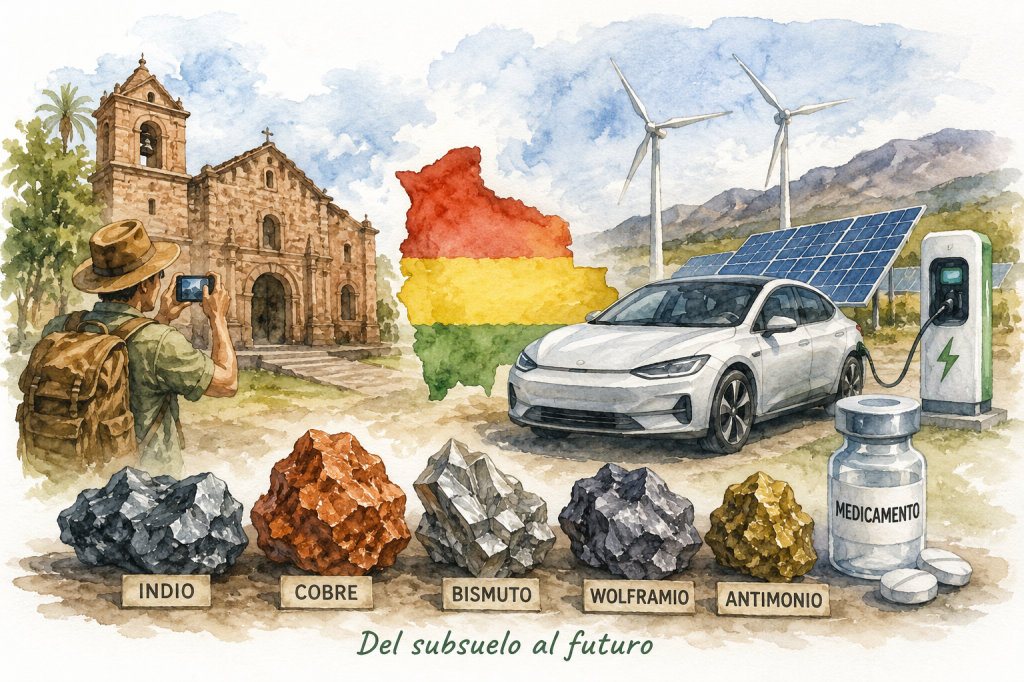
Bolivia possesses a range of critical minerals, the exploitation of which requires investment and cutting-edge technology./Illustration: Óscar Parada
The 21st-century economy needs critical minerals. Bolivia possesses several of them, but the challenge is only beginning.
A tourist walks through the historic streets of San José de Chiquitos, photographing the stone façade of a centuries-old mission church with a smartphone. Later, the traveler continues the journey in an electric vehicle and eventually uses medication to treat a minor cut.
None of these actions seems remarkable. Yet each depends on a group of resources that are quietly reshaping the global economy: critical minerals.
The smartphone screen contains indium. The electric vehicle relies on rare-earth elements such as neodymium. The medicine may contain bismuth. These minerals are largely unknown to the public, but they are essential components of the technologies driving the energy transition, artificial intelligence, advanced manufacturing, and modern healthcare.
According to the International Energy Agency’s Global Critical Minerals Outlook 2025, critical minerals have evolved from industrial commodities into strategic assets linked directly to economic competitiveness, energy security, and geopolitical influence. The race for leadership in the twenty-first century is increasingly being fought beneath the ground.
No country understood this transformation earlier than China. While much of the world continued to view minerals as simple raw materials, Beijing invested heavily in exploration, refining capacity, technology development, and supply-chain control. The result, according to the IEA, is a dominant position in global mineral processing that has prompted the United States, the European Union, Japan, and other industrial powers to seek alternative sources and reduce dependence on Chinese supply chains.
The transition to a low-carbon economy requires far more than lithium alone. Graphite forms the overwhelming majority of lithium-ion battery anodes. Copper is indispensable for power grids, electric vehicles, and renewable-energy infrastructure. Rare earths are essential for advanced motors and electronics. Demand for many of these materials is expected to rise significantly over the coming decades.
Bolivia possesses a remarkable share of this mineral wealth.
More Than Lithium
International attention has largely focused on Bolivia’s vast lithium resources, but the country’s geological potential extends well beyond the salt flats.
Bolivia also holds significant deposits of antimony, tungsten, tin, indium, bismuth, rare earth elements, and other minerals increasingly classified as strategic. Geologist and former Mining Minister Héctor Córdova argues that the resources themselves are not new.
“Bolivia always had these minerals,” he notes. “What has changed is the value the world assigns to them.”
A recent study by Fundación Jubileo, Critical Metals: Opportunity for Bolivia or an Extension of the Resource Curse?, reaches a similar conclusion. The report argues that Bolivia faces an extraordinary opportunity but warns that natural resources alone do not guarantee prosperity. Without exploration, geological knowledge, investment, and long-term policies, the country risks repeating the pattern of previous commodity booms that generated wealth without producing lasting development.
The study highlights the potential of antimony, tungsten, bismuth, indium, copper, tin, zinc, cobalt, magnesium, lithium, and rare earth elements. Córdova points out that at least 18 of the 34 minerals classified as critical by the United States are present in Bolivia, and several are already being produced, albeit on a relatively small scale.
Former Mining Minister Dionisio Garzón agrees that Bolivia’s geological potential is substantial. Yet he argues that turning that potential into economic advantage requires far more than identifying new deposits. The country must attract investment, expand exploration efforts, improve geological information, and integrate itself into global value chains.
A Persistent Paradox
Perhaps nowhere is Bolivia’s challenge more visible than in Telamayu, home to South America’s only bismuth smelter.
At a time when demand for bismuth is increasing because of its applications in medicine, electronics, and industry, the facility operates at only a fraction of its capacity. Decades ago, ore from the Tasna mining district supplied the plant, which processed hundreds of tons of concentrate each month. As mining priorities shifted toward tungsten, tin, and gold, the supply of bismuth declined and the smelter gradually fell into underuse.
The infrastructure remains in place, but the opportunity has largely been left untapped.
The same pattern can be observed in Bolivia’s zinc industry. Each year, approximately 1.5 million metric tons of zinc concentrates are exported to smelters abroad. Hidden within those shipments are small quantities of highly valuable minerals such as indium.
According to Córdova, international buyers routinely ask about the indium content of Bolivian concentrates because it affects the value of the material. Yet Bolivia typically receives little or no compensation for the metal itself.
The real profits are generated elsewhere. Once the concentrates reach processing facilities in countries such as South Korea, Belgium, or the Netherlands, indium is separated, refined, and sold as a high-value product.
Garzón notes that indium is not the only missed opportunity. Zinc concentrates also contain traces of cadmium, germanium, selenium, and other minerals that can be recovered and commercialized. Bolivia lacks the industrial capacity to extract many of these materials, while other countries have built entire industries around them.
As a result, Bolivia exports not only raw materials but also much of the value that is created when technology, expertise, and processing capacity are added to those materials.
A Strategic Choice
The International Energy Agency expects global demand for critical minerals to continue growing as economies electrify and advanced technologies become more widespread. Bolivia remains well positioned to benefit from that trend.
The question is no longer whether the country possesses the necessary resources. It does.
The challenge is whether Bolivia can move beyond the traditional role of raw-material supplier and capture a greater share of the value generated by those resources.
The tourist traveling through Bolivia may never realize that the smartphone, electric vehicle, and medicine carried along the journey all depend on minerals found beneath Bolivian soil. Yet for Bolivia itself, the implications are clear.
The country faces a strategic choice: continue exporting commodities, or begin exporting the knowledge, technology, and industrial value that the global economy increasingly demands.

The Telamayu plant today operates at minimum capacity./Photo: Comibol
Por César del Castillo, El Deber:
Minerales críticos pueden reposicionar a Bolivia en la geopolítica mundial
Bolivia posee una gama de minerales críticos, cuya explotación requiere de inversiones y tecnología de punta./Ilustración: Óscar Parada
La economía del siglo XXI necesita minerales críticos. Bolivia posee varios, pero el desafío apenas comienza
Un turista recorre las calles de San José de Chiquitos. Fotografía con su celular la fachada imponente templo misional construido en piedra, continúa el viaje en un vehículoeléctrico y, horas después, aplica un medicamento para aliviar una pequeña herida. Ninguno de esos gestos parece extraordinario. Sin embargo, todos dependen de minerales que hoy redefinen la economía mundial.
Detrás de esa escena cotidiana hay una cadena invisible. La pantalla táctil del celular contiene indio; el motor del vehículo eléctrico utilizaneodimio; el medicamento incorpora bismuto. Son minerales poco conocidos por el público, pero esenciales para la transición energética, la inteligencia artificial y la economía del futuro.
El futuro ya está aquí. En su informe Global Critical Minerals Outlook 2025, la Agencia Internacional de Energía (AIE) sostiene que estos recursos dejaron de ser simples insumos para la industria y se convirtieron en un componente estratégico de la seguridad energética y del poder de las naciones. La disputa por el liderazgo económico del siglo XXI también se libra bajo tierra.
Y hubo un país que entendió ese cambio mucho antes que el resto: Mientras gran parte del mundo todavía veía los minerales críticos como simples materias primas, Beijing comprendió que serían la base de la transición energética, la revolución tecnológica y una nueva fuente de poder. Durante décadas invirtió en exploración, refinación, desarrollo tecnológico y control de las cadenas de suministro.
El informe de la AIE concluye que esa estrategia le permitió consolidar una posición dominante en la cadena de valor y controlar buena parte del procesamiento mundial de estos recursos, una ventaja que hoy condiciona la estrategia de Estados Unidos, la Unión Europea, Japón y otras potencias, empeñadas en reducir su dependencia.
La transición energética no funciona con un solo mineral. Funciona con una combinación de recursos cuya importancia depende de la tecnología que los utiliza. El grafito, por ejemplo, constituye entre el 90% y el 95% del ánodo de las baterías de ion-litio, por lo que resulta tan indispensable como el propio litio para la electromovilidad. El cobre es el gran conductor de la electrificación, presente en redes eléctricas, parques eólicos y vehículos eléctricos.
El viaje continúa. Sin saberlo, el turista recorre un país cuyo subsuelo alberga minerales presentes en celulares, vehículos eléctricos, drones, medicamentos, cosméticos y una infinidad de tecnologías que hoy sostienen la economía global.
El valioso subsuelo
Bolivia siempre estuvo en el mapa de los minerales críticos; pero la competencia global por las tecnologías del futuro revalorizó recursos que durante décadas permanecieron al margen de las grandes inversiones.
Esa riqueza no se limita al litio. El país también alberga importantes reservas de antimonio, wolframio, estaño e indio, además de bismuto, tierras raras y otros minerales considerados estratégicos. “Bolivia siempre tuvo esos minerales. Lo que cambió fue el valor que el mundo les asigna”, resume el geólogo y exministro de Minería Héctor Córdova.
Un reciente estudio de la Fundación Jubileo, Metales críticos: oportunidad para Bolivia o prolongación de la maldición de las materias primas, coincide en que el país enfrenta una oportunidad inédita. Sin embargo, advierte que la sola existencia de recursos minerales no garantiza desarrollo ni mayores ingresos. Sin exploración, conocimiento geológico, inversión y políticas públicas de largo plazo, la riqueza del subsuelo puede seguir el mismo destino que otros ciclos extractivos de la historia boliviana.
El estudio destaca el potencial de minerales como el antimonio, el wolframio, el bismuto, el indio, el cobre, el estaño, el zinc, el cobalto, el magnesio, el litio y las tierras raras. Córdova añade otra dimensión: de los 34 minerales considerados críticos por Estados Unidos, al menos 18 están presentes en Bolivia y varios de ellos ya forman parte de la producción nacional, aunque todavía en volúmenes muy inferiores a la demanda internacional.
Ese diagnóstico es compartido por el exministro de Minería Dionisio Garzón. A su juicio, el potencial geológico del país es indiscutible, pero convertirlo en una ventaja competitiva exige mucho más que descubrir yacimientos. Bolivia necesita atraer inversiones, ampliar la exploración, generar información confiable e integrarse a cadenas de valor que hoy concentran otros países.
Minerales ricos, decisiones pobres
Si el turista que comenzó su viaje en San José de Chiquitos continuara hasta Potosí, probablemente se encontraría con una de las mayores paradojas de la minería boliviana. En Telamayu permanece prácticamente abandonada la única fundición de bismuto construida en Sudamérica. Mientras Estados Unidos y Europa consideran estratégico este metal y su demanda crece por aplicaciones médicas, electrónicas e industriales, Bolivia mantiene subutilizada una planta que alguna vez la convirtió en el principal productor mundial de bismuto.
La planta de Telamayu, hoy opera al mínimo de su capacidad./Foto: Comibol
Pero esa historia no empezó con el abandono. Hubo un tiempo en que los hornos de Telamayu trabajaban con el mineral que llegaba desde Tasna y la planta procesaba hasta 400 toneladas de concentrados al mes. Luego cambió la lógica del negocio. Las cooperativas concentraron sus esfuerzos en extraer wolfram, estaño y oro; el bismuto dejó de ser prioridad y la materia prima dejó de llegar. Los hornos se fueron apagando poco a poco.
Hoy la planta apenas procesa pequeñas cantidades. Para Córdova, el bismuto atraviesa “un momento extraordinario”. Garzón observa la misma escena y llega a la misma conclusión: la infraestructura sigue allí, pero la oportunidad parece haberse quedado detenida en el tiempo.
La pérdida no termina en Telamayu. Cada año salen de Bolivia alrededor de 1,5 millones de toneladas de concentrados de zinc rumbo a fundiciones de otros países. A simple vista parecen una exportación más.
Pero dentro de esas toneladas viajan pequeñas cantidades de indio, uno de los minerales más cotizados para fabricar productos de las nuevas tecnologías y paneles solares. “Los compradores siempre preguntan cuánto indio contiene el concentrado”, cuenta Córdova. La respuesta influye en la negociación, pero ese metal no se paga.
El verdadero negocio empieza cuando el barco llega a Corea, Bélgica u Holanda. Allí el indio se separa, se refina y vuelve al mercado convertido en un producto de mucho mayor valor, y Bolivia no recibe rédito alguno.
Garzón amplía el mapa de esas oportunidades que cruzan la frontera. Junto al indio también viajan cadmio, germanio, selenio y otros minerales presentes en pequeñas proporciones dentro de los concentrados. Bolivia no dispone de fundiciones capaces de recuperarlos. Otros países sí.
Allí los separan, los industrializan y obtienen ganancias que muchas veces superan las del metal principal. Quizá esa sea la paradoja más difícil de aceptar: Bolivia no solo exporta minerales; también exporta parte del valor que esos minerales adquieren cuando alguien más les agrega conocimiento, tecnología e industria.
Todavía hay tiempo
La oportunidad no ha desaparecido. La Agencia Internacional de Energía prevé que la demanda de minerales críticos seguirá creciendo durante las próximas décadas impulsada por la transición energética y el desarrollo tecnológico. Bolivia todavía posee recursos que el mundo necesita. El desafío ya no consiste solo en extraerlos, sino en convertirlos en conocimiento, industria y valor.
Quizá el turista nunca sepa que el vehículo eléctrico en el que recorrió Bolivia, el celular con el que fotografió la Chiquitania o el medicamento que llevó en su mochila dependen de minerales que este país también posee. Pero esa es la decisión que Bolivia todavía tiene pendiente: seguir exportando materias primas o comenzar a exportar inteligencia, tecnología y valor.


Leave a comment