By Los Tiempos:
Due to the Lack of Dollars, Banks Are Migrating to Cryptocurrencies Under a Central Bank Rule
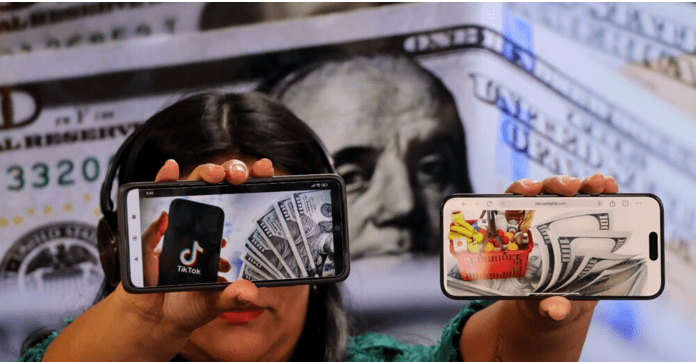
 Dollar bills and cryptocurrencies | Social media
Since 2023, Bolivia has stopped receiving the amount of U.S. dollars demanded by the market. Foreign currency has become a scarce and highly valued commodity. Three years into the country’s most severe dollar shortage, financial institutions still face difficulties supplying dollars to the public and have begun offering so-called virtual dollars, or USDT, a cryptocurrency whose value is pegged to the U.S. dollar.
“Your money evolves. Enjoy a 100% digital experience with an e-wallet available 24/7 to purchase USDC via QR code and move your money within Bolivia and around the world,” advertises one of the financial institutions operating nationwide.
The first bank to offer this virtual currency explains that “USDT (Tether) is a stablecoin. Its main advantage is that it provides a less volatile alternative compared to other cryptocurrencies, making trade and investment easier.”
The bank says the service “was created as an alternative for customers who need to transfer funds abroad,” although other financial institutions are also trading in Bitcoin, the cryptocurrency with the highest market value internationally.
Cryptocurrencies were previously prohibited in Bolivia, but the shortage of dollars led the Central Bank of Bolivia (BCB) to authorize such transactions through Board Resolution No. 084/2024, issued on June 25 two years ago. Authorities at the time stated that the measure would benefit a wide range of activities, not only commercial and productive sectors.
Recently, current BCB President David Espinoza stated that virtual assets (VAs) “were not a good decision by the previous administration; we are studying the issue,” adding that they “create many risks, and we need to determine how they will be supervised, since virtual assets are not part of the current framework.”
Meanwhile, Economy Minister Gabriel Espinoza said the government is evaluating whether to recognize them as a means of payment. “What we have today is basically the lifting of a prohibition, but there is no broader regulation. The previous administration did this out of desperation, trying to find in USDT an alternative to the dollar, and it ended up creating even more disorder in the market,” he explained.
He also recalled that “Bolivia is on the FATF gray list, another problem inherited from the past, and these cryptoassets must be carefully evaluated. We are working on regulations to govern their use for those who have adopted them—often out of necessity—and know how to use them properly.”
It should be noted that in 2025, the Financial Action Task Force (FATF) placed Bolivia on its “gray list” due to deficiencies in combating money laundering and terrorist financing. However, the final determination may depend on developments under the new administration.
The initial idea is that USDT, the digital currency that maintains parity with the U.S. dollar, could circulate formally and perform a role similar to that of physical dollars.
Although the government ordered the return of dollar-denominated savings according to a schedule, the shortage of dollars persists. The greatest concern now is the current flexible exchange rate.
Por Los Tiempos:
A falta de dólares, la banca migra a las criptomonedas con la norma del BCB
Billetes en dólares y criptomonedas. | RRSS
A partir de 2023 Bolivia dejó de percibir los dólares que demanda. Las divisas se convirtieron en un artículo suntuario. Después de tres años del peor proceso que vive el país, las entidades financieras aún enfrentan problemas para abastecer con dólares a la población que la demanda y optó por ofertar los denominados billetes virtuales o USDT, una criptomoneda cuyo valor está vinculado a la moneda estadounidense.
“Tu dinero evoluciona. Disfruta de una experiencia 100 % digital con una e-wallet disponible 24/7 para comprar USDC mediante QR y mover tu dinero en Bolivia y el mundo”, ofrece una de las entidades financieras que operar en toda Bolivia.
El primer banco que empezó a ofrecer esta moneda virtual explica que el “USDT (Tether) es una stablecoin o moneda estable. Su principal ventaja es que proporciona una alternativa menos volátil en comparación con otras criptomonedas, facilitando así el comercio y la inversión”.
Asegura que este servicio “nace como una alternativa para que el cliente pueda transferir fondos al exterior”, aunque también hay otras entidades financieras que también transan con la criptomoneda bitcoin, que tiene el mayor valor hasta el momento en los mercados internacionales.
En Bolivia estaba prohibido el uso de criptomonedas, pero la escasez de dólares obligó al Banco Central (BCB) a aprobar este tipo de transacciones mediante la Resolución de Directorio N°084/2024 del 25 de junio de hace dos años. Las autoridades de entonces señalaron que favorecería a gran parte de las actividades, no solo comerciales y productivas.
Recientemente, el actual presidente del BCB, David Espinoza, aseguró que los denominados activos virtuales (AV) no “ha sido una decisión buena del anterior régimen, estamos en estudio”, esto debi do a que “genera muchos riesgos y vamos a ver cómo vamos a efectuar la supervisión de los mismos, los AV no están en el actual esquema”.
Por su parte, el ministro de Economía, Gabriel Espinoza, sostuvo que el Gobierno evalúa incluirlas como forma de pago, lo “que hoy día tenemos es básicamente el levantamiento de una prohibición, pero no hay mayor normativa al respecto. Se hizo así en la anterior gestión gubernamental prácticamente por desesperación, trataron de encontrar en el USDT una alternativa al dólar y terminaron por desordenar más el mercado”, explicó.
Recordó que “Bolivia está en la lista gris de GAFI, una más de las averías que nos dejaron en el pasado y estos criptoactivos tienen que ser bien evaluados. Estamos trabajando en normativa para regular su uso para aquellas personas que las han adoptado en muchos casos por necesidad y saben usarlas de manera adecuada”.
Cabe recordar que, en 2025, el Grupo de Acción Financiera Internacional (GAFI) decidió incluir a Bolivia en su “lista gris” debido a las deficiencias en la lucha contra el lavado de dinero y el financiamiento del terrorismo. Aunque habrá que esperar su determinación luego del cambio de régimen.
La idea, en principio, es que esta moneda digital, el USDT, que tiene paridad con el dólar, pueda circular de manera formal y se le pueda otorgar una función similar a los dólares.
Pese a que el Gobierno determinó la devolución de ahorros en dólares de acuerdo con cronograma, hasta el momento persiste la escasez de dólares y lo que más preocupa es que la actual cotización flexible.


Leave a Reply