By Milton Condori, Vision 360:
IMF Funds Should Be Used to Bolster Reserves and Stabilize the Dollar Exchange Rate, Economists Say
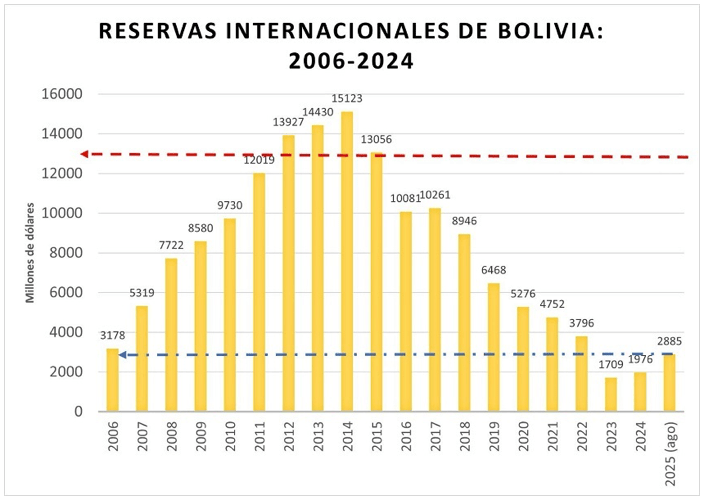
Economists Antonio Saravia and Fernando Romero argue that turning to the International Monetary Fund (IMF) was necessary, as Bolivia is facing an economic crisis from which it has struggled to emerge.
The U.S. dollar. Photo: Canva
On Wednesday, Economy Minister Gabriel Espinoza announced that the government is in the final stages of securing a $2.8 billion financing package from the IMF. Economists Antonio Saravia and Fernando Romero said part of those funds should be injected into the financial system to help stabilize the exchange rate of the U.S. dollar, while the remainder should be directed toward investment and development projects. Both described the loan as a form of financial bailout for an economy under severe strain.
“Theoretically, the $2.8 billion will be freely available, which means it should be used to strengthen international reserves and stabilize the exchange rate,” Saravia told Visión 360.
Romero agreed, saying that a portion of the funds—although it is not yet clear how much—should be allocated to the foreign-exchange market, with the Central Bank channeling resources through the financial system to curb further increases in the dollar’s value and provide temporary stability.
The recommendation follows a Bs 1.35 increase in the dollar’s price since Bolivia moved to a more flexible exchange-rate regime at the end of June.
Saravia argued that around $1 billion of the $2.8 billion package should be directed to the banking sector, noting that the government owes banks roughly $2 billion. According to him, that debt has contributed to restrictions on access to U.S. dollars, as banks have been unable to fully meet depositors’ demands.
“If the Central Bank allocates $1 billion to the banking system once the IMF funds arrive, it would help calm concerns. People would see that dollars are available again, restoring confidence in the financial system. That would ease pressure on the exchange rate and reduce demand for dollars,” Saravia said.
He added that the remaining funds should be used to create a financial buffer that would allow the government to continue implementing planned economic reforms.
Romero said part of the financing should also be directed toward high-impact economic and social projects, particularly productive sectors capable of generating foreign currency earnings.
“Resources should be channeled into productive and economic activities that generate dollars, because those are the dollars that will ultimately be used to repay the country’s loans,” he said.
A Bailout for the Economy
The government announced Wednesday that it is close to securing the $2.8 billion IMF loan, down from the $5 billion it had initially sought. Both economists characterized the package as a bailout and stabilization mechanism for Bolivia’s economy.
“This is a financial rescue, not a standard loan. Countries turn to the IMF when there are no other options left—when they have fallen into a deep economic crisis and need outside support. That is the kind of agreement Bolivia is pursuing,” Saravia said.
Romero described the financing as “a kind of stabilization fund” that the government had been negotiating for months. He argued that the first step toward the preliminary agreement was the devaluation associated with the new flexible exchange-rate regime, under which the dollar is currently trading at around Bs 11.13.
“It represents a rescue package—like a blood transfusion or an injection of oxygen,” Romero said.
Both economists acknowledged that the financing would increase Bolivia’s external debt but maintained that it is necessary given the severity of the country’s economic challenges.
“There is nothing to celebrate here. Yes, it is a rescue package, but it comes after many years of irresponsibility,” Saravia said.
Por Milton Condori Apaza, Vision 360:
Recursos del FMI deben destinarse a apuntalar las reservas y estabilizar el tipo de cambio del dólar, afirman economistas
Los economistas Antonio Saravia y Fernando Romero señalaron que recurrir al Fondo Monetario Internacional (FMI) era necesario, ya que el país atraviesa una crisis económica de la que le resulta difícil salir.
La moneda estadounidense. Foto: Canva
El miércoles, el ministro de Economía, Gabriel Espinoza, informó que el Gobierno se encuentra en la etapa final para concretar un financiamiento de 2.800 millones de dólares con el Fondo Monetario Internacional (FMI). Los economistas Antonio Saravia y Fernando Romero señalaron que parte de ese monto debe inyectarse al sistema financiero para estabilizar el tipo de cambio del dólar y otra parte destinarse a inversiones y proyectos. Además, calificaron el préstamo como un “rescate financiero” y un “fondo de salvataje” ante la crisis económica que atraviesa el país.
“Teóricamente van a llegar 2,800, que tendrían que ser de libre disponibilidad, esto significa que se debería utilizar para apuntalar las reservas internacionales y estabilizar el tipo de cambio”, sostuvo Saravia, en contacto con Visión 360.
En tanto, Romero apuntó que “una parte, aunque no se sabe cuánto, debe ir al mercado cambiario y el Banco Central va a inyectar recursos a través del sistema financiero a la economía boliviana para evitar que siga subiendo el precio del dólar y se establezca por un tiempo determinado”.
Dicha recomendación surge luego de que el precio del dólar subiera Bs 1,35 desde la flexibilización del tipo de cambio, a fines de junio.
Para Saravia, cerca de 1.000 millones de dólares de los 2.800 deberían destinarse a la banca, debido a que el Estado le adeuda alrededor de 2.000 millones de dólares, situación que, según afirmó, provocó que las entidades financieras tengan “un corralito porque no te devuelve todos los dólares que tiene, debido a esa deuda”.
“Si el BCB cuando llegue la plata del fondo destina 1,000 millones a la banca, con eso pone paños fríos a la gente, la gente dice bueno ya están los dólares y entonces eso va a traer certidumbre y otra vez confianza en el sistema financiero, eso va a hacer que el tipo de cambio disminuya, que no haya una presión muy alta por dólares”, recomendó Saravia.
Además, indicó que el monto restante debería utilizarse para crear un colchón financiero que permita continuar con las reformas que tiene previstas el Gobierno.
A su vez, Romero indicó que esos recursos también deben ser canalizados “a proyectos y obras que deberían ser de alto impacto económico-social y lo idóneo sería que se canalicen actividades productivas y económicas que te generen dólares, porque son con los dólares que vas a pagar tus créditos”.
Un rescate, un salvataje
El miércoles, el Gobierno anunció que se encuentra en la etapa final para acceder a un crédito de 2.800 millones de dólares del FMI, pese a que inicialmente había solicitado 5.000 millones. Para los economistas, esto representa un rescate financiero y un fondo de salvataje para la economía del país.
“Implica un rescate financiero, no es un préstamo normal. Uno llega al FMI cuando ya no hay otra opción, cuando el país ha caído en el abismo profundo de la crisis y no hay nada que lo salve, ese es el tipo de acuerdo que vamos a conseguir, es un rescate financiero”, indicó el economista Saravia.
Para Romero, esos 2.800 millones de dólares significan para el país “una especie de fondo de salvataje, un fondo de estabilización, que el Gobierno ha negociado hace meses atrás, y que el primer paso de este preacuerdo ha sido, la devaluación de la moneda a través del régimen flexible, que ha hecho que actualmente el dólar se cotice a 11 bolivianos con 13 centavos. Significa un salvataje, como una transfusión de sangre o una oxigenación”.
Sin embargo, ambos coincidieron en que este financiamiento representa un incremento de la deuda externa, aunque lo consideran necesario debido a la gravedad de la crisis económica que enfrenta el país.
“Aquí no hay nada que celebrar, esto es un rescate, sí, pero es uno al que se llega después de haber tenido muchos años de irresponsabilidad y la economía ni lachas”, indicó Saravia.


Leave a comment