
By EFE, Red Uno:
Justice sentenced two women and one man to three years in prison after proving the trafficking of 26 giant Titicaca frogs, a species classified as critically endangered.
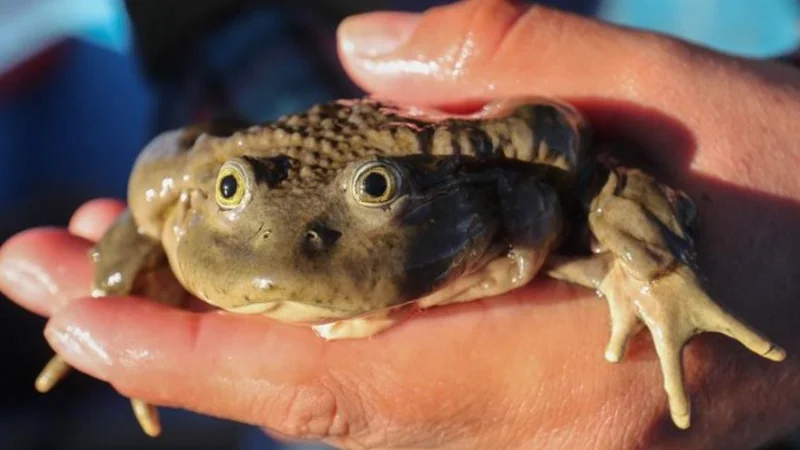
Historic sentence for trafficking giant frogs from Lake Titicaca. Photo: file image/EFE Verde
Bolivia’s Justice system sentenced two women and one man to three years in prison for illegal wildlife trafficking after more than two dozen giant Titicaca frogs were found in a food establishment. The species is endemic to Bolivia and Peru and is endangered.
The Bolivian Ministry of Development Planning and Environment reported in a press release that the sentence, according to the institution, “constitutes a precedent in the application of environmental criminal legislation” and in the defense of “the country’s natural heritage.”
The two women must serve their sentences at the Obrajes Women’s Orientation Center in La Paz, while the man will be imprisoned at San Pedro prison in the same city.
The case originated in a joint operation carried out last February in the community of Huatajata, located on the shores of Lake Titicaca, which is shared by Bolivia and Peru, about 82 kilometers from the city of La Paz.
The operation involved the General Directorate of Biodiversity and Protected Areas (DGBAP), the Prosecutor’s Office, the Forestry and Environmental Preservation Police (Pofoma), the La Paz Mayor’s Office through the Vesty Pakos Biopark, the Bolivian Amphibian Initiative (BAE), and the Decentralized Public Institute of Fisheries and Aquaculture (IPD-PACU).
The ministry recalled that during the raid on a food establishment, 26 giant Titicaca frogs were found, 25 of them alive and one dead, “in addition to a frozen specimen whose species could not be identified due to its state of preservation.”
“The rescued individuals were transferred under specialized protocols for evaluation and temporary custody, with all technical information documented in the report prepared by the DGBAP,” the statement says.
This emblematic species (Telmatobius culeus) is considered the largest aquatic frog in the world and can be found at depths of up to 100 meters. Its soft, loose, sack-like skin with folds allows it to breathe in waters located more than 3,000 meters above sea level.
The ministry noted that, besides being one of the most emblematic species of the Andean highlands, the giant frog “plays a fundamental role in the ecological balance of Lake Titicaca,” but its populations have suffered “a drastic decline” due to threats such as “illegal trade for consumption and alleged medicinal purposes.”
It also recalled that in Bolivia the species is classified as “critically endangered” in the Red Book of Wild Vertebrate Fauna. In addition, it is included in Appendix I of the Convention on International Trade in Endangered Species of Wild Fauna and Flora (CITES), “which grants it the highest level of protection” worldwide. EFE
Por EFE, Red Uno:
La Justicia impuso tres años de prisión a dos mujeres y un hombre tras comprobar el tráfico de 26 ranas gigantes del lago Titicaca, una especie catalogada en peligro crítico de extinción.
Justicia dicta histórica condena por tráfico de ranas gigantes del lago Titicaca. Foto: imagen archivo/EFE Verde
La Justicia boliviana sentenció a tres años de cárcel a dos mujeres y un hombre acusados de tráfico ilegal de vida silvestre, tras el hallazgo en un establecimiento de expendio de alimentos de más de una veintena de ranas gigantes del lago Titicaca, una especie endémica de Bolivia y Perú que está en peligro de extinción.
El Ministerio boliviano de Planificación del Desarrollo y Medio Ambiente informó en un comunicado de prensa sobre esta sentencia que, según esa entidad, “constituye un precedente en la aplicación de la normativa penal ambiental” y la defensa “del patrimonio natural del país”.
Las personas sentenciadas son dos mujeres que deberán cumplir la pena en el Centro de Orientación Femenina de Obrajes, en La Paz, y un hombre que será encarcelado en el penal de San Pedro, en la misma ciudad.
El caso se originó en un operativo conjunto realizado en febrero pasado, en la comunidad de Huatajata, situada a orillas del lago Titicaca, que comparten Bolivia y Perú, a unos 82 kilómetros de la ciudad de La Paz.
En esa operación participaron la Dirección General de Biodiversidad y Áreas Protegidas (DGBAP), la Fiscalía, la Policía Forestal y de Preservación del Medio Ambiente (Pofoma), la Alcaldía de La Paz, a través del Bioparque Vesty Pakos, la Iniciativa Boliviana de Anfibios (BAE) y el Instituto Público Desconcentrado de Pesca y Acuicultura (IPD-PACU).
El ministerio recordó que durante el allanamiento realizado en un establecimiento de expendio de alimentos fueron hallados 26 ejemplares de rana gigante del lago Titicaca, de los cuales 25 estaban vivos y uno sin vida, “además de un ejemplar congelado cuya especie no pudo ser identificada debido a su estado de conservación”.
“Los individuos rescatados fueron trasladados bajo protocolos especializados para su evaluación y custodia temporal, quedando toda la información técnica documentada en el informe elaborado por la DGBAP”, señala el comunicado.
Esta especie emblemática (Telmatobius culeus) es considerada la rana acuática más grande del mundo y puede estar presente en profundidades de cien metros, con su piel suave y holgada en forma de saco con pliegues que le permiten respirar en aguas que están a más de 3.000 metros sobre el nivel del mar.
El ministerio señaló que, además de ser una de las especies más emblemáticas del altiplano, la rana gigante “cumple un papel fundamental en el equilibrio ecológico del Lago Titicaca”, pero sus poblaciones sufrieron “una drástica disminución” debido a amenazas como “el comercio ilegal para consumo y supuestos fines medicinales”.
También recordó que en Bolivia, la especie está clasificada como en “peligro crítico” en el Libro Rojo de la Fauna Silvestre de Vertebrados y, además, está en el Apéndice I de la Convención sobre el Comercio Internacional de Especies Amenazadas de Fauna y Flora Silvestres (Cites), “que le otorga el máximo nivel de protección” en el mundo. EFE


Leave a Reply