By El Deber:
“They Must Go to Jail”: Productive Sector Demands Prison Sentences for Those Responsible for the Road Blockades

Photo: APG
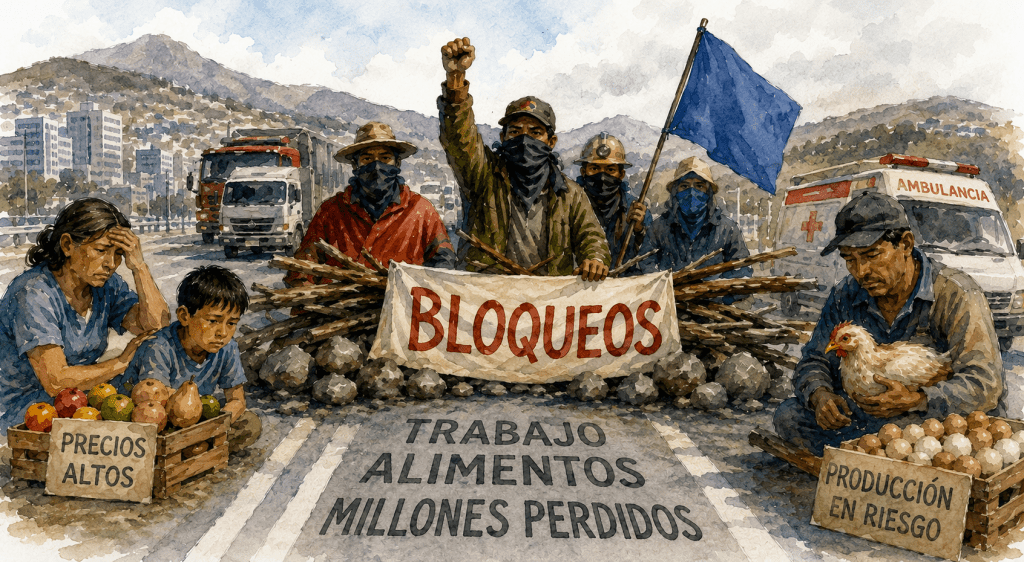
Exporters, agricultural producers, and transport operators warn that the country is facing economic losses, unemployment, and risks to food security. They are demanding prison sentences for those responsible for the blockades that left roads closed for more than 40 days.
Representatives of the export, agricultural, and transportation sectors on Wednesday demanded that those responsible for the road blockades, which have persisted for more than 40 days across much of the country, be identified and punished. Industry leaders reported multimillion-dollar economic losses, damage to production, and a humanitarian crisis affecting hundreds of drivers stranded on highways. They called on the government to enforce the law and prevent impunity.
“Jail for the Blockaders”
Oswaldo Barriga, president of the National Chamber of Exporters, Logistics and Investment Promotion (CANEB) and the Santa Cruz Chamber of Exporters, Logistics and Investment Promotion (CADEX), reported that losses to the export sector had reached $978 million as of Tuesday, June 16, marking 47 consecutive days of conflict in the country.
“From the National Chamber of Exporters, we have demanded and continue to demand sanctions. The people responsible for inciting this level of violence and negligent homicide—because the moment someone dies due to a blockade, it becomes a homicide (…) We want jail for the people who incited this violence and financed these blockades,” he stated.
Barriga argued that investigations must be launched to identify those responsible for the blockades and bring them before the courts. He said that beyond recent talks between the Bolivian Workers’ Central (COB) and the government, sanctions are necessary for the damage caused to the national economy.
He also noted that exporters, agricultural producers, transport operators, and other participants in the economic chain have been left defenseless against the effects of the blockades and called for concrete measures to guarantee free movement and productive activity.
“These people must go to jail. We demand the opportunity to sit down with the government and identify short-, medium-, and long-term actions that guarantee freedom to export, freedom to produce, and freedom to transport. Whether through laws or regulations (…) Pursue those responsible, Mr. President,” he added.
Impact of the Blockades on Production
Klaus Frerking, president of the Eastern Agricultural Chamber (CAO) and the National Agricultural Confederation (Confeagro), warned that the 48 days of blockades are causing severe economic and productive damage and called for those responsible to be held accountable.
“We must work on health, we must work on production, we must generate the economy that this country needs. In any dialogue, the Constitution and the law must come first. Someone must be held accountable for these 48 days of harm suffered by Bolivian families and the Bolivian economy,” he stated.
The agricultural leader said that several production chains have been severely affected. In Cochabamba, only 40% of milk production is currently being processed, leaving 180,000 liters per day without a destination. He also reported that the poultry sector has cut weekly shipments of baby chicks by half over the past three weeks.
Frerking further warned of a decline in cattle slaughter in Santa Cruz. He explained that while more than 2,500 head of cattle were previously processed daily, the current figure has dropped to around 1,400.
“The country’s food security will not be guaranteed until the necessary conditions are restored and private investors feel confident enough to invest again,” he said.
The CAO president emphasized that the sector is not presenting demands but rather proposals to reactivate the economy.
“There are no lists of demands here. We have always approached the government and society with proposals. The only way out of this economic crisis is through work. But there must be accountability for all the outrageous actions committed during these 48 days. We ask the government to put the Constitution and the law first before signing any agreements with the blockaders,” he said.
Drivers Stranded for More Than a Month
As a result of the road blockades, thousands of truck drivers have been stranded on interdepartmental routes. Luis Añez, president of the Bolivian Chamber of National and International Cargo Transport, criticized the fact that dialogue between the government and protest groups only began after more than six weeks of conflict.
He said that thousands of transport operators remain unable to work or earn income to meet their financial obligations.
According to Añez, the blockades have left the sector in a critical situation, with drivers stranded for weeks on highways, exposed to aggression, psychological pressure, and separation from their families. He also lamented that some drivers died during the conflict and questioned who would take responsibility for the resulting economic and human losses.
“We transport operators are effectively being held hostage. What will happen with all the losses we have suffered? How are we supposed to pay our loans, taxes, and other obligations?” he asked.
Añez called on the government to uphold the Constitution and guarantee legal certainty for the sector, while ensuring that the damage caused by the blockades does not go unpunished. He stressed that transport operators “simply want to work and earn a living for their families” and demanded concrete actions to reactivate the economy and prevent similar situations from recurring.
“An Economic and Humanitarian Problem”
For his part, Erlan Melgar, president of the Eastern Transportation Chamber (CTO), denounced the situation faced by hundreds of drivers stranded by the blockades and argued that the issue has become not only an economic crisis but also a humanitarian one.
He said many transport operators remain trapped on highways under precarious conditions, without adequate access to food, drinking water, medication, or basic services.
Melgar also lamented the deaths of three drivers during this period and warned of other health-related cases requiring urgent attention.
He criticized what he described as a lack of response from institutions responsible for protecting human rights. He explained that the CTO, together with the Bolivian Chamber of Transport, filed complaints with the Ombudsman’s Office, human rights organizations, and the United Nations to expose the situation faced by affected drivers.
“They have no food, no water, no sanitary conditions. We have seen it through the media (…) They are drinking water alongside the animals, which are suffering as well,” he said.
Melgar also expressed concern about the impact of the blockades on legal certainty, investment, and confidence in the country. He argued that Bolivia needs stability to generate jobs and development and said that responsibility for the deaths and damages caused during the conflict must be investigated.
In that regard, he announced that the transportation sector will join any legal actions aimed at pursuing civil and criminal accountability for the damages caused over the past several weeks.
Por El Deber:
“Deben ir presos”: Sector productivo exige cárcel para los responsables de los bloqueos
Foto: APG
Exportadores, agropecuarios y transportistas advierten que el país enfrenta pérdidas económicas, desempleo y riesgo para la seguridad alimentaria. Piden cárcel para los bloqueadores que dejaron al país con rutas cerradas por más de 40 días.
Representantes de los sectores exportador, agropecuario y transporte exigieron este miércoles que se identifique y se sancione a los responsables de los bloqueos de carreteras que se vienen prolongando desde hace más de 40 días en casi todo el país. Los dirigentes denunciaron millonarias pérdidas económicas, afectaciones a la producción y una crisis humanitaria para cientos de conductores varados en las carreteras, por lo que pidieron al Gobierno garantizar el cumplimiento de la ley y evitar la impunidad.
“Cárcel para los bloqueadores”
Oswaldo Barriga, presidente de la Cámara Nacional de Exportadores, Logística y Promoción de Inversiones (CANEB) y de la Cámara de Exportadores, Logística y Promoción de Inversiones de Santa Cruz (CADEX), informó que las pérdidas para el sector exportador alcanzaron los 978 millones de dólares hasta el martes, 16 de junio, cuando se cumplieron 47 días consecutivos de conflicto en el país.
“Desde la Cámara Nacional de Exportadores hemos exigido, hemos pedido sanciones y lo sostenemos: las personas responsables de incitar a este nivel de violencia, homicidios culposos, porque el momento que alguien fallece por un bloqueo ya es un homicidio (…) Queremos cárcel para las personas que han incitado a esta violencia, que han financiado estos bloqueos“, manifestó.
Barriga sostuvo que deben iniciarse investigaciones para identificar a los responsables de los bloqueos y que estos enfrenten procesos judiciales. Consideró que, más allá de los recientes acercamientos entre la Central Obrera Boliviana (COB) y el Gobierno, es necesario que existan sanciones por los daños ocasionados a la economía nacional.
Asimismo, señaló que el sector exportador, el agropecuario, el transporte y otros actores de la cadena económica se encuentran indefensos frente a los efectos de los bloqueos, por lo que pidió medidas concretas para garantizar la libre circulación y la actividad productiva.
“Esas personas deben ir presas. Nosotros exigimos poder sentarnos con el gobierno para identificar acciones de corto, de mediano y de largo plazo que garanticen la libertad de exportación, la libertad de producción, la libertad de transporte. Será con leyes, será con normas (…) Persiga a los culpables, señor presidente”, apuntó.
Impacto de los bloqueos en la producción
El presidente de la Cámara Agropecuaria del Oriente (CAO) y de la Confederación Agropecuaria Nacional (Confeagro), Klaus Frerking, advirtió que los 48 días de bloqueos están generando graves perjuicios económicos y productivos, y pidió que se identifique a los responsables de los daños ocasionados.
“Tenemos que trabajar en salud, tenemos que trabajar en producción, tenemos que generar economía que necesita este país. En todo diálogo tiene que estar por delante la Constitución, tiene que estar por delante la ley. Alguien tiene que hacerse cargo de estos 48 días de perjuicio que han sufrido las familias bolivianas, que ha sufrido la economía boliviana”, manifestó.
El dirigente señaló que varias cadenas productivas se encuentran afectadas. Indicó que en Cochabamba solo se está procesando el 40% de la producción de leche, mientras que 180.000 litros diarios quedan sin destino. Asimismo, aseguró que el sector avícola redujo a la mitad la carga semanal de pollitos bebé durante las últimas tres semanas.
Frerking también alertó sobre una caída en la faena de ganado en Santa Cruz. Explicó que de más de 2.500 reses procesadas diariamente, actualmente se están faenando unas 1.400. “La seguridad alimentaria de este país no va a estar asegurada hasta que tengamos de nuevo las condiciones, hasta que el privado se anime otra vez a invertir“, sostuvo.
El titular de la CAO señaló que el sector no presenta pliegos petitorios, sino propuestas para reactivar la economía. “Aquí no hay pliegos petitorios. Siempre hemos llegado al Gobierno y a la sociedad con propuestas. La única forma de salir de esta crisis económica es trabajando, pero tienen que haber responsables de todas las barbaridades que han hecho en estos 48 días. Le pedimos al Gobierno que primero esté la Constitución y esté la ley por delante, antes de estar firmando algo con los bloqueadores”, manifestó.
Conductores varados hace más de un mes
Debido a los bloqueos de rutas, miles de choferes quedaron varados en las rutas interdepartamentales. Luis Añez, presidente de la Cámara Boliviana de Transporte Nacional e Internacional de Carga, cuestionó que el diálogo entre el Gobierno y los sectores movilizados se realice después de más de seis semanas de conflicto. Señaló que miles de transportistas permanecen afectados, sin poder trabajar ni generar ingresos para cumplir con sus obligaciones económicas.
El dirigente afirmó que los bloqueos dejaron al sector en una situación crítica, con conductores varados durante semanas en las carreteras, expuestos a agresiones, presión psicológica y alejados de sus familias. Además, lamentó que algunos choferes hayan fallecido durante el conflicto y preguntó quién asumirá la responsabilidad por las pérdidas económicas y humanas ocasionadas.
“Los transportistas nos encontramos verdaderamente secuestrados. ¿Qué va a pasar con todas las pérdidas que nosotros tenemos? ¿Cómo vamos a pagar nuestros créditos, nuestros impuestos, nuestras obligaciones que tenemos?”, manifestó.
Áñez pidió al Gobierno garantizar el cumplimiento de la Constitución y la seguridad jurídica para el sector, además de evitar que los perjuicios ocasionados por los bloqueos queden impunes. Sostuvo que los transportistas “únicamente buscan trabajar y generar ingresos para sus familias”, por lo que exigió acciones concretas para reactivar la economía y evitar que situaciones similares vuelvan a repetirse en el país.
“Un problema económico y humanitario”
Por su parte, el presidente de la Cámara de Transporte del Oriente (CTO), Erlan Melgar, denunció la situación que atraviesan cientos de conductores varados por los bloqueos y afirmó que el problema ya no solo es económico, sino también humanitario. Señaló que muchos transportistas permanecen atrapados en las carreteras en condiciones precarias, sin acceso adecuado a alimentación, agua potable, medicamentos ni servicios básicos.
Asimismo, lamentó el fallecimiento de tres conductores durante este periodo y alertó sobre otros casos de salud que requieren atención urgente.
Melgar cuestionó la falta de respuesta de las instituciones encargadas de velar por los derechos humanos. Explicó que la CTO, junto con la Cámara Boliviana de Transporte, presentó denuncias ante la Defensoría del Pueblo, organismos de derechos humanos y las Naciones Unidas para exponer la situación de los choferes afectados. “No tienen alimentación, no tienen agua, no tienen condiciones de salubridad. Lo hemos visto a través de los medios de comunicación (…) están tomando agua conjuntamente con los animalitos que también están sufriendo”, manifestó.
Melgar lamentó el impacto que los bloqueos tienen sobre la seguridad jurídica, la inversión y la confianza en el país. Afirmó que Bolivia necesita estabilidad para generar empleo y desarrollo, y consideró que las responsabilidades por las muertes y los daños ocasionados durante el conflicto deben ser investigadas. En ese sentido, anunció que el sector transportista se sumará a las acciones legales que se impulsen para exigir responsabilidades civiles y penales por los perjuicios causados durante las últimas semanas.


Leave a Reply