
By Erbol:
IN PILÓN LAJAS
Training and equipping Community Firefighter Brigades strengthens indigenous resilience against forest fires
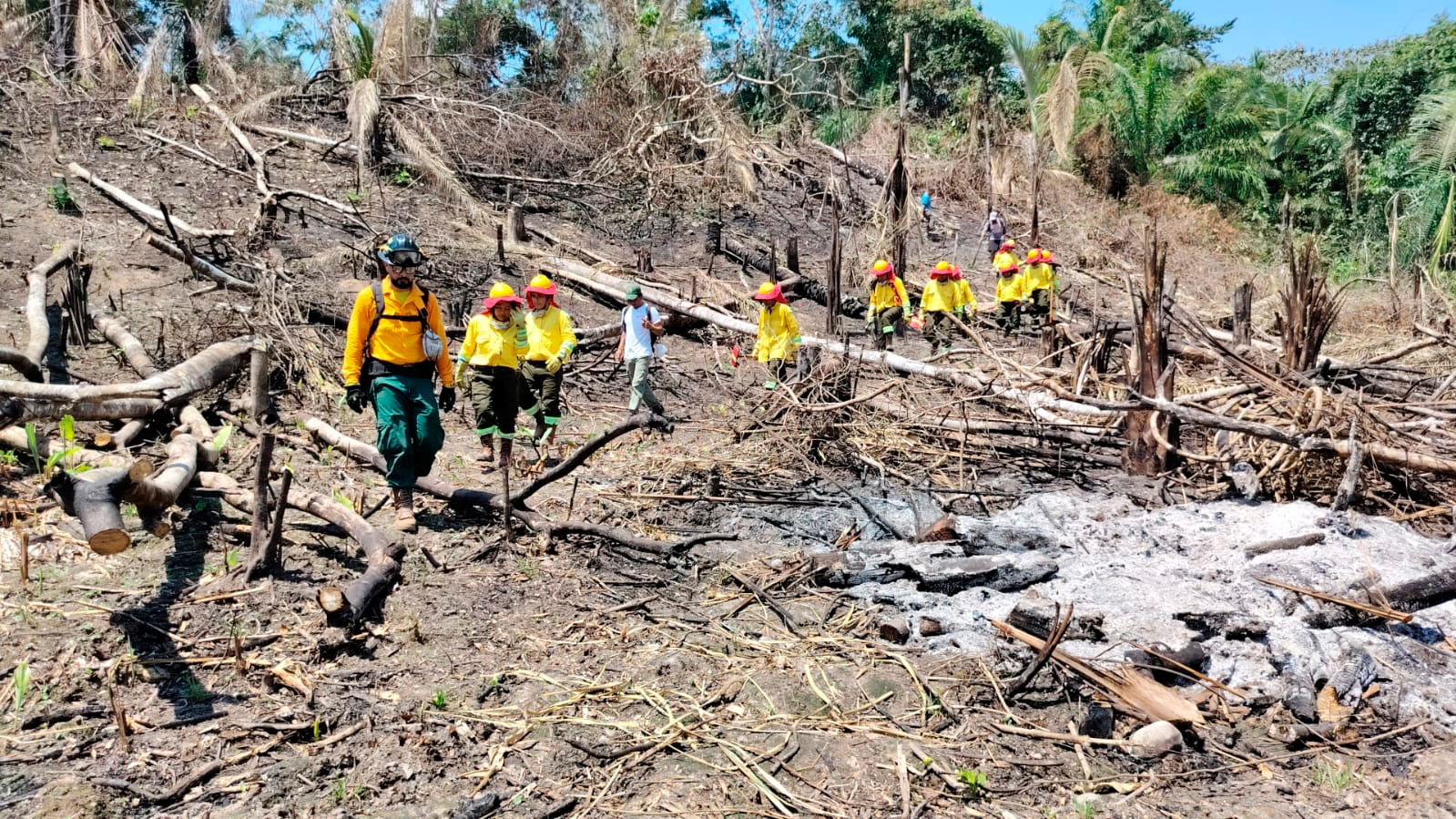
A Forest Firefighter brigade during training in Pilón Lajas. Photo: WCS Bolivia
The capacity to confront forest fires in the 23 indigenous communities of the Pilón Lajas Biosphere Reserve and Native Community Territory, one of Bolivia’s protected areas and ancestral territory inhabited by Tsimane, Mosetén, and Tacana communities, has been strengthened through the formation, training, and equipping of Community Firefighter Brigades prepared to act under contingency plans and apply appropriate techniques for integrated fire management.
The announcement was made by the president of the Regional Tsimane-Mosetén Council (CRTM) Pilón Lajas, Magaly Tipuni, who said: “The training and equipment are the result of the efforts of the 23 communities themselves, which, together with the support of the Canadian Fund for Local Initiatives and in coordination with WCS Bolivia, helped meet the challenge as a Mosetén, Tsimané, and Tacana people and territory after the disasters caused by the 2023 forest fires.”
She recalled that three years ago a major disaster occurred due to severe fires in the La Paz Amazon region, which also had serious impacts on the Pilón Lajas territory. “That is why community members were prepared and trained as a first response to a fire emergency,” she emphasized.
The Pilón Lajas Biosphere Reserve and Native Community Territory (RB-TCO) is a protected area and indigenous territory of 400,000 hectares. It includes parts of the Sud Yungas, Larecaja, and Franz Tamayo provinces in the department of La Paz, and Ballivián province in the department of Beni, located in a region between the Andes and the Amazon. It stands out for its immense Amazonian and sub-Andean biodiversity and is home to 23 Tsimane, Mosetén, and Tacana indigenous communities that manage the territory together with the National Service of Protected Areas (SERNAP).
The firefighters are organized into 25 squads distributed across 17 communities. Initially they have two immediate-response water tank units to extinguish fires, three communication antennas, as well as uniforms and specialized tools, along with a joint protocol developed between the Regional Tsimane-Mosetén Council and the Biosphere Reserve.
Roider Villarroel, Risk Management officer at WCS Bolivia, explained that contingency plans were first developed, followed by training on prevention and firefighting, and finally the brigades were equipped.
“As a project, the idea is that we can continue strengthening this work not only with equipment but also with knowledge,” he added.
Regarding Integrated Fire Management, Villarroel explained that it is a strategic and multidisciplinary approach that integrates prevention, preparedness, use of fire, response to forest fires, and ecological restoration, simultaneously considering ecological, social, cultural, economic, and operational factors in order to reduce risks and maximize benefits in ecosystems.
He said that throughout Bolivia fire is used as a traditional tool to prepare land for agriculture (slash-and-burn clearing). “Fire is not an enemy; it is a tool that must be learned to be used, like a knife in the kitchen, like a vehicle, like a chainsaw. If we do not learn to use the tool we have in our hands, it can become a risk both to ourselves and to our relationship with the forest,” he added.

“We are not afraid of fires”
Forest firefighter Wendy Ruíz (17) from the indigenous community of San José de Canaán, located in the municipality of San Borja in the department of Beni, said that one of the main motivations for joining the Community Firefighter Brigades was the fires that occurred in 2023.
“Now we are not afraid of fires because they taught us how to use the tools and how to confront them,” the brigadier added.
Similarly, Camila Cunay (18) from the Puente Yucumo community, located along the road between Yucumo and Rurrenabaque, explained that many people were motivated by what happened in 2023 when fires affected the entire La Paz Amazon region.
Cunay, who is also a territory guard, stated that with the training of brigadiers they learned the proper techniques to fight fires without risking the lives of firefighters.
“We have many young brigadiers who already know how to face fires because everyone saw what happened to us in 2023. Now we can use the tools and we will be equipped to avoid the risk,” explained Nicolás Cuata, also a territory guard of Pilón Lajas. He thanked the Canadian Fund for Local Initiatives and WCS Bolivia for their support, highlighted the participation of young people as brigadiers, and noted that additional tools, equipment, and uniforms are expected.
WCS Bolivia is an international nonprofit organization dedicated to protecting wildlife and natural landscapes. For several years it has implemented, together with the 23 communities, the Management Plan and Life Plan for the protected area and indigenous territory of Pilón Lajas, helping guide residents’ participation in protecting the area and implementing natural resource management projects aimed at improving the population’s quality of life.
The Canadian Fund for Local Initiatives (CFLI) is a program of the Canadian government that seeks to strengthen civil society and bilateral relations, prioritizing issues such as gender equality, democracy, the environment, and human rights. (Cronista21)
Por Erbol:
EN PILÓN LAJAS
Formación y equipamiento de Brigadas de Bomberos Comunales fortalece la resiliencia indígena contra los incendios forestales
Una brigada de Bomberos Forestales durante las capacitaciones en Pilón Lajas. Foto: WCS Bolivia
La capacidad de enfrentar los incendios forestales en las 23 comunidades indígenas de la Reserva de la Biosfera y Tierra Comunitaria de Origen Pilón Lajas, una de las áreas protegidas de Bolivia, territorio originario donde habitan comunidades tsimanes, mosetenes y tacanas, se fortaleció con la formación, capacitación y el equipamiento de Brigadas de Bomberos Comunales que están capacitados para actuar en el marco de planes de contingencia y utilizar técnicas adecuadas para el manejo integral del fuego.
El anuncio fue realizado por la presidenta del Consejo Regional Tsimane´ Mosetén (CRTM) Pilón Lajas, Magaly Tipuni que dijo, “la formación y el equipamiento es un logro del propio esfuerzo de las 23 comunidades que, junto con el apoyo del Fondo Canadiense para Iniciativas Locales y en coordinación con la WCS Bolivia, ayudaron a cumplir con el desafío como pueblo y territorio mosetén, tsimané y tacana, después de los desastres ocasionados por los incendios forestales en 2023”.
Recordó que hace tres años se produjo un gran desastre por los fuertes incendios ocurridos en la región de la amazonia paceña y que también tuvieron serios impactos en el territorio de Pilón Lajas. “Por eso fue la preparación y el adiestramiento de los comunarios como una primera respuesta a la emergencia de un incendio”, destacó.
La Reserva de la Biosfera y Tierra Comunitaria de Origen (RB-TCO) Pilón Lajas es un área protegida y territorio indígena de 400.000 hectáreas, abarca partes de las provincias Sud Yungas, Larecaja y Franz Tamayo en el departamento de La Paz, y la provincia Ballivián en el departamento del Beni, situada en una región entre andina y amazónica. Sobresale por su inmensa biodiversidad amazónica y subandina y es hogar de 23 comunidades indígenas tsimane´, mosetén y tacana que gestionan el territorio junto con el Servicio Nacional de Áreas Protegidas (SERNAP).
Los bomberos están organizados en 25 cuadrillas distribuidas en 17 comunidades, inicialmente cuentan con dos unidades de tanques de respuesta inmediata para apagar incendios, tres antenas de comunicación, además de uniformes y herramientas especializadas, así como un protocolo conjunto que fue elaborado entre el Consejo Regional Tsimané Mosetén y la Reserva de la Biósfera.
El responsable en Gestión de Riesgos de la WCS Bolivia, Roider Villarroel, explicó que inicialmente se elaboraron Planes de Contingencia, luego se realizaron capacitaciones en temas de prevención y combate, y finalmente cumplimos con el equipamiento.
“Como proyecto la idea es que podamos seguir fortaleciendo, no sólo con equipamiento, sino también con conocimientos”, agregó.
Respecto del Manejo Integral del Fuego, Villarroel puntualizó que es un enfoque estratégico y multidisciplinario que integra prevención, preparación, uso del fuego, respuesta a Incendios Forestales y restauración ecológica, considerando simultáneamente factores ecológicos, sociales, culturales, económicos y operativos, para reducir riesgos y maximizar los beneficios en los ecosistemas.
Dijo que en todo el territorio boliviano se usa el fuego como herramienta tradicional para la habilitación de áreas destinadas a la agricultura (chaqueo). “El fuego no es un enemigo, es una herramienta que debe aprender a usarse, como lo es un cuchillo en la cocina, como lo es un vehículo, como lo es una motosierra, si no aprendemos a usar la herramienta que tenemos en nuestras manos, esta misma podría significar un riesgo para nosotros como para nuestra relación con el bosque”, añadió.
“No tememos a los incendios”
La bombera forestal Wendy Ruíz (17) de la comunidad originaria San José de Canaán ubicada en el municipio de San Borja del departamento de Beni, afirmó que una de las principales motivaciones para ser parte de las Brigadas de Bomberos Comunales fue por los incendios ocurridos el 2023.
“Ahora no tememos a los incendios porque nos enseñaron a usar las herramientas y cómo enfrentarlos”, agregó la brigadista.
De forma coincidente Camila Cunay (18) de la comunidad Puente Yucumo ubicada entre el tramo de Yucumo a Rurrenabaque, explicó que muchos se animaron por lo que sucedió en el 2023 cuando los incendios afectaron a toda la región amazónica paceña.
Cunay, que también es guardaterritorio, aseveró que, con la formación de los brigadistas, se pudo aprender las técnicas adecuadas para combatir el fuego, sin arriesgar la vida de los bomberos.
“Tenemos a muchos brigadistas jóvenes que ya saben cómo enfrentar los incendios, porque todos vieron lo que nos pasó en 2023, ahora ya podemos usar las herramientas y estaremos equipados para evitar el riesgo”, explicó Nicolás Cuata, que también es guardaterritorio de Pilón Lajas, y agradeció por el apoyo al Fondo Canadiense para Iniciativas Locales y a la WCS Bolivia, destacó la participación de los jóvenes como brigadistas y adelantó que se espera una mayor dotación de herramientas, equipamiento y uniformes.
La WCS Bolivia es una organización internacional sin fines de lucro dedicada a proteger la vida silvestre y los paisajes naturales, desde hace varios años implementa junto con las 23 comunidades el Plan de Manejo y Plan de Vida del área protegida y territorio indígena Pilón Lajas con incidencia en orientar la participación de sus habitantes en la protección del área y en la ejecución de proyectos de manejo de recursos naturales dirigidos a mejorar la calidad de vida de la población.
El Fondo Canadiense para Iniciativas Locales (FCIL) es un programa del gobierno canadiense que busca fortalecer la sociedad civil y las relaciones bilaterales, priorizando temas como igualdad de género, democracia, medio ambiente y derechos humanos. (Cronista21)

 Bolivian Thoughts | Pensamientos Bolivianos (Bilingual/Bilingüe)