
By El Diario:
War in the Middle East Affects the Hydrocarbons Sector
Between Distrust and the Risk of Returning to the Past
The increase in the price of oil on the international market will cause fuel prices to rise, which will affect the final commercialization value.
After more than 100 days of Rodrigo Paz’s government, the hydrocarbons sector has entered an uncertain phase because the authorities in charge, despite having extensive experience, have not yet made structural decisions to change Yacimientos Petrolíferos Fiscales Bolivianos (YPFB). This is reflected in the reappearance of lines at gas stations, the very poor quality of gasoline, and the wait for regulations to restructure the entire sector to make it attractive to private capital. Meanwhile, distrust is growing and the risks of returning to the past are close.
Report
The recent Ipsos Ciesmori report, “Poor Quality Gasoline: Perceptions of the Government Narrative and the Compensation Insurance,” reveals deep skepticism regarding the government’s narrative about fuel quality and supply problems.
In this context, the survey shows that 65% of citizens in the main urban axis distrust the official explanation that attributes the failures to “sabotage” or a “political boycott.” In contrast, only 27% support this official thesis.
The majority perception (44%) is that this narrative is an excuse to evade YPFB’s responsibility for the lack of controls, while 21% point to a direct lack of transparency in imports.
Regionally, skepticism is notably deeper in Cochabamba, where credibility in the government’s version drops to 19%. In contrast, Santa Cruz shows the highest level of confidence in the official discourse, although it still remains a minority with barely 30% support.
Regarding the government’s response through insurance to repair affected vehicles, public opinion is divided. Some 46% consider the 12 requirements demanded to access the benefit to be fair, viewing them as necessary to prevent fraud. However, 33% describe the process as excessively bureaucratic, suggesting that it seeks to discourage claims, and 13% consider it exclusionary due to the complexity of the documentation.
Finally, there is strong disbelief regarding the promise of retroactive reimbursements for those who already repaired their engines on their own. Some 68% of the population distrusts that this announcement will be fulfilled. The main reasons for this distrust are the technical difficulty of proving damage in engines already repaired (44%) and the perception that it is a political promise to curb protests (24%). Pessimism about reimbursements is strongest in El Alto (79% distrust) and Cochabamba (74%).
Faced with this negative perception among the population, energy sector analyst Álvaro Ríos Roca wrote on his account @alvaroriosroca: “The mystery of the gasoline has been solved. Something did not add up in the official explanations. (There were) about six (contradictions). The base gasoline had gum outside specification. The most outrageous thing is that everything indicates they tried to hide the truth.”
YPFB
During the first 100 days of government, authorities in the hydrocarbons sector have not managed to restructure the state oil company. However, due to the poor gasoline quality, a YPFB press release states that more than 400 officials were dismissed as part of the restructuring process.
Hydrocarbons sector analyst at the Jubileo Foundation, Raúl Velásquez, explained on his account @RaulVelag that “since 2005 (Hydrocarbons Law 3058), year after year the population trusts YPFB less and less.”
“Fifteen executive presidents, all interim, between 2006–2026. Twenty years marked by corruption, political meddling, waste, and improvisation. Zero credibility in YPFB. Reform is urgent,” he observed.
He therefore proposes suggestions such as appointing the president and board of YPFB from shortlists proposed by the Plurinational Legislative Assembly (ALP). For this, no new regulation is required; it is already in the statutes. Also, by law repealing Articles 22 and 23 of Law No. 3058, establishing that the statute defines the structure and location.
He complements the proposal by suggesting resizing YPFB, outsourcing refining, transportation, and commercialization, as well as implementing an Institutional Reform Program in YPFB and the National Hydrocarbons Agency (ANH), institutionalizing all positions based on prior experience in Roads, Taxes, and Customs (1999–2001).
Risks
Last year, Ríos warned that during the current administration the country might have to import part of the natural gas consumed domestically due to the lack of exploration to discover new reserves.
However, in an interview with a media outlet, the Minister of Hydrocarbons and Energy, Mauricio Medinaceli, assured that they are working to avoid that possibility and expect positive results during the current administration.
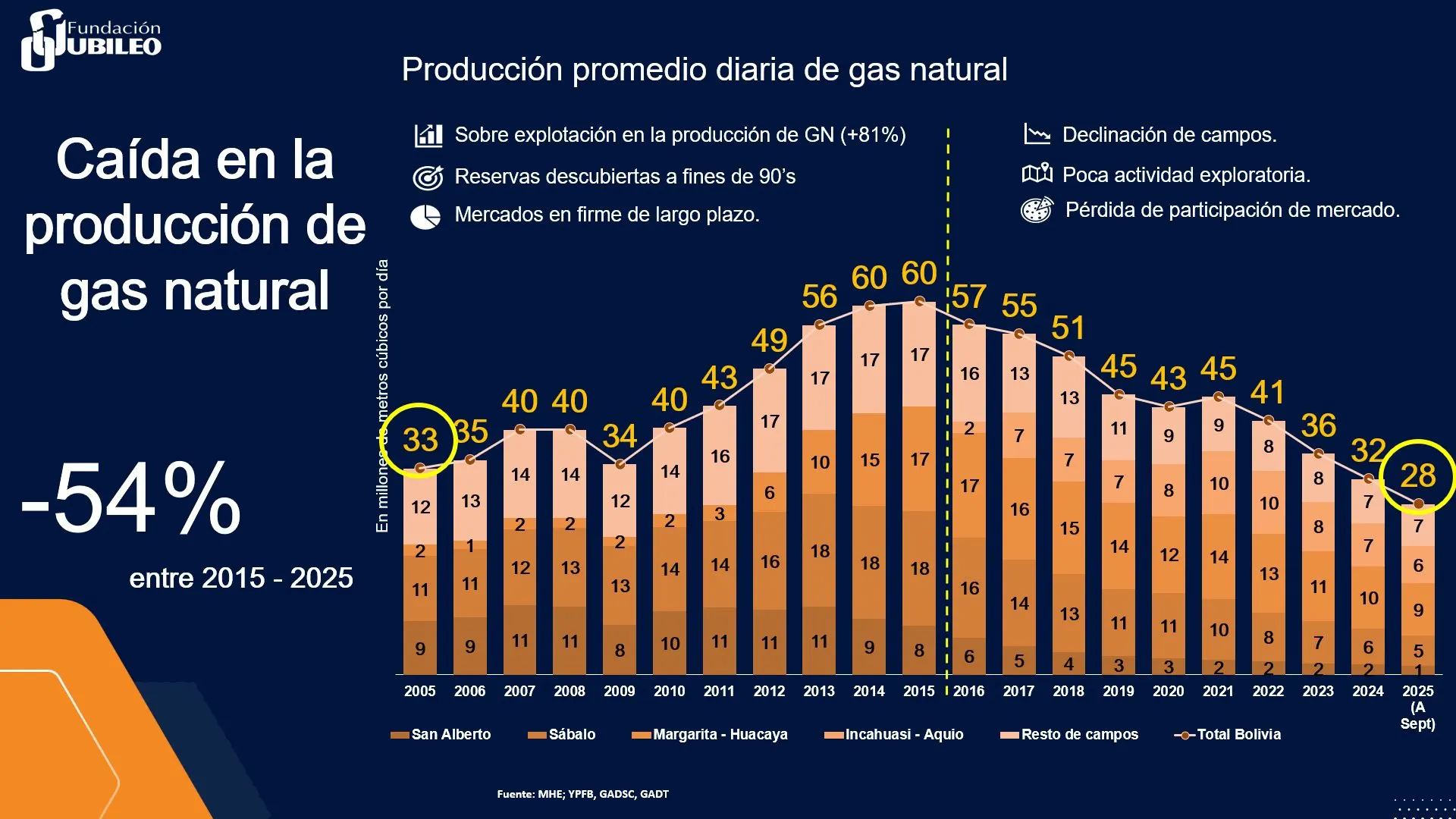
As is remembered, the drop in gas production caused the loss of the Argentine market and a reduction in income, while lower volumes are being sent to Brazil, not reaching 50% of what used to be exported—30 million cubic meters per day (MMmcd)—and therefore revenues fell from $6 billion to less than $2 billion.
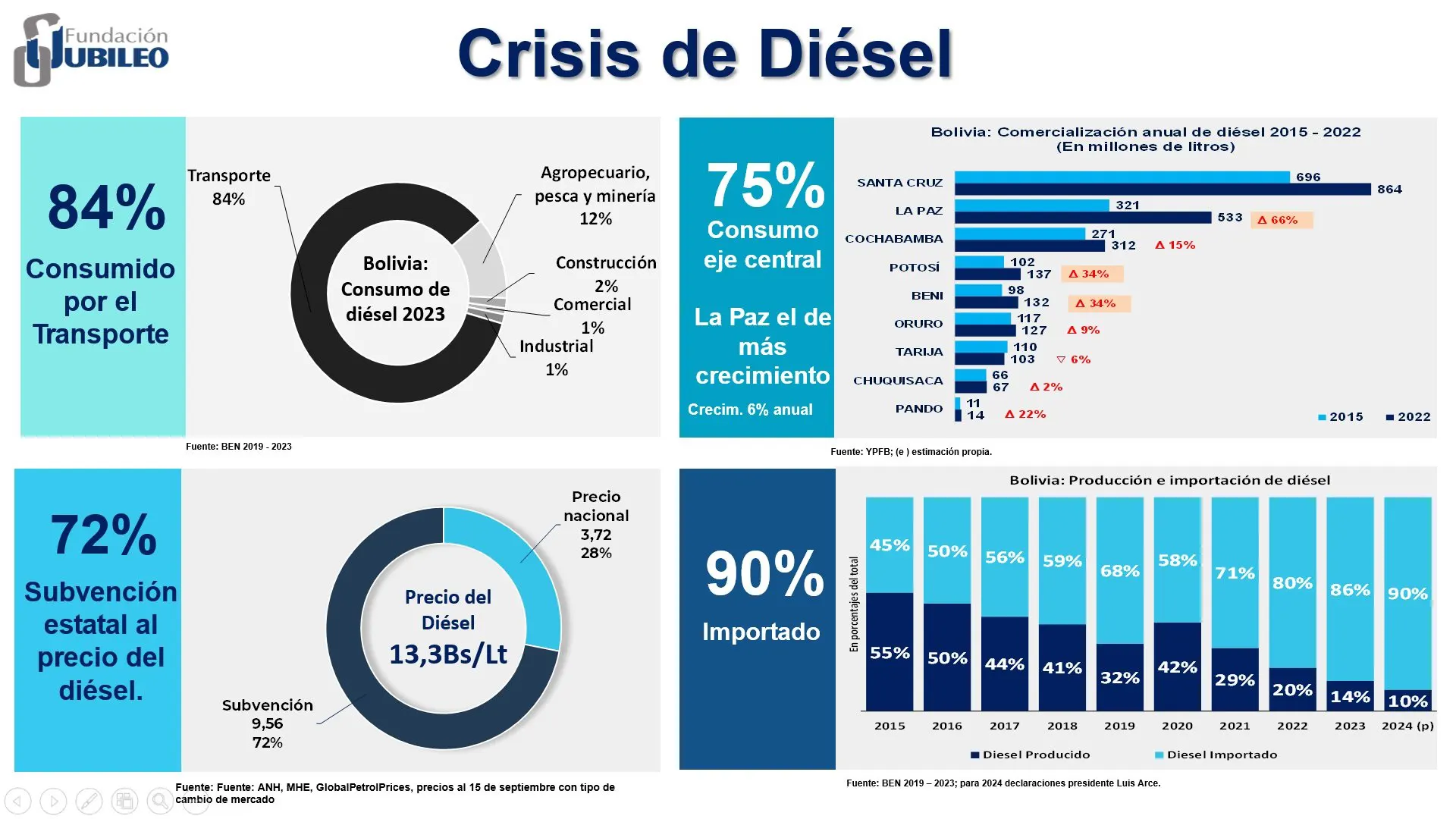
This situation was further complicated by the drop in liquids production, especially for gasoline and diesel, which led to the import of both at a cost of around $3 billion per year.
Despite having eliminated the subsidy, the specter of restoring it has not disappeared, economists warn, as armed conflicts in the Middle East resurface following attacks by the United States and Israel against Iran, and the response was quick to come, to the point of closing the Strait of Hormuz.
This scenario affects the global economy and Bolivia is not spared due to its imports, which account for more than 50% of gasoline and over 90% of diesel; now the budget may increase following the rise in oil prices.
In this regard, analyst Gonzalo Chávez warned on his account @GonzaloCHavezA: “Very bad news. Oil above $90 per barrel; hydrocarbon subsidies will return in Bolivia, at least until June.”
Official
Last Thursday, the Minister of Hydrocarbons and Energy, Mauricio Medinaceli, reported before the Senate that warnings about gasoline quality made in September 2025 by the Bolivian Automotive Chamber (CAB) to the previous YPFB administration were not addressed in time. Therefore, the current government is investigating the irregularities and applying corrective measures to guarantee quality fuels.
According to the note in question, “these problems would be directly related to the quality of gasoline marketed in the country. However, the institutional response at that time was the creation of working groups, without immediate corrective measures.”
Gasoline Controls
The Ministry reported that, through YPFB and the National Hydrocarbons Agency, new control measures have been implemented throughout the gasoline supply chain. Among the main actions are increased quality controls at plants and tanker trucks with independent certifications, a progressive tank cleaning program for storage facilities, stricter parameters for imported fuels, and the incorporation of additives to improve gasoline stability and prevent gum formation.
Likewise, YPFB announced the inclusion of new additives to improve gasoline, which, according to the state company, caused delays in fuel dispatches and led to the return of queues. However, reports of poor-quality gasoline continue.
The government plans to increase national production in refineries through the import of crude oil, with the objective of reducing dependence on imported fuels.
Damage
The Contingency Registration and Evaluation System (SREC) was enabled through WhatsApp 72150600 and the line 50850088, where users can register reports about the effects of gasoline on their vehicles.
Each case will be registered, validated, and technically evaluated. Damages will be classified as minor, medium, and severe. Minor cases may be resolved more quickly through a sworn statement and direct payment, while the others will require additional technical evaluation.
On the other hand, following statements by Samuel Doria Medina, an ally of Rodrigo Paz, who published on his account @SDoriaMedina that the government should stop blaming other administrations for fuel problems.
Medinaceli’s reaction did not take long, and his response was: “Whoever thinks this is not the fault of the previous administration does not fully understand the hydrocarbons sector.”
Data
After 20 years of rent-seeking and statism:
– Between 2005–2015 gas reserves discovered in the 1990s were overexploited to obtain more revenue in order to spend more.
– Gas production fell by 54% between 2015–2025 due to lack of exploration, loss of markets, and corruption.
Source: Raúl Velásquez
Por El Diario:
Guerra en Medio Oriente afecta sector de hidrocarburos
Entre la desconfianza y el riesgo de retornar al pasado
El incremento del precio del petróleo en el mercado internacional provocará alza de los combustibles, que afectará al valor final de comercialización.
Tras más de 100 días de gobierno de Rodrigo Paz, el sector hidrocarburos ingresó a una fase incierta debido a que las autoridades al frente, a pesar de tener toda la experiencia, todavía no tomaron decisiones estructurales para cambiar a Yacimientos Petrolíferos Fiscales Bolivianos (YPFB), lo que se refleja en filas nuevamente de los surtidores, la calidad pésima de la gasolina y en espera de normativa para reestructurar todo el área para que sea atractivo al capital privado. Mientras tanto, la desconfianza crece y los riesgos de volver al pasado están cerca.
Informe
El reciente informe de Ipsos Ciesmori, “Gasolina de mala Calidad: Percepciones sobre la Narrativa Gubernamental y el Seguro de Compensación”, revela un profundo escepticismo respecto a la narrativa gubernamental sobre los problemas de calidad y suministro de combustible.
En ese marco, la encuesta muestra que el 65% de los ciudadanos del Eje Troncal desconfía de la explicación oficial que atribuye las fallas a un “sabotaje” o “boicot político”. En contraste, solo el 27% respalda esta tesis oficial.
La percepción mayoritaria (44%) es que dicha narrativa es una excusa para evadir la responsabilidad de YPFB por la falta de controles; en tanto, un 21% señala una falta de transparencia directa en la importación.
A nivel regional, el escepticismo es notablemente más profundo en Cochabamba, donde la credibilidad en la versión gubernamental cae a un 19%. Por el contrario, Santa Cruz presenta el nivel más alto de confianza en el discurso oficial, aunque este sigue siendo minoritario con apenas 30% de respaldo.
En cuanto a la respuesta gubernamental mediante el seguro para reparar vehículos afectados, la opinión está dividida. Un 46% considera justo los 12 requisitos exigidos para acceder al beneficio, viéndolos necesarios para evitar fraudes. Sin embargo, el 33% califica el proceso como excesivamente burocrático, sugiriendo que busca desincentivar los reclamos y un 13% lo considera excluyente por la complejidad de la documentación.
Finalmente, existe una alta incredulidad sobre la promesa de reembolsos retroactivos para quienes ya repararon sus motores por cuenta propia. El 68% de la población desconfía que este anuncio se cumpla. Las principales razones para esta desconfianza son la dificultad técnica de demostrar daños en motores ya reparados (44%) y la percepción de que es una promesa política para frenar protestas (24%). El pesimismo sobre los reembolsos se agudiza en El Alto (79% de desconfianza) y Cochabamba (74%).
Ante esa percepción negativa de la población, el analista del sector energético Álvaro Ríos Roca, escribió en su cuenta @alvaroriosroca: “se resolvió el misterio de la gasolina. Algo no cuadraba en las explicaciones oficiales. (Hubo) como 6 (contradicciones). La gasolina base tenía goma fuera de especificación. Lo más indignante, todo indica que trataron de ocultar la verdad”.
YPFB
En los 100 días de gobierno, las autoridades del sector hidrocarburos no lograron reestructurar la entidad petrolera, pero a raíz de la mala calidad de la gasolina, una nota de prensa de YPFB sostiene que se desvincularon a más de 400 funcionarios, en el marco del proceso de reestructuración.
El analista del sector de hidrocarburos de la Fundación Jubileo, Raúl Velásquez, explica en su cuenta de @RaulVelag que “desde el 2005 (Ley Hidrocarburos 3058), año tras año que la población confía cada vez menos en YPFB”.
“15 presidentes ejecutivos todos interinos entre 2006-2026. 20 años marcada por la corrupción, manoseo político, despilfarro e improvisación. Cero, credibilidad en YPFB. Urge una reforma”, observó.
Por ello se anima a plantear sugerencias, como nombrar presidente y directorio de YPFB a partir de ternas propuestas por la Asamblea Legislativa Plurinacional (ALP). Para esto no se requiere nueva norma, está en los estatutos, también mediante ley derogar los artículos 22 y 23 de la Ley N°3058, establecer que el Estatuto define estructura y ubicación.
Complementa con la propuesta de redimensionar YPFB, terciarizar refinación, transporte y comercialización, así como implementar Programa de Reforma Institucional en YPFB y la Agencia Nacional de Hidrocarburos (ANH), institucionalizando todos los cargos a partir de experiencia previa en Caminos, Impuestos y Aduanas (1999-2001).
Riesgos
El año pasado, Ríos advertía que en la presente gestión el país podría importar parte del gas natural que se consume en el país, ante la falta de exploración para el descubrimiento de nuevas reservas.
Sin embargo, en una entrevista con un medio de comunicación, el ministro de Hidrocarburos y Energía, Mauricio Medinaceli, aseguró que están trabajando para alejar esa posibilidad y esperan resultados positivos en la presente gestión.
Como se recordará, la caída de la producción de gas provocó la pérdida del mercado argentino y la reducción de ingresos, mientras que a Brasil se envían menos volúmenes que no llegan al 50% de lo que se exportaba, de 30 millones de metros cúbicos día (MMmcd) y, por ende, bajaron los ingresos de 6.000 millones de dólares a menos de 2.000 millones.
Esa situación se complicó con la caída de la producción de líquidos, para la gasolina en especial y el diésel, lo que provocó la importación de ambos a un costo de alrededor de 3.000 millones de dólares al año.
A pesar de haber eliminado la subvención, el fantasma de restituirlo no se aleja, advierten economistas al resurgir conflictos bélicos en Medio Oriente tras los ataques de Estados Unidos e Israel contra Irán, y la respuesta no se dejó de esperar, hasta el punto de cerrar el estrecho de Ormuz.
Ese panorama afecta a la economía global y Bolivia no se salva por la importación que realiza de gasolina en más del 50% y de diésel que pasa el 90%; ahora el presupuesto puede subir tras el incremento del precio del petróleo.
Al respecto, el analista Gonzalo Chávez advirtió en su cuenta @GonzaloCHavezA: Muy malas noticias. Petróleo a más de 90 dólares el barril, volverán las subvenciones a los hidrocarburos en Bolivia, por lo menos, hasta junio.
Oficial
El pasado jueves, el ministro de Hidrocarburos y Energías, Mauricio Medinaceli, denunció ante la Cámara de Senadores que advertencias sobre la calidad de la gasolina realizadas en septiembre de 2025 por la Cámara Automotor Boliviana (CAB) a la anterior gestión de YPFB no fueron atendidas oportunamente, por lo que el Gobierno actual investiga las irregularidades y aplica correctivos para garantizar combustibles de calidad.
Según la nota en cuestión, “estos problemas tendrían relación directa con la calidad de la gasolina comercializada en el país. Sin embargo, la respuesta institucional en ese momento fue la conformación de mesas de trabajo, sin medidas correctivas inmediatas”.
Controles a la gasolina
El Ministerio informó que, a través de YPFB y la Agencia Nacional de Hidrocarburos, se implementaron nuevas medidas de control en toda la cadena de suministro de gasolina. Entre las principales acciones se encuentran el incremento de controles de calidad en plantas y cisternas con certificaciones independientes, un programa progresivo de limpieza de tanques de almacenamiento, la aplicación de parámetros más estrictos para combustibles importados y la incorporación de aditivos para mejorar la estabilidad de la gasolina y evitar la formación de gomas.
Asimismo, YPFB anunció la inclusión de nuevos aditivos para mejorar la gasolina, lo que, según versión de la estatal, habría provocado demoras en los despachos de combustibles, lo que provocó el retorno de filas. Pero los reportes de mala gasolina continúan.
El Gobierno prevé incrementar la producción nacional en refinerías mediante la importación de crudo, con el objetivo de reducir la dependencia de combustibles importados.
Daños
Se habilitó el Sistema de Registro y Evaluación de Contingencias (SREC), mediante el WhatsApp 72150600 y la línea 50850088, donde los usuarios pueden registrar sus reportes sobre los efectos de la gasolina al motorizado.
Cada caso será registrado, validado y evaluado técnicamente. Los daños serán clasificados en leves, medios y graves. Los casos leves podrán resolverse de forma más ágil mediante declaración jurada y pago directo, mientras que los otros requerirán una evaluación técnica adicional.
Por otra parte, ante declaraciones de Samuel Doria Medina, aliado de Rodrigo Paz, que publicó en su cuenta @SDoriaMedina, que indicaba que deje de culpar a otros gobiernos por los problemas de combustible.
La reacción de Medinaceli no se dejó esperar y la respuesta fue: “Quien piensa que esto no es culpa de la gestión pasada es que no conoce el sector de hidrocarburos a cabalidad”.
Datos
Luego de 20 años de rentismo y estatismo:
– Entre 2005-2015 sobre explotaron las reservas de gas, descubiertas en los 90’s para obtener + renta para gastar más.
– Caída en la producción de gas en -54% entre 2015-2025 por falta de exploración, pérdida de mercados y corrupción.
Fuente: Raúl Velásquez
https://www.eldiario.net/portal/2026/03/08/entre-la-desconfianza-y-el-riesgo-de-retornar-al-pasado/

 Bolivian Thoughts | Pensamientos Bolivianos (Bilingual/Bilingüe)