
By Germaine Barriga, Vision 360:
Former Minister Álvaro Ríos questions the possible causes that led to the distribution of contaminated gasoline
The hydrocarbons expert said that, several days after it became known that the gasoline being distributed was contaminated with manganese and gums, the government has still not given certainty to the public so that people feel safe filling up with good-quality gasoline.
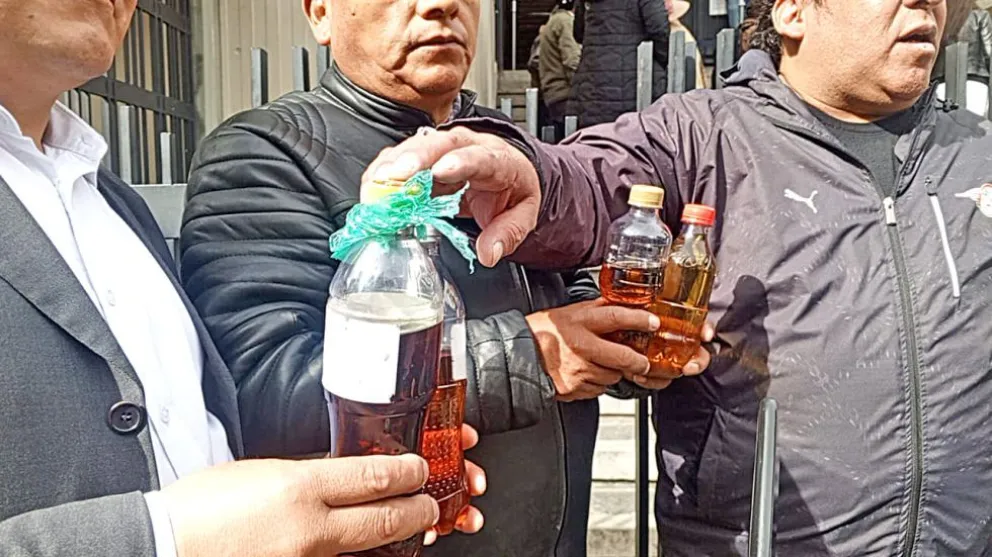
Drivers showed bottles of the contaminated gasoline. Photo: Correo del Sur
Álvaro Ríos, a hydrocarbons expert, cast doubt on the possible causes that may have led to the distribution of poor-quality gasoline in the country, an issue that triggered a conflict due to protests by drivers, who are demanding compensation from the government for the damage caused to their vehicles.
At the beginning of this week, drivers from La Paz and Cochabamba reported that the National Hydrocarbons Agency (ANH) was distributing poor-quality gasoline, damaging their vehicles. In the following days, drivers from Santa Cruz and Oruro joined in, as well as mototaxi operators from Beni, who carried out protests in several departments.
Ríos said he was confused by what had happened and commented that the situation is a mystery, because some media or some people blame ethanol, but “I want to rule out that this is the cause,” he said in an interview with EJU TV.
He explained that although “ethanol has to be added to the gasoline that arrives in order to reach the octane level required for special gasoline, which in this case is the one with the problem, from what I have seen I want to rule out that ethanol is responsible for this contamination.”
He said he wanted to rule this out for two simple reasons: first, because alcohol cannot generate the carbon residue shown on the motorcycles, considering that hundreds of motorcycles are shown damaged with carbon buildup.
“Anhydrous alcohol is not going to generate this carbon, even if we add it in excess; nor is it going to change the color,” like the gasoline drivers are showing, which looks like sludge, dark brown mud, he maintained. “I want to almost completely rule out that this is an ethanol problem.”
It is impossible for almost all gasoline nationwide to be contaminated
Regarding the explanation given by authorities from the Ministry of Hydrocarbons, Yacimientos Petrolíferos Fiscales Bolivianos (YPFB), and the ANH — that specific cases of residual gasoline were identified in some tanks with lower parameters corresponding to previous purchases, as well as higher concentrations of gums and manganese — Ríos said it seemed impossible to him.
“It seems impossible to me that they use tanks that are contaminated and that almost all the gasoline nationwide becomes contaminated or has this gum, this manganese that they say is in tanks that were not being used,” he argued.
He said that, considering gasoline has been imported for three months and the new government has been in power for three months, the problem could only have occurred in Santa Cruz, in one tank, assuming an operator made a mistake, put gasoline in a tank that had gum and manganese, which mixed and was pumped out, but the problem would have been localized.
“But it is nationwide; this has to do with a factor that for me is still a mystery. I don’t want to speculate because I have no way to speculate about the cause that is giving all Bolivians — and those of us who use gasoline — this headache,” he said.
Lack of government information
Ríos questioned that, several days after the gasoline problem became known, it is still not known how much poor-quality gasoline is in YPFB or at service stations.
The truth is that we do not know how much gasoline with these specifications is in YPFB tanks or at pumps, which creates anxiety among the population.
“I have friends calling me and asking me if I know when they should fill their tanks, because many prefer to take Uber or look for another way to get around so as not to damage their vehicles,” he said.
Therefore, he said that this information should be the first thing YPFB, the Ministry of Hydrocarbons, or the ANH should provide, because a shortage is being registered. “It’s more or less a shortage and you go with anxiety to look for gasoline.”
“That is, gentlemen, starting Sunday you can go fill your vehicle because the gasoline is within specification and we guarantee that fuel, but they are creating this anxiety that we don’t know whether we can go fill up,” he said.
YPFB structure is the same that was with Arce
Asked about a possible boycott against the government, Ríos recalled that “within YPFB the leadership that reported to the former president of YPFB, (Armin) Dorgathen, and to the owner of YPFB, who was Mr. Marcelo Arce, remains, who from the 8th floor of the Chaco Oil Company managed all the decisions of YPFB.”
He said the executive staff of YPFB has not been changed, when in his view the president of YPFB should first have placed people he trusts at the highest levels and then begun to clean out downward whatever could be cleaned out, which was not done.
He considered that if there is trust in these people, whom the same government calls “criminals,” “thugs who have robbed the country, who were in Botrading, and they keep them there, then what happened with the contaminated gasoline is a mystery.”
Por Germaine Barriga Velarde, Vision 360:
Exministro Álvaro Ríos pone en duda las posibles causas que provocaron la distribución de gasolina contaminada
El experto en hidrocarburos consideró que, después de varios días de conocerse que la gasolina distribuida estaba contaminada con manganeso y gomas, el gobierno no haya dado certidumbre a la población para que se sienta segura de cargar gasolina de buena calidad.
Los choferes mostraron botellas de la gasolina contaminada. Foto Correo del Sur
Álvaro Ríos, experto en hidrocarburos, puso en duda las posibles causas que habrían provocado la distribución de gasolina de mala calidad en el país, extremo que desató un conflicto debido a las protestas de los choferes, quienes demandan un resarcimiento al gobierno por los daños provocados en sus vehículos.
A inicios de la presente semana, choferes de La Paz y Cochabamba denunciaron que la Agencia Nacional de Hidrocarburos (ANH) estaba distribuyendo gasolina de mala calidad, provocando daños a sus vehículos, y en los siguientes días se sumaron choferes de Santa Cruz, Oruro y mototaxistas de Beni, quienes realizaron protestas en varios departamentos.
Ríos explicó que se encontraba confundido por lo sucedido, y comentó que lo que pasó es un misterio, porque hay algunos medios o alguna gente que le echa la culpa al etanol, pero yo quiero descartar que esa sea la causa, dijo en una entrevista con EJU TV.
Explicó que, si bien, “a la gasolina que llega hay que añadirle etanol para llegar al octanaje que necesita la gasolina especial, que es en este caso la que tiene el problema, por lo que he visto, quiero descartar que sea el etanol el responsable de esta contaminación”.
Dijo que quería descartar ese extremo por dos razones simples: la primera, porque el alcohol no puede generar esta carbonilla que muestran las motocicletas, considerando que se muestran cientos de motocicletas dañadas con carbonilla.
“El alcohol anhidro no va a generar esta carbonilla, aunque le pongamos en exceso; tampoco va a cambiar el color”, como la gasolina que muestran los choferes, que es una gasolina que parece un lodo, un barro de color café oscuro, sostuvo. “Yo quiero descartar casi totalmente que sea un problema de etanol”.
Es imposible que casi toda la gasolina a nivel nacional esté contaminada
Con relación a la explicación que dieron las autoridades del Ministerio de Hidrocarburos, Yacimientos Fiscales Bolivianos (YPFB) y la ANH, en sentido de que se identificaron casos específicos de gasolina residual localizada en algunos tanques, con parámetros inferiores correspondientes a adquisiciones anteriores, además de concentraciones superiores de gomas y manganeso, Ríos consideró que le parecía imposible.
“Me parece imposible que usen tanques que estén contaminados y que casi toda la gasolina a nivel nacional se contamine o tenga esta goma, este manganeso que dicen tener en tanques que no se usaban”, planteó.
Sostuvo que, considerando que se ha importado gasolina desde hace tres meses y que el nuevo gobierno está en el poder hace tres meses, entonces ese problema podría haberse presentado solo en Santa Cruz, en un tanque, suponiendo que un operador se equivocó, puso la gasolina en un tanque que tenía goma y que tenía manganeso, que se mezcló y eso se bombeó, pero el problema hubiera sido focalizado.
“Pero es a nivel nacional; esto tiene que ver con un factor que para mí es aún un misterio. Yo no quiero especular porque no tengo cómo especular sobre la causa que nos está dando este dolor de cabeza a todos los bolivianos y a los que usamos gasolina”, afirmó.
Falta de información del gobierno
Ríos cuestionó que, después de varios días de conocido el problema de la gasolina, hasta la fecha no se sepa la cantidad de gasolina de mala calidad que se encuentra en YPFB o en los surtidores.
Lo cierto es que no sabemos cuánta gasolina con estas especificaciones está en tanques de YPFB o en los surtidores, extremo que genera zozobra en la población.
“Yo tengo a gente amiga llamándome y preguntándome si yo supiera cuándo debería cargar gasolina al tanque, porque muchos prefieren andar en Uber o andan buscando en qué ir para no dañar su vehículo”, afirmó.
Por ello, sostuvo que esa información debería ser la primera que debería dar YPFB, el Ministerio de Hidrocarburos o la ANH, porque se está registrando un desabastecimiento. “Es más o menos un desabastecimiento y uno va con zozobra a buscar gasolina”.
“Es decir, señores, a partir del domingo usted puede ir a cargar su vehículo porque la gasolina está dentro de la especificación y garantizamos ese combustible, pero están generando esta zozobra de que no sabemos si podemos ir a cargar”, afirmó.
Estructura de YPFB es la que estuvo con Arce
Ríos, consultado sobre un posible boicot en contra del gobierno, recordó que “dentro de YPFB sigue la cúpula que reportaba al expresidente de YPFB, (Armin) Dorghaten, y al dueño de YPFB, que era don Marcelo Arce, quien desde el piso 8 de la Empresa Petrolera Chaco manejaba todos los designios de YPFB”.
Sostuvo que el personal ejecutivo de YPFB no ha sido cambiado, cuando desde su punto de vista, el presidente de YPFB, lo primero que debería haber hecho es poner gente de su confianza en los más altos niveles y luego ir depurando hacia abajo lo que se pueda, lo que no se hizo.
Consideró que, si se tiene confianza en esta gente, a la que el mismo gobierno llama “delincuentes”, “maleantes, que han robado al país, que han estado en Botrading, y los sigue manteniendo ahí, es un misterio lo que sucedió con la gasolina contaminada”.

 Bolivian Thoughts | Pensamientos Bolivianos (Bilingual/Bilingüe)