By Correo del Sur:
Jubileo proposes 5 solution alternatives for the subsidy
The State covers, with public resources, 74% of the cost of gasoline and 73% of diesel
Jubileo proposes 5 solution alternatives for the subsidy. Photo: ANH
The subsidy for hydrocarbons has ceased to be a policy of stability and has instead become the epicenter of an unprecedented fiscal and energy crisis. This is the stark conclusion of the latest report from the Jubileo Foundation, titled “Hydrocarbon Subsidy, a Necessary Reform,” which meticulously dissects how a policy originally designed as temporary 20 years ago has transformed into an unsustainable burden that, in 2024 alone, required an estimated 2.4 billion dollars in state resources. The document not only warns about the severity of the diagnosis, but also stresses that the new government, in power since November 8, inherits a critical situation marked by a scarcity of foreign currency and a recurring shortage of fuel, forcing immediate structural decisions.
To grasp the magnitude of the problem, the report urges the public to look beyond the long lines at gas stations and to understand the root causes, describing a kind of perfect storm triggered by the collapse of domestic production and the price freeze that encouraged irrational consumption.
The collapse
The report details that the root of the imbalance lies not only in international prices but in the collapse of domestic hydrocarbon production. Between 2014 and 2025, national production of liquid hydrocarbons—petroleum and condensate needed to refine gasoline and diesel—fell dramatically by 62%. At the same time, natural gas production, which historically financed the State and international reserves, shrank by 54% since 2015.
This contraction in domestic supply had an immediate domino effect on imports. Lacking sufficient raw material to feed refineries, Bolivia went from being a country with some energy autonomy to one with critical dependence on foreign supply. The numbers are striking: in 2016 the country imported just 12% of the gasoline it consumed, but by 2024 that dependence had jumped to 58%. The situation is even more dramatic for diesel, the fuel powering agribusiness and heavy transport, where imports surged from 50% to 90%. In simple terms, out of every ten liters of diesel sold in the country, nearly nine are purchased abroad with increasingly scarce dollars.
Subsidy
The analysis by the Jubileo Foundation highlights what it calls a “blind” subsidy. The term refers to a policy that does not distinguish who benefits from state aid. Currently, the subsidized price benefits public transport—which moves the working class—just as much as it benefits owners of high-end private vehicles, illegal mining operations, and smuggling activities.
This incentive of artificially low prices triggered an explosion in the vehicle fleet, which multiplied fivefold since 2004, rising from fewer than 500,000 units to more than 2.5 million in 2024. The concerning fact is that most of these new vehicles are private cars, showing that the subsidy encouraged inefficient, atomized transport instead of mass mobility solutions.
Gap
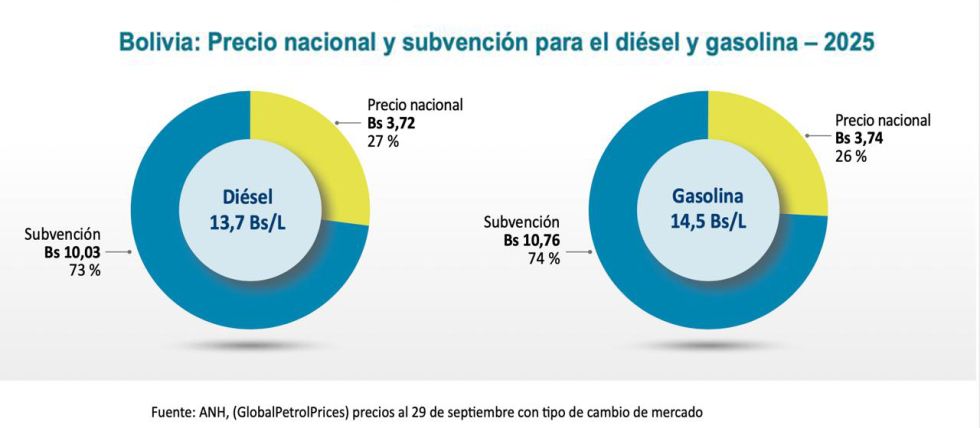
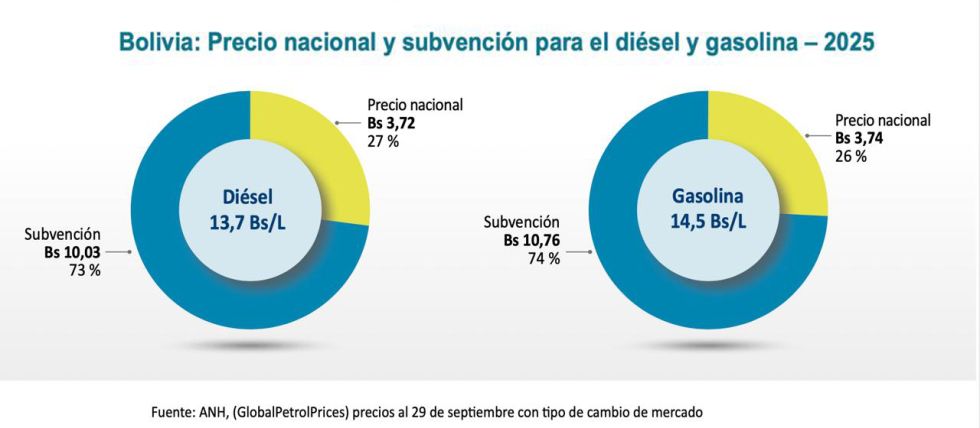
The economic dimension of the subsidy becomes clearer when reviewing the enormous difference between the real import price and the domestic retail price. Using international reference prices and the market exchange rate at the end of September 2025, the report states that the real price of gasoline should be around Bs 14.5 per liter, and diesel around Bs 13.7.
However, these products are sold domestically at Bs 3.74 and Bs 3.72, respectively. This means the State covers 74% of the cost of gasoline and 73% of diesel with public funds. Final consumers pay less than a third of the real cost, a distortion that drains international reserves of the Central Bank of Bolivia (BCB) and makes any attempt at fiscal balance impossible.
Five alternatives
Given this scenario, which Jubileo deems unsustainable for the current five-year period, the organization proposes moving beyond inaction and presents five concrete technical alternatives to reform the subsidy policy. These options aim to shift from a generalized subsidy to more efficient and fair schemes, noting that any measure must be accompanied by liberalizing imports so the private sector can bring in fuel.
The first alternative is the total elimination of the subsidy. Known in economics as shock therapy, this measure would immediately remove state support and align domestic prices with international ones. Although from a strictly fiscal and energy standpoint this would be the quickest solution to close the deficit and stop the dollar drain, the report warns clearly that this path carries a high risk of inflation and political and social instability, given its immediate impact on the population’s cost of living.
As a more moderate second option, Jubileo suggests refocusing the subsidy. The proposal maintains the current frozen price only for public transport, thus protecting fare costs for citizens. For all other consumers—private vehicles—the price would be liberalized. Implementing this measure would require strict use of technology, specifically the B-SISA system, to identify and tag vehicles that truly provide public transport service. The main challenge is whether the State can effectively enforce controls to prevent subsidized fuel from being diverted to the black market.
A third option is demand-side subsidies through vouchers. Under this scheme, pump prices would rise to real levels for all buyers, but the State would deliver direct compensation, via bank transfers or vouchers, to vulnerable sectors and transport operators. The philosophy behind this proposal is to shift the subsidy’s focus: stop subsidizing the product (gasoline and diesel) and start subsidizing the people who actually need it. According to Jubileo, this would empower consumers to decide when and how they use the assistance, promoting savings and energy efficiency.
The fourth alternative explores implementing differentiated prices based on fuel quality. Similar to refocusing, this proposal would keep current gasoline and diesel at subsidized prices for public transport, but introduce higher-quality fuels at international prices for modern private vehicles that require them. In this way, a segmented market is created where those who can afford a higher-quality product pay its real cost, partially easing the State’s fiscal burden.
Finally, the fifth proposal targets a deeper transformation: subsidizing mass public transport. The Jubileo Foundation suggests that the State stop burning resources to subsidize fossil fuels and instead redirect those funds to finance municipal mass transport systems, ideally electric. Under this model, the central government would use the subsidy budget to co-finance loans and projects for municipal governments, addressing the root problem by reducing the need for small, polluting vehicles.
The gas problem
The Foundation’s analysis also covers Liquefied Petroleum Gas (LPG) and natural gas. In the case of LPG, whose cylinder price is frozen at Bs 22.50 even though it reaches up to Bs 100 in neighboring countries, a gradual price adjustment is recommended. The proposal is to increase the price by at least 10% annually, in a predictable and announced manner, until it matches the import cost. The goal is to encourage households with access to domestic natural gas networks to stop consuming LPG and switch to piped gas, reserving subsidized cylinders only for areas and populations not connected to pipelines.
For industrial users and thermoelectric plants that consume natural gas, the document suggests quarterly price adjustments based on export opportunity cost. This seeks to correct the current distortion where the domestic market consumes gas reserves at extremely low prices, discouraging exploration and reducing hydrocarbon revenues.
Conditions
The document concludes by calling for political responsibility and transparency. For the Jubileo Foundation, the prerequisite for successful reform is that the new authorities be honest with the population, presenting real and complete data on the critical energy situation. It also warns that reducing the fiscal deficit and ensuring a sufficient flow of foreign currency must come first, to avoid the cure being worse than the disease. The reform, it stresses, is not just a technical necessity but an imperative to prevent a total collapse of Bolivia’s energy security in the coming years.
Por Correo del Sur:
Jubileo propone 5 alternativas de solución para la subvención
El Estado cubre, con recursos públicos, el 74% del costo de la gasolina y el 73% del diésel
Jubileo propone 5 alternativas de solución para la subvención Foto: ANH
La subvención a los hidrocarburos dejó de ser una política de estabilidad para convertirse en el epicentro de una crisis fiscal y energética sin precedentes. Esta es la cruda conclusión del más reciente informe de la Fundación Jubileo, titulado “Subvención a los hidrocarburos, una reforma necesaria”, el cual disecciona con rigor técnico cómo una medida diseñada temporalmente hace 20 años se transformó en una carga insostenible que, solo en la gestión 2024, demandó recursos estatales por un valor estimado de 2.400 millones de dólares. El documento no solo alerta sobre la gravedad del diagnóstico, sino que advierte que el nuevo gobierno, instalado en el poder desde el pasado 8 de noviembre, hereda una situación límite caracterizada por la escasez de divisas y el desabastecimiento recurrente de combustibles, lo que obliga a tomar decisiones estructurales inmediatas.
Para comprender la magnitud del problema, el informe invita a la ciudadanía a mirar más allá de las largas filas en los surtidores y entender las causas de fondo, describiendo una especie de tormenta perfecta originada por la caída de la producción interna y el congelamiento de precios que incentivó un consumo irracional.
El colapso
El informe detalla que la raíz del desajuste no está solamente en los precios internacionales, sino en el desplome de la oferta interna de hidrocarburos. Entre 2014 y 2025, la producción nacional de hidrocarburos líquidos –que incluye el petróleo y el condensado necesario para refinar gasolina y diésel– cayó dramáticamente en un 62%. Al mismo tiempo, la producción de gas natural, que históricamente financió las arcas del Estado y las reservas internacionales, se redujo en un 54% desde el año 2015.
Esta contracción en la oferta nacional tuvo un efecto dominó inmediato sobre las importaciones. Al no tener materia prima suficiente para alimentar las refinerías, Bolivia pasó de ser un país con cierta autonomía energética a tener una dependencia crítica del exterior. Las cifras son elocuentes: si en 2016 el país importaba apenas el 12% de la gasolina que consumía, para 2024 esa dependencia se disparó hasta el 58%. El escenario es todavía más dramático en el caso del diésel, el combustible que mueve la agroindustria y el transporte pesado, donde la importación pasó del 50% al 90%. En términos simples, de cada diez litros de diésel que se venden en el país, casi nueve son comprados en el extranjero con dólares que hoy escasean en la economía nacional.
Subvención
El análisis de la Fundación Jubileo pone el foco en lo que denominan una subvención “ciega”. El término hace referencia a que la política vigente no distingue quién se beneficia de la ayuda estatal. Actualmente, el precio subvencionado favorece por igual al transporte público, que moviliza a la clase trabajadora, y a los propietarios de vehículos particulares de alta gama, así como a la minería ilegal y al contrabando.
Este incentivo de precios artificialmente bajos provocó una explosión del parque automotor, que se multiplicó por cinco desde el año 2004, pasando de menos de 500 mil unidades a más de 2,5 millones de vehículos en 2024. Lo preocupante del dato es que la gran mayoría de estos nuevos motorizados son vehículos particulares, lo que demuestra que el subsidio fomentó un transporte ineficiente y atomizado en lugar de soluciones masivas.
Brecha
La dimensión económica del subsidio se explica mejor al revisar la enorme diferencia entre el precio real de importación y el precio de venta al público. Utilizando precios de referencia internacional y el tipo de cambio de mercado a finales de septiembre de 2025, el informe detalla que el precio real de un litro de gasolina debería rondar los Bs 14,5 bolivianos, y el del diésel los Bs 13,7.
Sin embargo, estos productos se venden en el mercado interno a Bs 3,74 y Bs 3,72 respectivamente. Esto implica que el Estado cubre, con recursos públicos, el 74% del costo de la gasolina y el 73% del diésel. El consumidor final paga menos de la tercera parte de lo que realmente cuesta el producto, una distorsión que drena las reservas internacionales del Banco Central de Bolivia (BCB) y hace inviable cualquier intento de equilibrio fiscal.
Cinco alternativas
Ante este panorama, que Jubileo califica de insostenible para el actual quinquenio, la entidad propone abandonar la inacción y pone sobre la mesa de debate cinco alternativas técnicas concretas para reformar la política de subvención. Estas opciones buscan transitar desde el subsidio generalizado hacia esquemas más eficientes y justos, aclarando que cualquier medida debe ir acompañada de la liberación de la importación para que el sector privado pueda traer su propio combustible.
La primera alternativa planteada es la eliminación total de la subvención. Esta medida, conocida en economía como una terapia de choque, consistiría en suprimir de una sola vez el aporte estatal y nivelar los precios internos con los internacionales. Aunque desde una perspectiva estrictamente fiscal y energética sería la solución más rápida para cerrar el déficit y frenar la sangría de dólares, el informe advierte con claridad que esta ruta conlleva un riesgo alto de inflación y de inestabilidad política y social, dado el impacto inmediato que tendría sobre el costo de vida de la población.
Como una segunda vía más moderada, Jubileo sugiere la refocalización del subsidio. La propuesta consiste en mantener el precio congelado actual únicamente para el servicio de transporte público, protegiendo así el costo de los pasajes para la ciudadanía. Para el resto de los consumidores, es decir, los vehículos particulares, se liberaría el precio. La implementación de esta medida dependería del uso riguroso de tecnología, específicamente del sistema B-SISA, para identificar y etiquetar a los vehículos que realmente prestan servicio público. El desafío principal de esta alternativa radica en la capacidad del Estado para ejercer controles efectivos que eviten el desvío de combustible subvencionado hacia el mercado negro.
Una tercera opción es el subsidio a la demanda mediante “vouchers”. Bajo este esquema, el precio en los surtidores se elevaría al nivel real para todos los compradores, pero el Estado entregaría una compensación directa, mediante transferencias bancarias o vales, a los sectores vulnerables y a los transportistas. La filosofía detrás de esta propuesta es cambiar el objeto del subsidio: dejar de subvencionar al producto (la gasolina y el diésel) para pasar a subsidiar a la persona que lo necesita. Según Jubileo, esto empoderaría a los consumidores para que sean ellos quienes decidan cuándo y en qué proporción utilizan esa ayuda, fomentando el ahorro y la eficiencia energética.
La cuarta alternativa explora la implementación de precios diferenciados basados en la calidad del combustible. Similar a la refocalización, esta propuesta mantendría el diésel y la gasolina actuales a precio subvencionado para el transporte público, pero introduciría en el mercado combustibles de mayor calidad a precio internacional para los vehículos privados modernos que lo requieran. De esta manera, se crea un mercado segmentado donde quien tiene la capacidad de pago por un mejor producto asume su costo real, aliviando parcialmente la carga fiscal del Estado.
Finalmente, la quinta propuesta apunta a una transformación de fondo: el subsidio al transporte público masivo. La Fundación Jubileo sugiere que el Estado deje de quemar recursos en subvencionar combustibles fósiles y, en su lugar, destine esos fondos a financiar la implementación de sistemas de transporte masivo municipal, idealmente eléctricos. En este modelo, el Gobierno central utilizaría el presupuesto de la subvención para cofinanciar préstamos y proyectos de los gobiernos municipales, atacando el problema de raíz al reducir la necesidad de utilizar vehículos pequeños y contaminantes.
El problema del gas
El análisis de la Fundación no se limita a los combustibles líquidos, sino que también aborda la situación del Gas Licuado de Petróleo (GLP) y el gas natural. En el caso del GLP, cuyo precio de venta en garrafa está congelado en Bs 22,50 pese a que en los países vecinos alcanza hasta Bs 100, se recomienda un sinceramiento gradual. La propuesta es incrementar el precio en al menos un 10% anual de manera anunciada y previsible, hasta igualar el costo de importación. El objetivo de esta medida es incentivar a que los hogares que tienen acceso a redes de gas natural domiciliario dejen de consumir GLP y migren al gas natural, reservando las garrafas subvencionadas solo para aquellas zonas y poblaciones donde no llega la red de ductos.
Para el sector industrial y las termoeléctricas que consumen gas natural, el documento sugiere ajustar los precios trimestralmente tomando como referencia el costo de oportunidad de exportación. Esto busca corregir la distorsión actual donde el mercado interno consume las reservas de gas a precios irrisorios, lo que desincentiva la exploración y reduce los ingresos por renta petrolera.
Condiciones
El documento concluye con un llamado a la responsabilidad política y a la transparencia. Para la Fundación Jubileo, la condición previa para el éxito de cualquiera de estas reformas es que las nuevas autoridades se sinceren con la población, presentando datos reales y completos sobre la crítica situación energética. Asimismo, advierte que es fundamental reducir primero el déficit fiscal y asegurar un flujo suficiente de divisas antes de aplicar los ajustes, para evitar que la medicina sea peor que la enfermedad. La reforma, insiste, no es solo una necesidad técnica, sino un imperativo para evitar el colapso total de la seguridad energética de Bolivia en los próximos años.

 Bolivian Thoughts | Pensamientos Bolivianos (Bilingual/Bilingüe)