
By Dehymar Antezana, Brújula Digital:
The first Museum of Mother Earth was inaugurated in Oruro with the main goal of preserving, showcasing, and preventing the ancestral cultural legacy of Bolivia—specifically the tradition of ritual “mesas” or “q’owa”—from being forgotten.
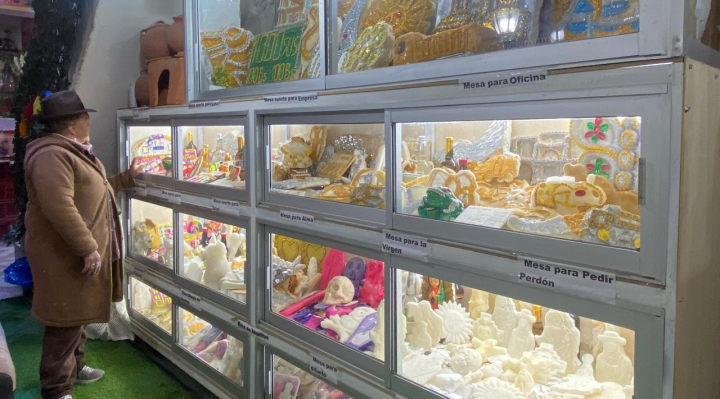
View of the Mother Earth Museum/Dehymar Antezana
White mesas, mesas for the souls, mesas for prosperity, mesas for the deceased, and mesas for health are some of the exhibits displayed in the recently inaugurated Madre Tierra Museum in the city of Oruro. It is the first of its kind in Bolivia.
The initiative comes from Mrs. Antonia Aguilar Romero de Morales, who took on the challenge of presenting Bolivia’s ancestral ritual mesas to ensure that the memory of this cultural heritage is not lost among the people of the country.
“That’s why I created the museum, so that it won’t be forgotten, so that our students can learn about our traditions, customs, and rituals that exist in Oruro, because Oruro, we could say, is the cradle of this kind of tradition, mainly due to our mining centers and Uru culture,” she explained.
The Museum of Mother Earth seeks to explain and recover ancient ancestral culture, particularly the ritual ceremony that took place when a mesa—also known as a “q’owa”—was offered to Pachamama, once called “Virgina” or “Virgin.”
“We must not forget our ancestral traditions; there are about fifty types of mesas. There are mesas for Pachamama, for raising spirits, Mesa Gloria for the Lord, mesas of forgiveness, mesas for little angels, mesas for the soul, cleansing mesas, mesas against curses, mesa especería—which was once practiced to bring rain but is hardly performed today,” she said.
There are also other types of mesas, such as the Santísimo (Holy Sacrament), represented by the Lord holding the world; mesas for the deceased, mesas for health, mesas for the mine, mesas for transportation, among others, using natural elements no longer common, such as corn, an ancestral symbol of protection.
Name
The museum was named “Mother Earth” because the earth itself sustains the planet and its inhabitants.
“I want anthropology students from different universities across the country, or citizens who wish to learn about these rituals, to visit so that ancestral culture remains alive,” she emphasized.
She also noted that she is preparing a book that will record each of these mesas and describe how they are traditionally offered, depending on the season or circumstance.
Aguilar’s challenge is to continue adding to the museum—located in her own home—examples of mesas offered to Pachamama from Bolivia’s nine departments. To achieve this, she will begin a tour of the country next week, starting with the city of Tarija.
According to studies in this field, Aguilar explained that the origin of these traditions dates back to ancient times, from the Uru culture, centered in the municipality of Huari in the department of Oruro.
She added that a photograph from 1917 shows a mesa offered to the San José mine in Oruro, providing evidence of how the ritual was practiced. Another noteworthy detail is that when the San José Club of Oruro was founded on March 19, 1942, at seven in the morning that day, a mesa was offered to Pachamama so the soccer team could receive the earth’s energy—something forgotten today.
The museum is located in Oruro, on Aroma “A” Street, near Tejerina passage. Admission is free.
“I love Oruro, I didn’t create the museum to charge money; I want Oruro and Bolivia to know their ancestral culture. Visits take place on weekend afternoons, but people can also contact me in advance so I can receive them,” she said.
She clarified that many people confuse mesas with witchcraft rituals; however, she stressed that they are a way of giving thanks to Mother Earth in a gesture of reciprocity.
BD/RPU
Por Dehymar Antezana, Brújula Digital:
Se inauguró en Oruro el primer Museo de la Madre Tierra con el objetivo principal de preservar, mostrar y evitar que se olvide el legado de la cultura ancestral boliviana, específicamente la tradición de las “mesas” rituales o “q’owa”.
Vista del museo Madre Tierra/Dehymar Antezana
Mesas blancas, mesas para las almitas, mesas para la prosperidad, mesas para difuntos y mesas para la salud son algunas de las muestras que se exhiben en el museo denominado Madre Tierra, inaugurado recientemente en la ciudad de Oruro. Es el primero de su género en Bolivia.
La iniciativa nace de la señora Antonia Aguilar Romero de Morales, quien se planteó el desafío de mostrar las mesas rituales ancestrales de Bolivia, con el objetivo de que la memoria de la cultura ancestral no sea olvidada por los habitantes de este país.
“Por ese motivo hice el museo, para que no se olviden, para que nuestros estudiantes se interioricen en nuestras tradiciones, costumbres y rituales que hay en Oruro, porque Oruro, podríamos decir, es la cuna de este tipo de tradiciones, principalmente por nuestros centros mineros y la cultura Uru”, aseguró.
Con el Museo de la Madre Tierra se pretende explicar y recuperar la cultura milenaria ancestral, la ceremonia ritual que se hacía al momento de colocar una mesa, también conocida como “q’owa”, que se ofrenda a la Pachamama, denominada antiguamente “Virgina” o “Virgen”.
“No se tienen que olvidar nuestras tradiciones ancestrales; son como cincuenta clases de mesas que se tienen. Hay mesa para la Pachamama, para llamar el ánimo, mesa Gloria para el Señor, mesa de perdón, mesa de angelitos, mesa para el alma, mesa de limpia, mesa contra las maldiciones, mesa especería, que se hacía antes para que llueva y hoy en día casi nadie la practica”, manifestó.
También hay otros tipos de mesas, como la del Santísimo, que consiste en un Señor sosteniendo el mundo; mesa para difuntos, mesa para la salud, mesa para la mina, mesa para el transporte, entre otras, con el uso de elementos naturales que ya no se utilizan, como los maíces, símbolo de protección ancestral.
Nombre
El museo fue bautizado como “Madre Tierra”, porque es precisamente la tierra el sustento del planeta y de sus habitantes.
“Quiero que vengan los estudiantes de Antropología de las distintas universidades del país o los ciudadanos que quisieran aprender acerca de este tipo de rituales, para que la cultura ancestral permanezca viva”, subrayó.
Asimismo, señaló que está preparando un libro que incluirá el registro de cada una de estas mesas y cómo se acostumbra a ofrendarlas, en función de la época del año o de las circunstancias.
Aguilar tiene como desafío seguir aumentando, en el museo que está en su casa, cada una de las mesas que se acostumbra a ofrendar a la Pachamama, pero de los nueve departamentos de Bolivia. Por ello, hará una gira por el interior del país, comenzando por la ciudad de Tarija la siguiente semana.
De acuerdo con los estudios realizados en este campo, Aguilar explicó que el origen de este tipo de tradiciones data de tiempos remotos, desde la cultura Uru, con epicentro en el municipio de Huari, en el departamento de Oruro.
Añadió que hay una fotografía de 1917, cuando se ofrendó una mesa a la mina de San José en la ciudad de Oruro, donde se observa cómo se practicaba este ritual. Otro elemento a destacar es que, cuando se fundó el Club San José de Oruro, el 19 de marzo de 1942, a las siete de la mañana de ese día, se ofrendó una mesa en honor a la Pachamama para que el equipo de fútbol tuviera la energía de la tierra, aspecto olvidado en la actualidad.
El museo está ubicado en la ciudad de Oruro, en la calle Aroma “A”, casi pasaje Tejerina. El ingreso es gratuito.
“Yo amo a Oruro, no hice el museo para cobrar; quiero que Oruro y Bolivia conozcan su cultura ancestral. Las visitas son los fines de semana por las tardes, pero también me pueden avisar con anticipación para que los pueda recibir”, explicó.
Un detalle que aclaró es que mucha gente confunde las mesas con rituales de brujería; sin embargo, señaló que son para agradecer, en una señal de reciprocidad, a la Madre Tierra.
BD/RPU

 Bolivian Thoughts | Pensamientos Bolivianos (Bilingual/Bilingüe)