
By Germán Huanca, Urgente.bo:
A figure has just been released that, last year, was kept highly secretive around this time. The Central Bank of Bolivia, today, before the end of the MAS’s 20 years in power, made public the new data on Net International Reserves (NIR) as of August 31, 2025. Bolivia had a total of 2.881 billion dollars accumulated as of that date. What does this level of reserves mean for Bolivia, and what evaluation parameters should we take into account?
When MAS took office in 2006, it inherited Net International Reserves totaling 3.178 billion dollars. Therefore, the first observation is that the 2.881 billion dollars reported by the BCB does not even reach the 2006 level.
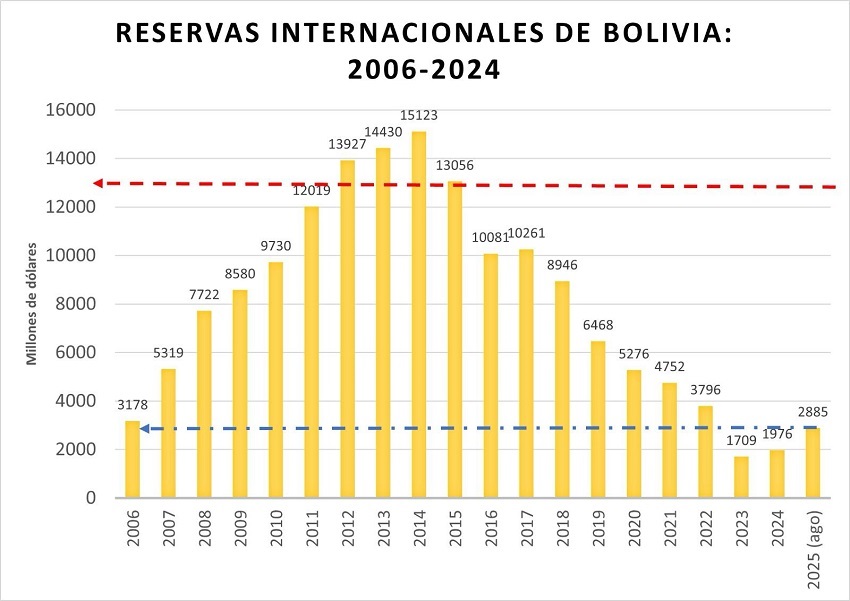
Furthermore, in 2006 the economy was worth 11.520 billion dollars; thus, Net International Reserves represented 27.5% of the economy’s value. However, the economy has grown more than fourfold in value: by December 2024 Bolivia had a GDP of 46.967 billion dollars, a figure that some outgoing politicians boast about, even saying, “you’re going to miss us.” Therefore, a second conclusion is that if we want to evaluate today’s economy compared to when MAS took over, and maintain the same NIR-to-GDP ratio as in 2006, today’s Net International Reserves should exceed 13 billion dollars.
Here comes a first analysis that has been repeated for years: the economy’s weakness is largely explained by the drastic reduction of Net International Reserves during these 20 years. This reduction stems mainly from the decision to finance the sustained fiscal deficit from 2014 up to this year, which undermined the government’s holdings of dollars in international accounts, as well as those of commercial banks, and weakened support for monetary issuance.
In light of the triumphalism expressed by BCB officials, displayed on their website, I must remind them that 2.881 billion dollars does not even reach the 2006 level. Moreover, the population is well aware that they are leaving behind an economy with fragile foundations, when it should have at least 13 billion dollars in Net International Reserves to ensure normal international trade.
Finally, the next government must think about closing that gap between 13 billion dollars and the 3 billion dollars that the current government will likely leave by December 2025. That makes a shortfall of 10 billion dollars. How will this amount be financed to restore the economy’s normal functioning, at least as it was in 2006? The candidates heading into the runoff must explain to the public their strategy for securing 10 billion dollars, since the current triumphalism of BCB officials is not enough to boost the economy and/or curb inflation.
(*) Master in Financial Economics
Por Germán Huanca Luna, Urgente.bo:
Acaba de lanzarse un dato que, el año pasado, se mantenía con mucho hermetismo para estas fechas. El Banco Central de Bolivia, hoy, antes de que se acabe la gestión de los 20 años que el MAS estuvo en el poder, hace público el nuevo dato de las Reservas Internacionales a finales del 31 de agosto de 2025. Bolivia tiene un total de 2.881 millones de dólares acumulados a esa fecha. ¿Qué significa este nivel de reservas para Bolivia y cuáles son los parámetros de evaluación que debemos tener en consideración?
El MAS, cuando se hizo cargo del gobierno en 2006, recibió un total de reservas internacionales equivalentes a 3.178 millones de dólares. Por lo tanto, el primer elemento que podemos observar es que el nivel de 2.881 millones de dólares presentado por el BCB ni siquiera llega a alcanzar el nivel del 2006.
Seguidamente, en 2006 la economía tenía una dimensión de 11.520 millones de dólares; por lo tanto, las reservas internacionales representaban el 27,5% del valor de la economía. Sin embargo, la economía ha crecido un poco más de 4 veces en valor, esto es, a diciembre de 2024 Bolivia tenía un PIB de 46.967 millones de dólares, del cual algunos políticos salientes se jactan y hasta indican “que los vamos a extrañar”. Por lo tanto, una segunda conclusión que podemos sacar es que, si queremos evaluar la economía actual comparada con el inicio del MAS al hacerse cargo de la economía, y para mantener la misma proporción al PIB que en 2006, hoy las reservas internacionales deberían superar los 13.000 millones de dólares.
Aquí viene un primer análisis que fuimos repitiendo desde muchos años atrás: la debilidad de la economía se explica en gran parte por la reducción drástica de las reservas internacionales durante los 20 años. Esta reducción se debe principalmente a la decisión de financiar el déficit fiscal sostenido desde 2014 hasta el presente año, lo cual afectó la tenencia de dólares en las cuentas internacionales que mantiene el gobierno de Bolivia, así como de los bancos comerciales, y también debilitó el respaldo a la emisión monetaria.
Ante el exitismo expresado por los funcionarios del BCB, que lo manifiestan en su página web, debo recordarles que 2.881 millones de dólares no llega siquiera al nivel del 2006. Además, la población está muy consciente de que están dejando una economía con cimientos endebles, cuando debería tener por lo menos 13.000 millones de dólares en reservas internacionales para poder enfrentar con normalidad el comercio internacional.
Finalmente, el próximo gobierno debe pensar en cerrar ese bache entre los 13.000 millones de dólares y los 3.000 millones de dólares que seguramente el actual gobierno dejará a diciembre de 2025. Esto da una diferencia de 10.000 millones de dólares. ¿Cómo se va a financiar ese monto para retornar al normal desenvolvimiento de la economía, al menos como lo teníamos en 2006? Los candidatos al balotaje deben explicar a la población la estrategia para conseguir 10.000 millones de dólares, ya que el exitismo actual de los funcionarios del BCB no es suficiente para impulsar la economía y/o eliminar la inflación.
(*) Máster en Economía Financiera
https://www.urgente.bo/noticia/rin-pequeño-y-desafío-para-el-nuevo-gobierno

 Bolivian Thoughts | Pensamientos Bolivianos (Bilingual/Bilingüe)